


Tamagawa Onsen
玉川温泉Akita mountain onsen with the most acidic natural spring in Japan (pH 1.05) and the highest single-source discharge. Famous for the Hokutolite radon stones.
A spout in the beech forest
Tamagawa sits at the base of Mt. Yakeyama in inland Akita, deep inside Towada-Hachimantai National Park. The source was found in 1680 by a local matagi hunter, but the valley was hard to reach and the first proper lodge only went up in 1885. The water comes out of a single vent called the Obuki (大噴, "Great Spout") at roughly 98 °C and 9,000 litres per minute, the largest single-source flow in Japan, then runs three metres wide down the gully as a steaming stream. The bathing village grew slowly around that fact. Designation as a National Health Resort came in 1959, and the place has since settled into one role above all: a long-stay toji destination, where guests book a week or more in self-catering wings and bathe on a schedule rather than for pleasure.
pH 1.2 and the radioactive rock
The Obuki water is the most acidic natural spring in Japan, at roughly pH 1.2, sharp enough to dissolve iron in the early Meiji pipework before the source was tamed. Most baths pour a one-tenth dilution; a small "100% source" tub is offered for short, careful entries. Around the vent the rocks are crusted with hokutolite (北投石), a barium-lead sulfate that incorporates trace radium and is found in only two places on earth, here and at Beitou in Taiwan. The Tamagawa deposit was named a Natural Monument in 1922 and elevated to a Special Natural Monument in 1952. Bathers credit the low-dose radiation, around fifteen to twenty millisieverts a year inside the steam paths, with the spring's hormesis reputation. Above the bathhouse a wooden boardwalk threads the open jigoku field, and guests carry mats out to lie on the warm rock in the steam, the original outdoor iwaban'yoku before the practice spread indoors.
Shin-Tamagawa and the plateau
Ten minutes' walk down the road, the sister inn Shin-Tamagawa Onsen opened in 1998 with the same piped source and a softer, modern wing for guests who want less austerity. Beyond both lodges the Hachimantai trails climb out of the beech forest onto the volcanic plateau, with marsh ponds and Mt. Yakeyama within an afternoon's reach.
Places in this area
2 places · Sorted by rating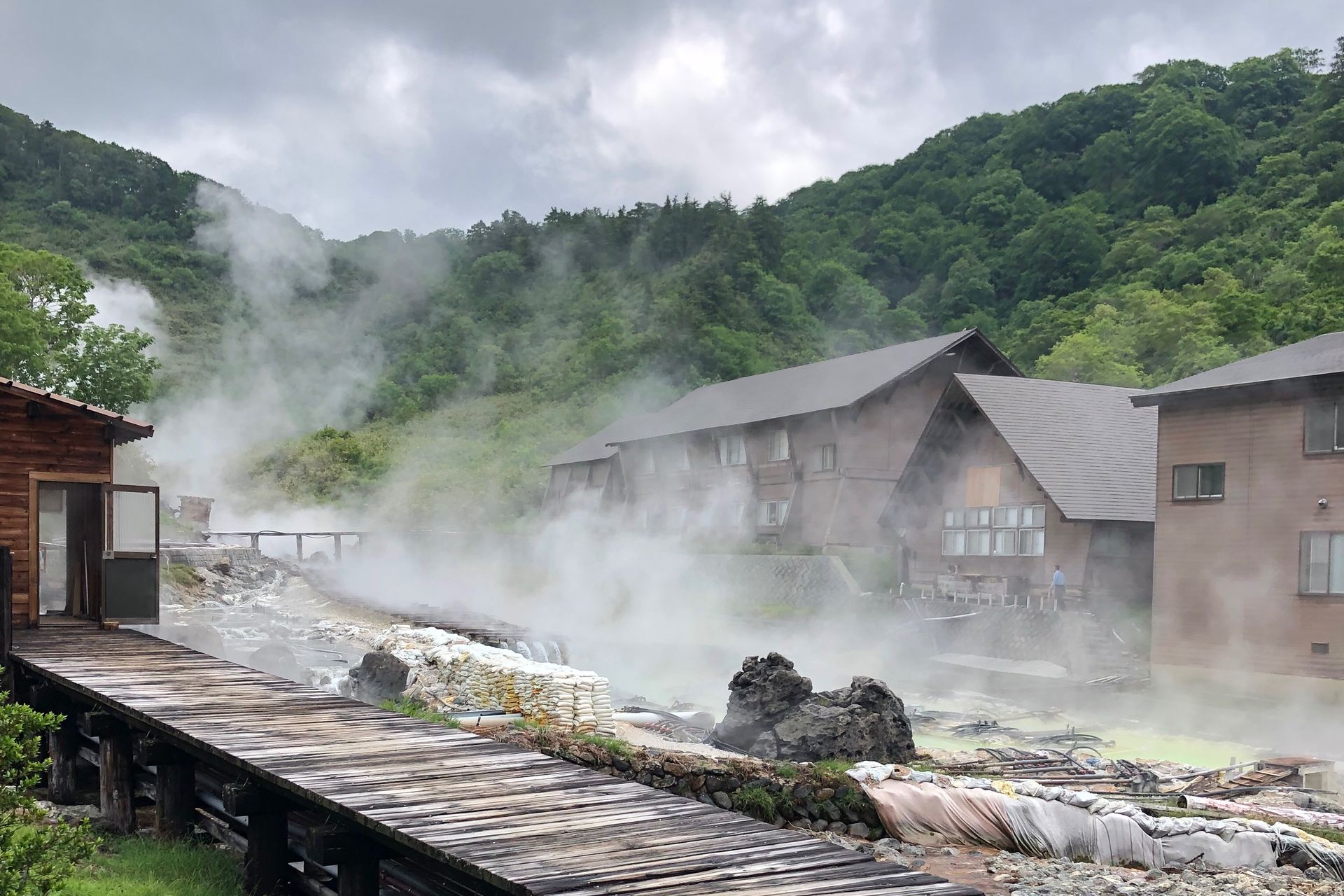
On the map
Loading map…
Nearby onsenchi
Within 50 kmSources
- Tamagawa Onsen Official Siteofficial— Operator pages on the pH 1.2 source, the bath line-up, and the indoor/outdoor iwaban'yoku.
- Tamagawa Hot Spring — Wikipedia (English)— 1680 matagi discovery, 9,000 L/min flow at 98 °C, hokutolite radioactivity figures, 1959 National Health Resort designation.
- 玉川温泉 (秋田県) — Wikipedia (Japanese)— Edo-period chronology, the Obuki source, and the 1998 opening of Shin-Tamagawa Onsen ten minutes on foot from the main lodge.
- Semboku City — Hokutolite, Tamagawa Onsen, Obuki Fountainhead, and Bedrock Baths— Municipal page on the Special Natural Monument designation and the Beitou (Taiwan) parallel.
- japan-guide.com — Tamagawa Onsen— Visitor-facing overview of the Hachimantai plateau setting and the toji programme.