
Yuda Onsen
湯田温泉Central Yamaguchi-city onsen with a famed 'white fox' founding legend. Alkaline simple spring, one of Japan's three big onsen towns built right inside a prefectural capital.
A wounded fox and a Restoration parlour
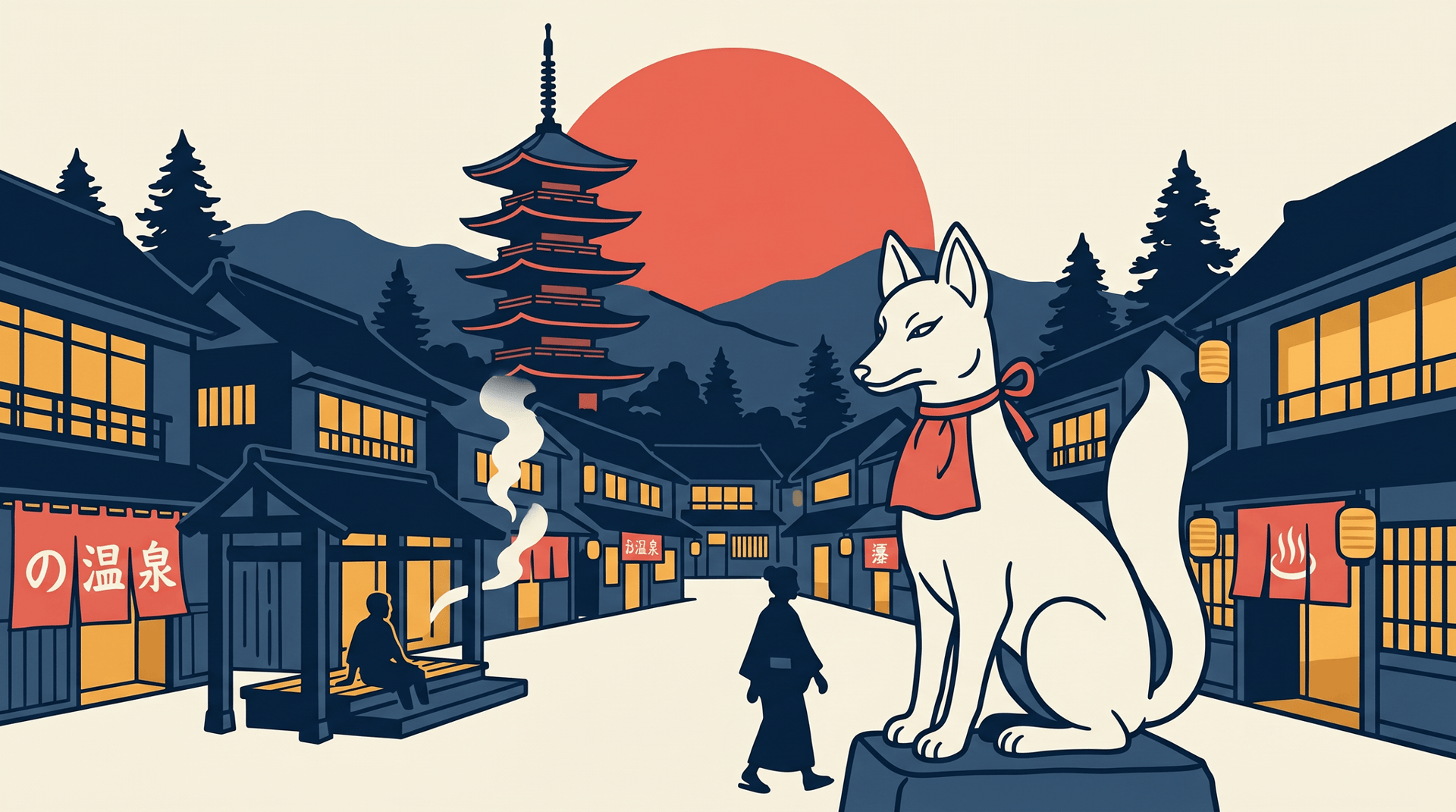
Yuda is a town that tells two founding stories at once. The older one is folk: a wounded white fox kept slipping down to a small temple pond at night to soak its injured leg, the resident monk noticed the water was warm, dug deeper, and found a hot spring welling up around a golden image of Yakushi Nyorai, the Medicine Buddha. The local retelling places the episode in the Muromachi period under the Ouchi lord Yoshioki, though the name "Yuda" appears in temple documents from Suo Amidaji as early as the 13th century, giving the spring something close to 800 years of recorded life. The fox has stayed on as the town's emblem: white-fox statues stand at street corners, the mascots Yuta and Yuko appear at every festival, and the annual Byakko Matsuri in May reenacts the legend in costume.
The second founding story is political. In the closing years of the Edo period, Yuda's inns sat squarely inside Choshu territory and became working parlours of the Meiji Restoration. Kido Takayoshi, Ito Hirobumi, Takasugi Shinsaku, Inoue Kaoru and visitors from Satsuma and Tosa, Saigo Takamori and Sakamoto Ryoma among them, are remembered as guests of houses here. One bath built in 1860, the Ishin no Yu ("Restoration Bath"), survives at Matsudaya Hotel and can still be used by overnight guests.
Soft alkaline water in a walkable town
The water itself is gentle: a colourless, slippery alkaline simple spring that the cooperative cites as one of the larger-flow alkaline springs in western Japan, with roughly 2,000 tons a day drawn from seven sources at temperatures comfortably above the 42°C threshold. It feels soft on the skin and is sometimes marketed as a bijin no yu, a "beauty water."
What makes Yuda unusual among onsen towns is the setting. There is no gorge, no mountain pass, no shrine forest to walk through; the district is built into central Yamaguchi City, a few minutes by train from Shin-Yamaguchi shinkansen station. The main street is genuinely walkable, lined with free foot baths, drinking-spring spouts, white-fox sculptures, and an evening illumination through the central quarter that turns the fox motifs into lanterns after dark.
Around Yuda
Walking distance and short bus rides connect Yuda to the cultural set Yamaguchi once earned the nickname "Western Kyoto" for. Ruriko-ji preserves a five-storey pagoda from 1442, one of Japan's three most celebrated and a designated National Treasure, a survivor of the Ouchi cultural flowering. Further out, the Akiyoshidai karst plateau and the limestone cavern of Akiyoshido lie within a manageable day trip. Yuda makes a quiet base for all of it: a city onsen with a fox at every corner.
Places in this area
11 places · Sorted by ratingセントコア山口
Yamaguchi
西の雅 常盤
Yamaguchi
おんせんの森
Yamaguchi
梅乃屋
Yamaguchi
On the map
Loading map…
Nearby onsenchi
Within 50 kmNo nearby onsenchi within range.
Sources
- Yuda Onsen, official ryokan cooperative siteofficial— The Yuda Onsen Ryokan Cooperative's portal. Source for the member inns, foot baths, "Konkon Park" facility, and the Yuta and Yuko fox mascots.
- 湯田温泉の歴史, official history pageofficial— The cooperative's own retelling of the white-fox legend under Ouchi Yoshioki, the 13th-century mention in the Suo Amidaji documents, and the Bakumatsu lodgings used by Restoration figures.
- ANA Japan Travel Planner: Yuda Onsen— English-language summary of the fox legend, the alkaline simple water, and the walkable downtown setting.
- Good Luck Trip: Yuda Onsen— Reference for the seven sources and roughly 2,000 tons of daily flow, and for the cluster of foot baths along the main street.
- Visit Yamaguchi: Yuda Onsen— Yamaguchi City tourism page covering the fox motif, the Bakumatsu connection, and access from Shin-Yamaguchi Station.