
Hakuba-Happo Onsen
白馬八方温泉Ski-resort onsen at the base of the Hakuba Happo-One slopes, in the Northern Japanese Alps.
A young spring under an old mountain
Hakuba-Happo Onsen is, by Japanese standards, a recent arrival. Earlier attempts to channel hot water down from Hakuba-Yari in the late nineteenth century failed, and the village stayed cold until the late-1970s ski boom made another effort worthwhile. A boring program in 1982 finally tapped the water that now feeds the bathhouses at the foot of the slope, with public facilities opening in stages through the late 1980s. What came up out of the serpentinite bedrock turned out to be unusual: an alkaline simple spring of pH 11.2, retested in 2006 at pH 11.5, putting it at the very top of Japan's alkaline-water rankings and inside the small global club of springs that clear pH 11 at all. Visitors meet it as "Happo no Bijin-no-yu", the beauty-water of Happo.
International attention arrived in 1998, when the Nagano Winter Olympics sited the men's and women's downhill at Happo-One and the ski-jumping and Nordic-combined events on the adjacent Hakuba hills. The lifts and runs above the village date from that build-out; so does the habit of stopping at a sotoyu on the way down.
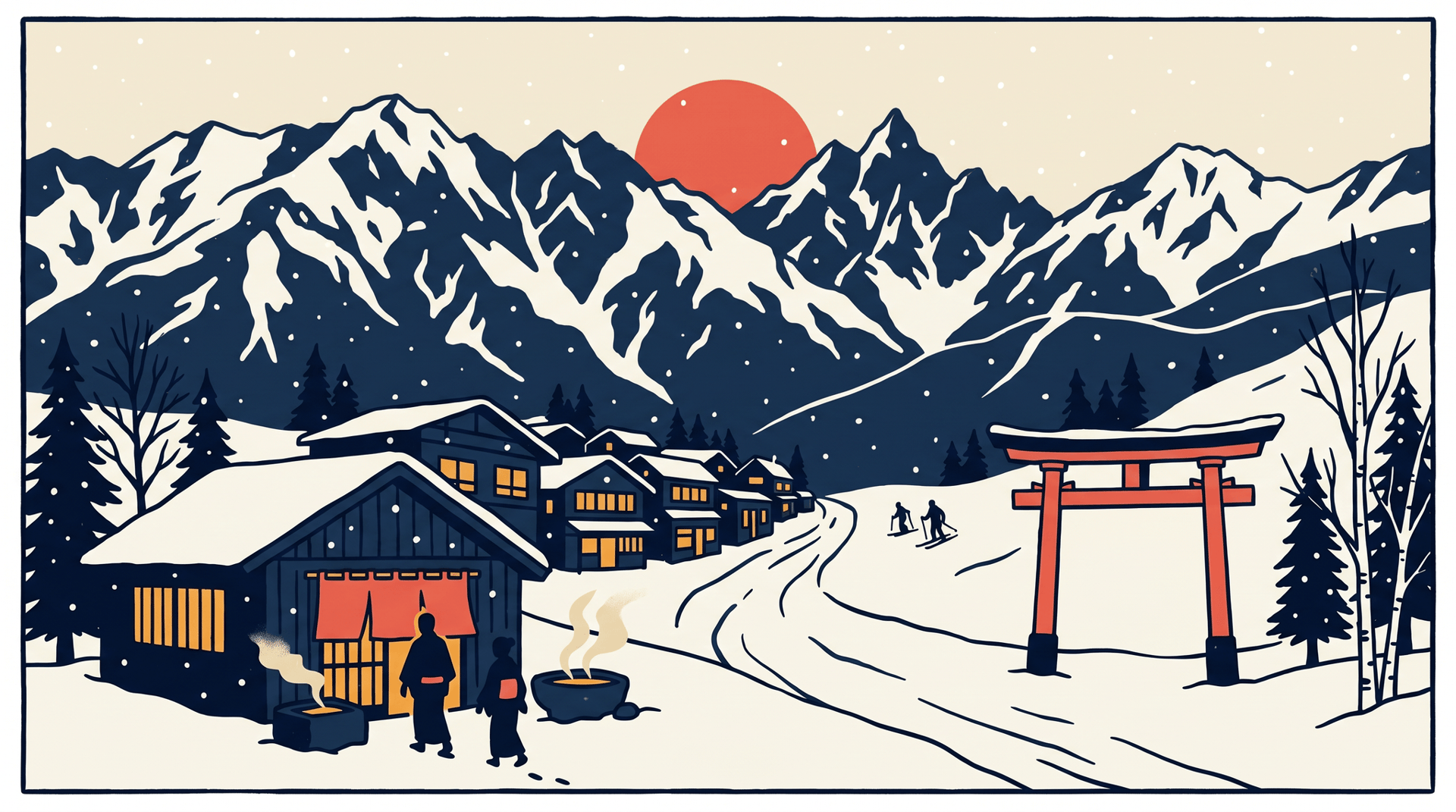
A ski village, a soaking village
Today the onsen runs as four day-use baths threaded through the resort. Happo no Yu sits at the entrance to the bathing zone as the largest of the four; Mimizuku-no-yu is a ten-minute walk from JR Hakuba Station and keeps cherry blossoms lit at night in spring; the hexagonal Sato-no-yu has been part of the village since 1988; and Obinata-no-yu, set highest up the valley, sits closest to the source and posts the strongest pH readings. Two free ashiyu near the station let you soak boots-off without committing to a full bath.
The water itself is the headline act: slick, almost soapy on the skin, and faintly metallic from the dissolved hydrogen that the serpentinite reaction releases. The view out of the rotenburo, across to the Northern Alps and the Olympic ski-jump tower, is the other one. In summer the same buses run on to Tsugaike Nature Park for marshland boardwalks, and the Daisekkei snow-gorge route up Shirouma-dake leaves from Sarukura further down the valley, so the village swings between a winter resort cycle of skiers and Australian seasonal staff and a quieter alpine-hiking rhythm the rest of the year.
Places in this area
4 places · Sorted by ratingOn the map
Loading map…
Nearby onsenchi
Within 50 kmSources
- Hakuba Happo Onsen — official public-baths siteofficial— Official portal for the four day-use bathhouses with hours, pricing, and the village ashiyu map.
- Hakuba Happo Onsen — about the waterofficial— Source page for the pH 11+ claim, the serpentinite geology, and the dissolved-hydrogen chemistry.
- Wikipedia (JA) — 白馬八方温泉— Cross-checked for the 1982 boring success, the 2006 pH 11.5 reading, and the bathhouse list.
- Onsenista — Hakuba Happo Onsen area guide— Bathhouse-by-bathhouse breakdown including Sato-no-yu's 1988 opening and the hexagonal Obinata-no-yu source closeness.
- Wikipedia — Venues of the 1998 Winter Olympics— Confirms Happo-One as the alpine downhill venue and the surrounding Hakuba sites for ski jumping and Nordic events.