
Misasa Onsen
三朝温泉Tottori river-town famous for radon-rich waters that are among the most active in the world.
A spring shown by a white wolf
The town traces its origin to the late Heian period, roughly 850 years ago, and to a Genji retainer named Okubo Saemon Tsunenaka. While on pilgrimage to the sacred mountain of Mitoku, Tsunenaka spared an aged white wolf he had drawn his bow against; that night the bodhisattva Myoken appeared in a dream and pointed him to a hot spring welling beneath an old tree. The site is still called Kabu-yu (株湯), the root-stock bath, and Misasa has grown around it ever since.
The waters became a national name in 1915, when surveys placed their radium content among the highest in the world. The town has been a working cure spa ever since, and Okayama University maintains a balneology research arm on site (today the Misasa Medical Center) where the medical case for low-dose radon therapy and its hormesis effect has been investigated for decades.
Riverside steam and toji culture
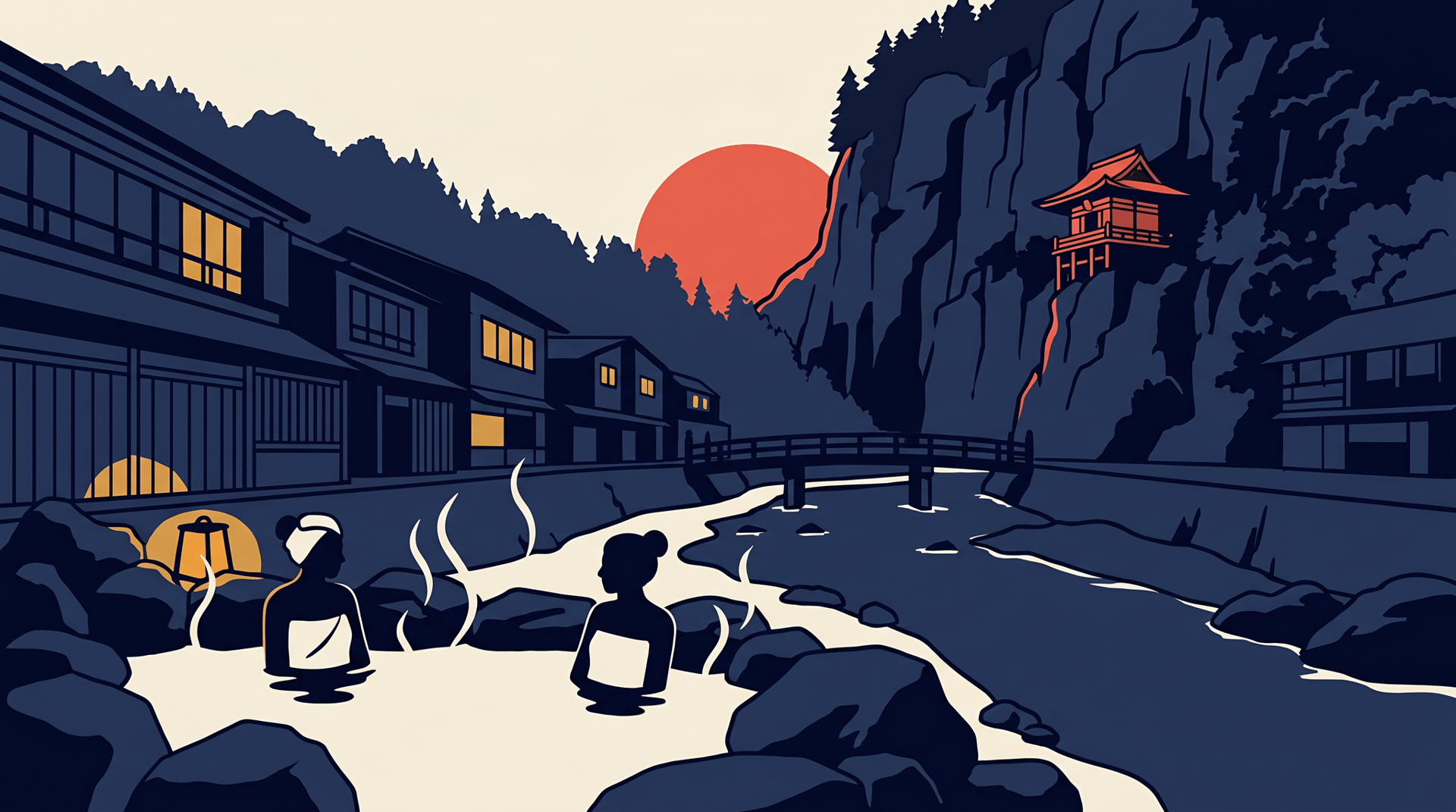
Misasa is small and walkable, a wooden valley town with shoji-lit ryokan running close to the Mitoku river. The signature address is the Kawara-buro (河原風呂), a free open-air bath set in the riverbed under Misasa Bridge, in full view of anyone crossing above. It is mixed bathing, twenty-four hours a day, and it is the oldest civic ritual the town still practices.
The water itself is the rest of the case for coming here. Hot, weakly radioactive, exhaling traces of radon as it cools, it is the kind of spring people have historically settled into for weeks at a time. That practice, toji (湯治), the long-stay cure, is still alive in Misasa in a way it no longer is at most resort spas; several ryokan keep weekly and monthly rates for guests who come to soak, eat quietly, and walk.
Nageiredo above the valley
Above the town, Mitokusan Sanbutsu-ji holds Tottori's only National Treasure: Nageiredo (投入堂), a small wooden hall improbably wedged into a cave high on a sheer cliff. Reaching it means a short but genuinely steep scramble using tree roots and a few chains, only permitted in groups of two or more, and the temple together with Misasa Onsen carries the joint Japan Heritage title "Land of the Six Purifications and the Six Healings."
Places in this area
10 places · Sorted by ratingOn the map
Loading map…
Nearby onsenchi
Within 50 kmNo nearby onsenchi within range.
Sources
- Misasa Onsen Tourism Association — Aboutofficial— The town association's English overview. Reference for the 850-year history, the white-wolf founding legend, and the world-class radium content.
- Japan Heritage — Mitokusan and Misasa Onsenofficial— Backs the joint Japan Heritage designation "Land of the Six Purifications and the Six Healings" linking the spa town to Mt. Mitoku.
- JNTO — Misasa Onsenofficial— National tourism office page. Reference for the Kawara-buro riverside bath and the town's toji long-stay tradition.
- Misasa, Tottori — Wikipedia— Cross-reference for the Okayama University Hospital Misasa Medical Center and the radon hormesis research program.
- JNTO — Mitokusan Sanbutsuji Templeofficial— Reference for Nageiredo, the National Treasure wedged into a cliff above the valley.