
Wakura Onsen
和倉温泉Sea-side onsen on the Noto Peninsula coast (Ishikawa) with 1200 years of history. Strong sodium chloride springs feeding luxury ryokan, including the famed Kagaya inn.
A spring that rose from the sea
Wakura's chronology runs back roughly 1,200 years, but the legend locals retell starts later, in the Eisho era (1046–1053), when crustal movement is said to have shifted the spring mouth offshore. A fishing couple from the village noticed an injured white heron healing itself in steam rising from the bay, and the place was named Yu-no-waku-ura, "the inlet where hot water springs forth," eventually contracted to Wakura. For generations the bath was literally in the sea, reached by boat at low tide. In 1641 the third Kaga-domain lord Maeda Toshitsune ordered the source enclosed and the surrounding shallows reclaimed, creating the artificial island Yu-jima and the bridge that fixed the spring on dry land. Under Maeda patronage the town settled into the role of a Kaga-han retreat, a polished bathing ground on the Sea of Japan side of the realm. The January 2024 Noto Peninsula earthquake struck the resort hard; the public bath Soyu resumed operation in late March, and the ryokan are returning in stages, so check ahead before planning a stay.
Salt water, Nanao Bay, and a kaiseki tradition
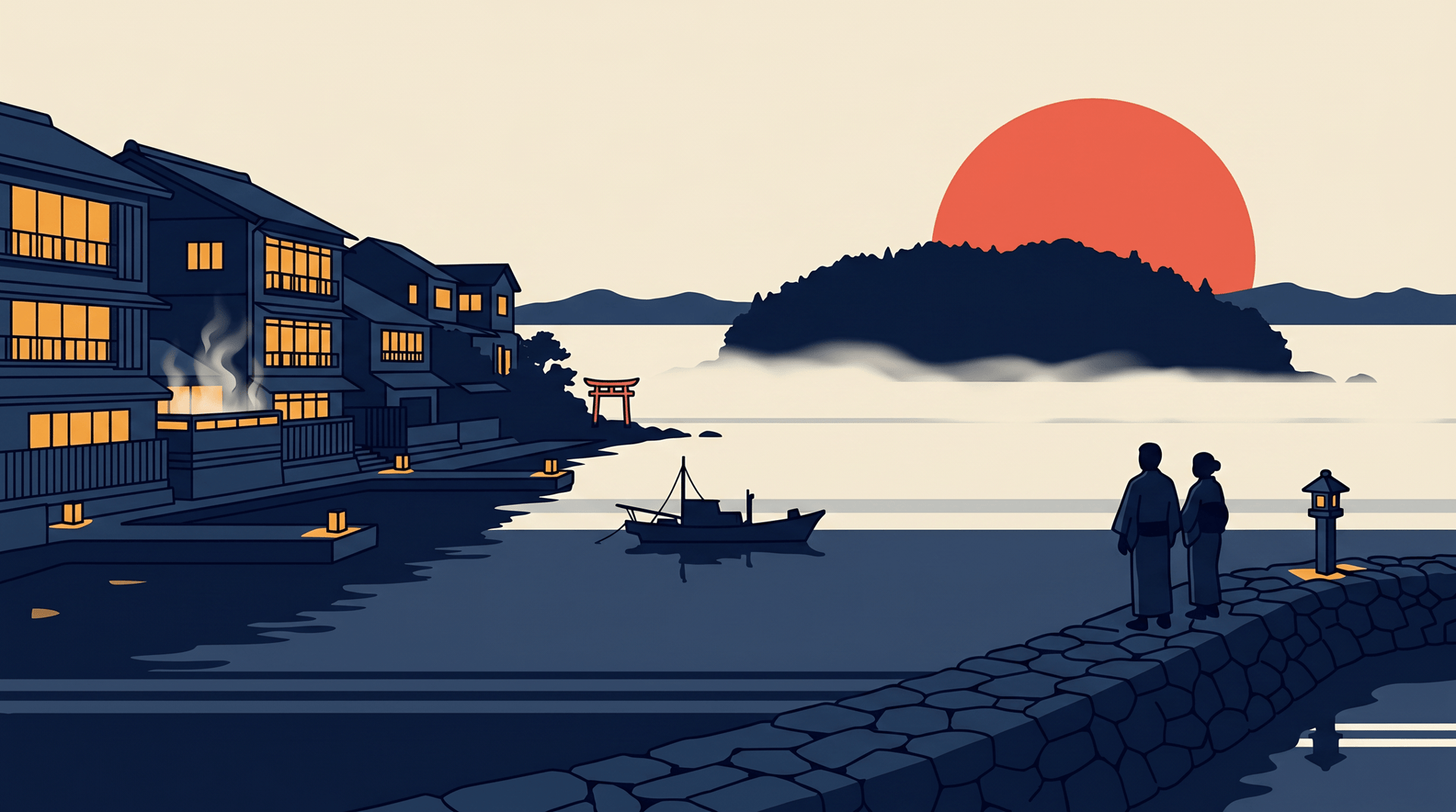
The water is a clear sodium-calcium chloride brine, hot at the wellhead and so saline that local salt was once boiled off from it. That mineral load is the resort's signature, and bathers feel it as a thick warmth that lingers long after the bath. Wakura sits along the south shore of Nanao Bay, with Notojima floating low on the water across the narrows; the better rooms face the island and the dawn light over the inland sea. The town's reputation rests as much on the table as on the bath. Ryokan here built their style around Noto seafood (winter yellowtail, oysters from Anamizu, sweet shrimp, abalone) plated as formal kaiseki, with the Kaga-style hospitality that the landmark inn Kagaya (founded 1906) made into a national reference point.
Beyond the inn
A short bridge crosses to Notojima, where the Notojima Aquarium reopened in March 2025 after earthquake repairs. The peninsula's coastal road north, past Wajima, Sosogi, and the terraced rice fields at Senmaida, is one of the great scenic drives in Honshu, slower and emptier than it used to be, and worth the day.
Places in this area
7 places · Sorted by rating美湾荘
Ishikawa
能州いろは
Ishikawa
TAOYA和倉
Ishikawa
Closed & restricted
1
On the map
Loading map…
Nearby onsenchi
Within 50 kmNo nearby onsenchi within range.
Sources
- Wakura Onsen Tourist Associationofficial— Town tourism office. Reference for the founding legend, the "ocean hot spring" framing, and post-earthquake recovery messaging.
- Wakura-zukushi — about the townofficial— English overview from the ryokan cooperative; covers the 1,200-year timeline and the white-heron legend.
- Wakura Onsen — Wikipedia— Cross-reference for spring chemistry (chloride, sodium, calcium), discharge volume, and resort context.
- 和倉温泉 — Wikipedia (Japanese)— Source for the Eisho-era seafloor shift, the 1641 reclamation under Maeda Toshitsune, and recovery counts after the 2024 earthquake.
- Kagaya — house historyofficial— Flagship ryokan founded 1906; useful for the Meiji-to-modern arc of Wakura hospitality.