Wakayama 12-Tou
An official onsen pilgrimage across Wakayama: collect stamps from its twelve onsen areas to earn the Mastery Card.
39 places
Earn this badge
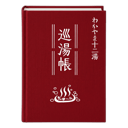
Wakayama 12-Tou (わかやま12湯) is an official onsen pilgrimage launched in February 2020 by the Wakayama 12-Tou Promotion Council, administered by the 協同組合和歌山県旅行業協会 (Wakayama Travel Industry Cooperative) in partnership with the prefecture's Hotel and Lodging Hygiene Association, municipal governments, regional tourism boards, and DMOs.
The program reframes onsen-bathing as a kind of secular pilgrimage: instead of 御朱印 (goshuin) stamps collected at temples, you collect 御湯印 (oyu-in, "bath stamps") in a 巡湯帳 (junyu-cho, "bathing book"). Finishing the book earns you a serial-numbered マイスターカード (Meister Card), currently held by just six people.
The pilgrimage covers 38 facilities across 30 stamp slots, sweeping the entire prefecture: from the Kada islands and Wakayama City in the north, through the Ryujin and Yunomine mountains, to the white-sand beaches of Shirahama, the Hashigui rocks at Kushimoto, the whaling town of Taiji, and the Kumano coast at Nanki-Katsuura.
The twelve onsen areas
Branded as "12湯" but covering thirteen distinct onsen districts:
- Wakayama Onsen-go (和歌山温泉郷): sodium-bicarbonate/chloride springs around Kada-Awashima, central Wakayama, Kimiidera and Hanayama; long associated with beauty / 美肌の湯.
- Minabe (みなべ): sodium-bicarbonate/chloride, with rock and cypress baths overlooking the Ume orchards.
- Ryujin (龍神温泉): one of Japan's Three Most Beautiful Waters (日本三美人の湯), high-bicarbonate, six facilities along the Hidaka-gawa.
- Yunomine (湯の峰温泉): Japan's oldest documented onsen (4th century), home to the UNESCO World Heritage Tsubo-yu (the only hot-spring bath inscribed on the World Heritage list).
- Watarase (渡瀬温泉): opened 1965, famous for its enormous source-flow outdoor bath.
- Kawayu (川湯温泉): winter "Sennin-buro" (千人風呂), a giant river-bed bath you literally dig yourself.
- Shirahama / Tsubaki (白浜・椿温泉): one of Japan's Three Ancient Springs (日本三古湯). The cluster has seven free public baths plus a dozen ryokan; Tsubaki is the rarer sulphur side.
- Susami (すさみ温泉): alkaline sulphur, famously praised by Taisho-era poet Noguchi Ujo.
- Kushimoto (串本温泉): sodium/calcium chloride springs at the prefecture's southernmost point, overlooking the Hashigui-iwa rocks.
- Taiji (太地温泉): coastal springs in the historic whaling town.
- Yukawa (湯川温泉): a Kumano-pilgrimage purification site dating back centuries.
- Nanki-Katsuura (南紀勝浦温泉): 175 distinct sources, one of the densest source clusters in Japan, anchored by the cave bath at Hotel Urashima.
- Yadori (やどり温泉): the program's northernmost member, in the Kii inland.
How it works
- Buy a 巡湯帳 at any participating facility for ¥2,200 (tax included). One free stamp is included from the purchase facility.
- Bathe at a participating facility, then present the booklet at the front desk and ask for a stamp.
- Pay ¥300 (tax included) per stamp.
- Repeat across the prefecture until all 30 slots are filled.
- Send the completed booklet (with your name, address, and phone written by hand) to the program office, along with ¥1,500 in postage by trackable mail. You receive a serial-numbered Meister Card and your name is added to the public registry.
There is no time limit and no required order, so finish at your own pace, across as many trips, seasons, or years as you need.
Stamping rules
- No bath = no stamp. Stamps are sold only to bathers. "温泉入浴をされていない方へ「御湯印」のみの販売は致しかねます" (you can't buy a stamp without bathing). Day-use admission is paid separately on top of the stamp fee.
- One stamp per person per bath. The same person can't double-stamp in a single visit.
- The official booklet only. Stamps in any other notebook or paper invalidate completion; only the official 巡湯帳 is recognised.
- Two kinds of stamps. Most stamps are facility-specific 御湯印; seven of the twelve areas also share a single area-wide stamp design, so multiple facilities can issue the same stamp number.
- Bring the booklet to the front desk. Some smaller facilities only stamp on request, so having the 巡湯帳 visible speeds things along.
Shared stamps (multiple facilities per slot)
Five areas have several facilities sharing one stamp number; in those areas you only need to bathe at one facility of your choice to fill that slot, and the design will be identical regardless.
- Stamp 6 (Ryujin): gamanoyu Inakayado Kawaguchi + Nyu Yamasemi Onsen-kan
- Stamp 18 (Shirahama/Tsubaki): Shiraraso, Quahouse Shirahama, Hotel Sanrakuso, Nagomi-no-yu Kachofugetsu
- Stamp 21 (Shirahama/Tsubaki): Yanagiya + Nanki Shirahama Marriott
- Stamp 25 (Kushimoto): Sango-no-Yu, Koboyu, Business Hotel Kushimoto
- Stamp 29 (Nanki-Katsuura): Kyukamura Nanki-Katsuura + Hotel Nagisaya
The remaining 25 stamps are unique to individual facilities, so a completionist visit hits 30 facilities at minimum but can total 38 if you collect every shared-stamp variant in person.
One unofficial extra: Ryujin-onsen Motoyu
Motoyu (元湯), the communal bath at the heart of Ryujin Onsen, is not on the official member list (re-checked July 2026). We list it anyway, marked "Unofficial" on its card, because a visitor found the program's poster hanging inside and was sold a stamp over the counter. Our reading is that it issues the shared Ryujin area stamp (No. 6), the same design the two listed facilities use, but nobody has confirmed that, so we show it with no stamp number.
Treat it as a bonus rather than a slot. It is worth a soak on its own merits, one of Japan's Three Most Beautiful Waters straight from the source, and if you specifically need stamp 6 for the booklet, ask at the front desk before you pay, or collect it at gamanoyu or Nyu Yamasemi where it is certain. We are checking with both the facility and the program office and will update this page once we hear back.
The Meister Card
Awarded for completing the full booklet.
- Requirement: all 30 御湯印 stamped.
- Application fee: ¥1,500 (paid as postage with trackable mail).
- What you submit: the filled 巡湯帳 with your name, address, phone written in by hand.
- What you receive: a numbered マイスターカード (a physical serial-numbered certificate).
- Public recognition: your serial number and name go onto the official registry.
As of July 2026 there are six named Meisters on the registry (serials 00001–00006): Nakada Yoshinori, Nakanishi Akihito, Sergei Mediushko, Onishi Yukiko, Nakanishi Taketo, and Shima Yoichiro. The numbers are awarded in order of completion, so getting one of the early serials is a real distinction.
There is no Master rank above Meister; the card itself is the lifetime achievement.
A note on the 12湯 summit
The first わかやま12湯サミット was held on 14 October 2021 in Ryujin, bringing the program's stakeholders together for the first time. It's not a public event but it indicates the program is being actively maintained, useful context if you're worried about whether your stamps will still mean something in five years.
Earning the Onsen Oni badge
The Wakayama 12 Yu Meister badge is awarded by Onsen Oni moderators to users who have received the official マイスターカード. Send a photo of your completed 巡湯帳 and/or the Meister Card through the feedback channel. This is a one-time lifetime badge, and there's no expiration on the program, so your collection can span any amount of time.
Tips
- Plan around Shirahama. It's the heaviest cluster, eight stamps across nine facilities. Two nights here can knock out a quarter of the booklet.
- Combine Yunomine + Watarase + Kawayu in one Kumano trip. They sit within a few kilometres of each other in the Hongu basin.
- Ryujin needs a car or planning. Six facilities, but they're spread along the Hidaka-gawa with sparse public transport, easiest as a one- or two-night stay.
- Don't skip Tsubo-yu. Yunomine's UNESCO bath is a 30-minute reservation per pair, so book on arrival.
- Check seasonal closures. Kawayu's Sennin-buro is winter-only (roughly December–February); ask at your inn before driving over.
- Bring cash. Some facilities don't accept cards for the stamp fee.
Sources
- 協同組合和歌山県旅行業協会 — わかやま12湯official
- 巡湯帳 (booklet guide)official
- 参加施設一覧 (Member directory)official
- マイスターカード registryofficial
- Program office: 073-427-0270 (わかやま12湯推進協議会 巡湯帳係)
- Onsen Oni community board #14 (Ryujin-onsen Motoyu)— The visitor report behind our unofficial listing of Motoyu.