

Akanko Onsen
阿寒湖温泉Eastern Hokkaido lakeside onsen on Lake Akan, in Akan-Mashu National Park. Ainu culture village (Akan-kotan) and the famous marimo algae of the lake.
A lake, a kotan, and an algae held sacred
The southern shore of Lake Akan was never a settled town in pre-modern times. The Ainu used the lake and its surrounding forests for hunting and fishing, and the first Japanese-style bathhouse opened only in 1902, once the springs had been formally claimed. Designation as part of Akan-Mashu National Park in 1934 set the frame for the resort that followed, and post-war tourism turned a handful of inns into the lakeside quarter that exists today.
The lake's other inheritance is biological. Marimo (毬藻), the spherical green algae that grow on its bed, were named in 1897 and recognised as a Natural Monument in 1921. Poaching and falling water levels brought them close to extinction in the mid-twentieth century, and in March 1952 they were elevated to a Special Natural Monument, one of the highest categories of protection in Japanese law. The yearly Marimo Festival, first held in 1950, opens with an Ainu kamuy-nomi rite and ends with the ceremonial return of marimo to the lake.
The Ainu Kotan and the lakefront quarter
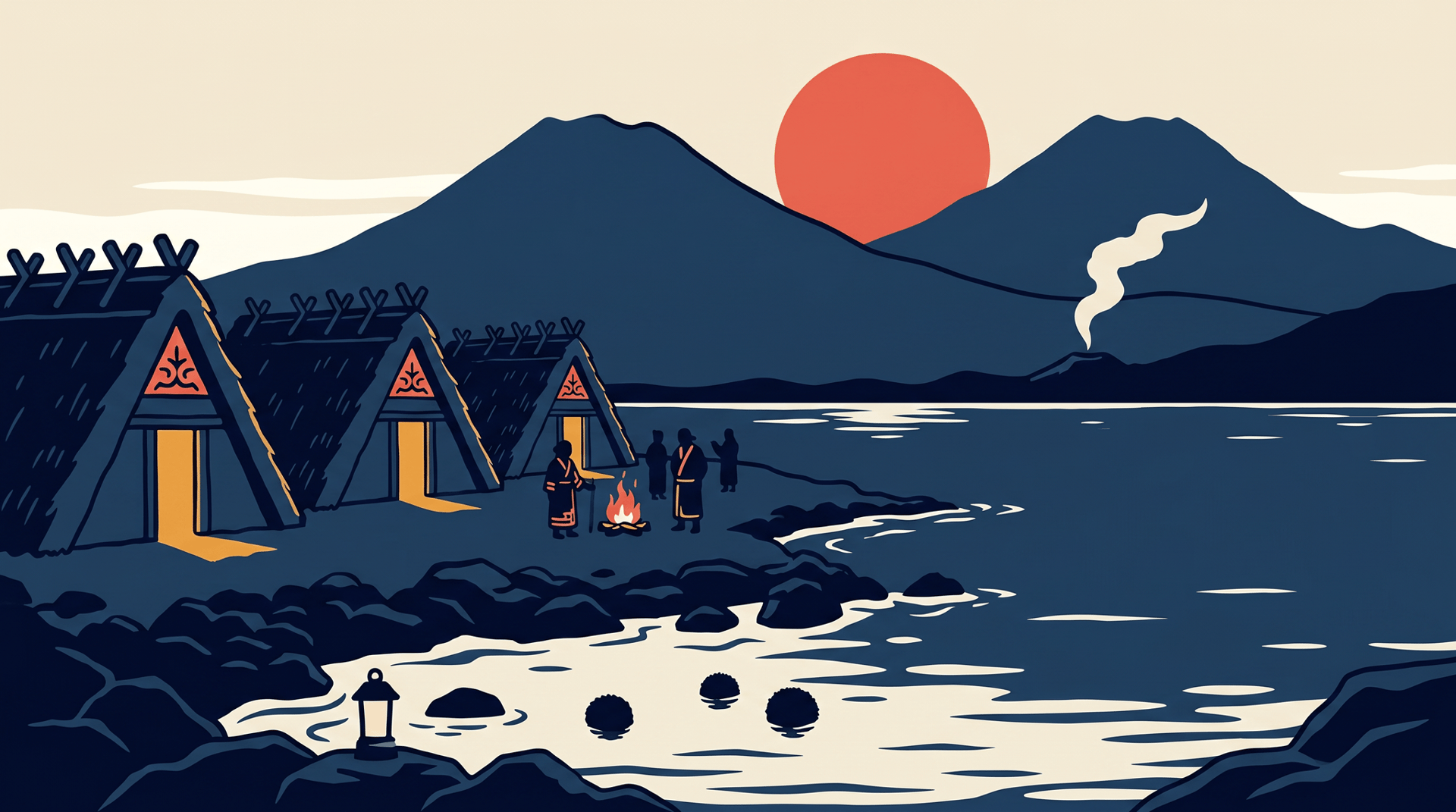
Adjacent to the inns runs the Akanko Ainu Kotan (アイヌコタン), the largest Ainu village in Hokkaido: roughly thirty-six households and a population of about a hundred and twenty, settled here from 1959 onwards on land donated by Maeda Mitsuko of the Maeda Ippoen estate. Workshops sell wood carvings and embroidery, and the Ikor theatre stages nightly performances of traditional dance and the contemporary piece Lost Kamuy, which braids Ainu chant with digital projection.
The quarter itself is compact: lakefront ryokan with open-air baths facing the water, a short promenade along the shore, and a free public foot bath open to anyone passing through. Steam rises off the lake on winter mornings, and in summer the deck of an evening inn looks straight out at Mt. Oakan to the east.
Beyond the shore
Pleasure boats leave the pier for Churui Island, where a small observation centre displays living marimo in their natural growth form. Further afield, the park's eastern half holds the caldera of Lake Mashu, famously clear and famously fog-bound, and the steaming fumaroles of Mt. Io (硫黄山), still actively releasing sulphur into the cold air.
Places in this area
4 places · Sorted by ratingOn the map
Loading map…
Nearby onsenchi
Within 50 kmSources
- Akanko Onsen Ryokan Association — Official Portalofficial— Town tourism office. Reference for the lakeside onsen quarter, ryokan listings, and the free public foot bath along the promenade.
- Akanko Ainu Kotan — Official Historyofficial— First-hand history of the village. Source for the Maeda Ippoen land grant and the 1959 consolidation of Hokkaido's largest Ainu Kotan.
- Akan-Mashu National Park (Ministry of the Environment)official— National park designation in 1934, caldera geology, and the Akan and Mashu sections of the park.
- Wikipedia (JA) — Akanko Onsen— Cross-check for spring sources, sulphur and simple-alkaline water types, and the 1902 opening of the first inn.
- National Parks of Japan — Akan-Mashu— Background on Mt. Oakan, Mt. Meakan, Lake Mashu, and Mt. Io within the wider park.