
Iizaka Onsen
飯坂温泉Historic Fukushima onsen town with nine free public bathhouses along the Surikami River, one of Tohoku's three great hot springs (Oshu sanmeisen).
Basho slept here, badly
Iizaka sits on the Surikami River in the northern outskirts of Fukushima city, a short ride on the Fukushima Kotsu Iizaka Line out of Fukushima Station. The local chronicle traces bathing here to the era of Yamato Takeru, who is said to have soaked away an illness in a spring called Saba-ko no Yu. The town's literary calling card came later, in the summer of 1689, when Matsuo Basho passed through on the journey recorded as Oku no Hosomichi. Basho's own page is wry rather than fond: rain fell, fleas and mosquitoes worked the thin lodging, and he left at first light. The visit still anchors the place. Iizaka counts itself, with Naruko and Akiu across the Ou range, among the three named hot springs of old Mutsu, and its public-bath culture has been called the local equivalent of Dogo and Arima for length of unbroken use.
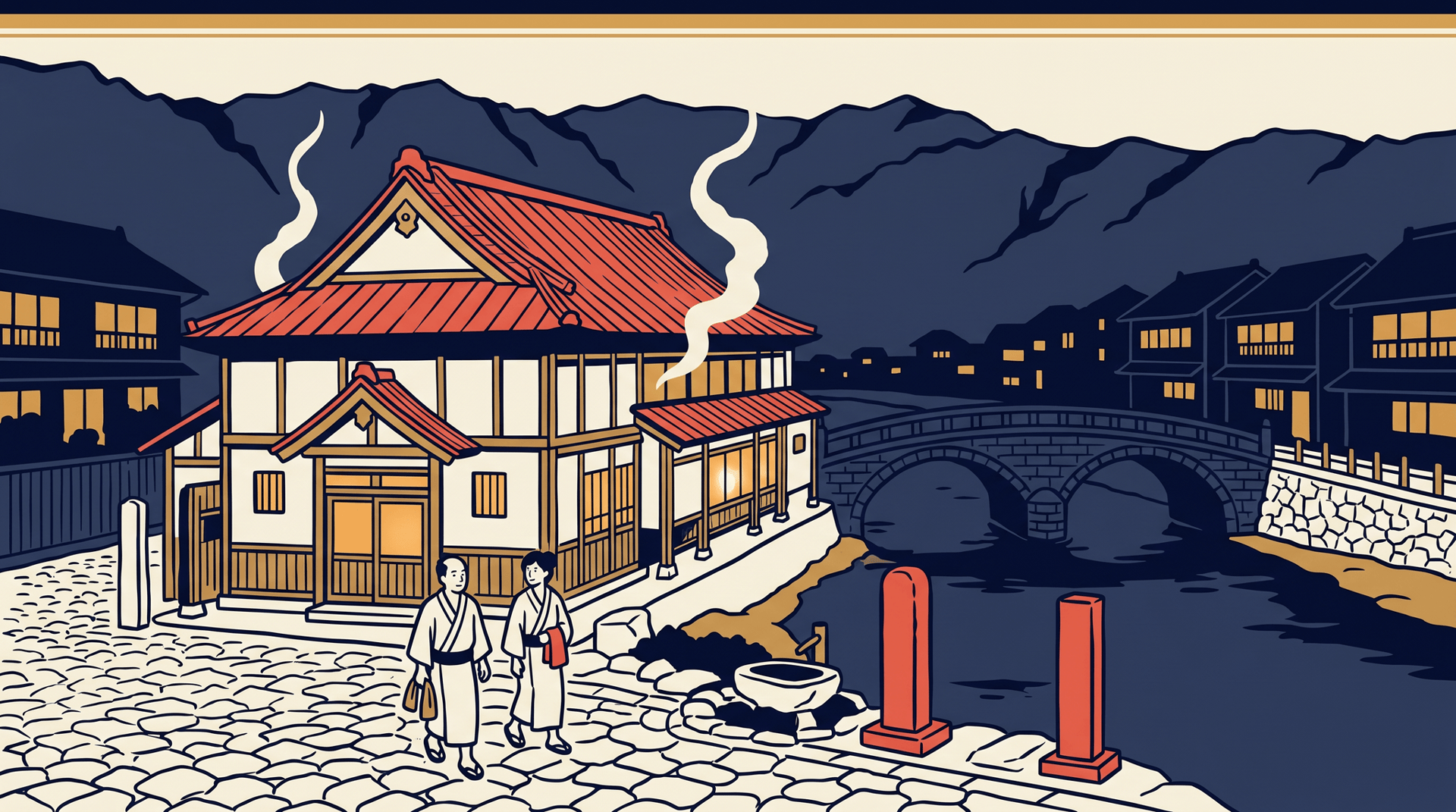
The center of that culture is Saba-yu (鯖湖湯), a small dark-timbered bathhouse rebuilt in 1993 to the lines of an 1889 Meiji-era predecessor once described as Japan's first wooden public bath of the modern period. The new building is faithful to the old one, slate roof and clean cypress benches, and a soak still costs about two hundred yen.
Nine sotoyu on a small river
The town is compact and easy to walk. Ryokan line both sides of the Surikami, the bridges short and low to the water, and nine public baths still operate among them on a rotating weekly schedule. The names read like a directory of old neighborhood landmarks: Saba-yu, Hako-yu, Dosen-no-yu, Senki-no-yu, Daimon-no-yu. The water runs hot in the local style, the entry rituals are quiet, and the rooms are unadorned. A guest who buys a small towel and a hundred-yen coin can follow one bath to the next on foot in an afternoon.
Iizaka gyoza, peach valley, dawn cherry
The kitchen leans on a single specialty: Iizaka gyoza, dumplings arranged in a tight circle and pan-fried into a shared disc, eaten with beer at small counters near the station. In early spring Akatsuki-zakura, the local dawn cherry, lights the riverbanks. A few weeks later the Asagiri Bridge carries walkers across to Hanamomo no Sato, a small valley planted with several hundred peach trees in dozens of varieties that bloom together for two short weeks in April.
Places in this area
34 places · Sorted by rating青葉旅館
Fukushima
あ~しあわせの湯
Fukushima
あづま荘
Fukushima
福住旅館
Fukushima
波来湯公園
Fukushima
橋本館
Fukushima
平野屋旅館
Fukushima
ほりえや旅館
Fukushima
ホテル天竜閣
Fukushima
一柳閣
Fukushima
喜久屋旅館
Fukushima
旧堀切邸
Fukushima
松島屋 桃香
Fukushima
なかむらや旅館
Fukushima
飯坂温泉 なかや旅館
Fukushima
伊勢屋
Fukushima
旅館 小松や
Fukushima
旅館 湯乃家
Fukushima
温泉屋ひろすけ旅館
Fukushima
鯖湖湯
Fukushima
新松葉旅館
Fukushima
摺上亭 大鳥
Fukushima
飯坂温泉 つたや旅館
Fukushima
On the map
Loading map…
Nearby onsenchi
Within 50 kmSources
- Iizaka Onsen Official Siteofficial— Umbrella site for the local ryokan and tourism association, with the nine-sotoyu lineup and the seasonal events calendar.
- Iizaka Onsen Official, Historyofficial— Local source for the Yamato Takeru legend, the Edo-era town size, and the Saba-yu wooden-bathhouse line about being a Meiji model.
- Iizaka Onsen Cooperative, Public Bath Guideofficial— Operating cooperative for the public baths, with the bath-by-bath roster, hours, and the standard 200 yen adult entry.
- Wikipedia, Iizaka Onsen— Backs the Fukushima Kotsu Iizaka Line access, the Surikami River setting, and the Matsuo Basho 1689 visit during Oku no Hosomichi.
- Wikipedia, Iizaka Onsen (Japanese)— Backs the Saba-yu reconstruction in 1993 modeled on the 1889 Meiji building and the Oshu three-onsen grouping with Naruko and Akiu.