
Jozankei Onsen
定山渓温泉Sapporo's mountain onsen, an hour from the city in the Toyohira river gorge. Sodium chloride springs and 60+ ryokan along a wooded canyon.
A wandering monk and a valley known to the Ainu
The springs of Jozankei surface along the upper Toyohira river, the same waterway the Ainu called part of sat poro pet, the "dry great river" whose name was later sounded out in kanji as Sapporo. Local Ainu had long known the hot water in the gorge; the explorer Matsuura Takeshiro recorded the source in 1858, almost a decade before any building stood beside it.
The resort itself dates to 1866, when an itinerant Shugendo monk named Miizumi Jozan was led upstream from Hariusu by Ainu guides and reached the steaming pools. Born in Bizen province in 1805, Jozan settled by the river, cut paths through the forest, and opened a healing bath for the sick and injured. The valley took his name in turn: Jozankei, "Jozan's gorge". From the 1918 opening of the Jozankei-Shiroishi railway the inns multiplied along the riverbank, and the town settled into its present role as the nearest hot-spring valley to Sapporo, roughly an hour by car from the city centre.
Cedar gorge, kappa, and a riverside spring
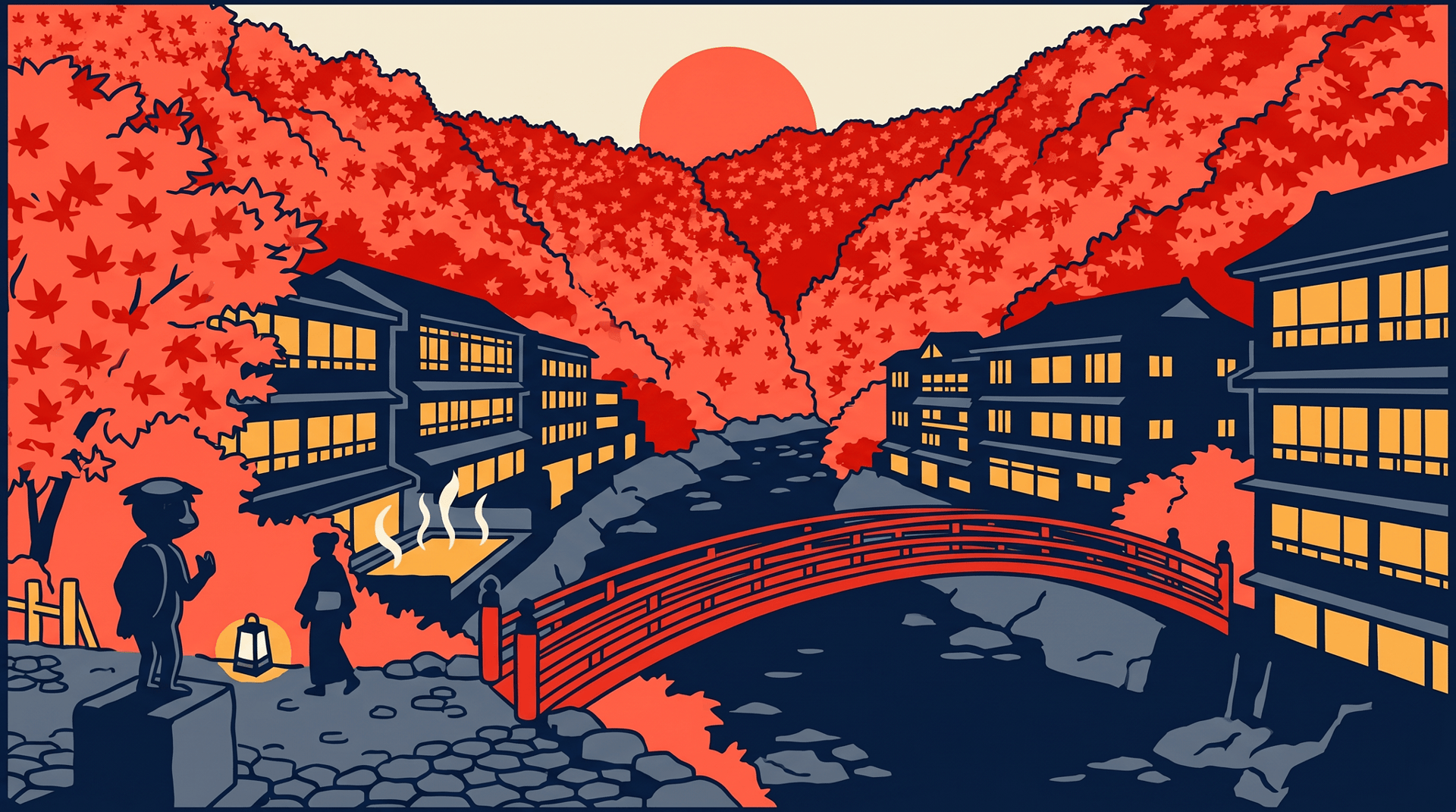
The ryokan of Jozankei terrace down the steep banks of the Toyohira, so that bath windows look straight onto the water and the cedar walls of the gorge. In autumn the slopes turn through gold and crimson around Futami-tsuribashi, the suspension bridge that crosses to the quietest stretch of the river; in winter the same view fills with snow on black branches. Beside the central Jozan-gensen-koen stand free ashiyu foot baths, a hand bath, and a stone pit for cooking onsen eggs; downstream the yu-no-taki spring trickles past a stone kappa soaking in his own open-air tub.
The water spirit, the kappa, is the town's mascot for a reason: local legend tells of a young man pulled into the deep pool of Kappa-buchi, who later appeared to his father in a dream to say he was living happily with his kappa wife and child. Today more than twenty kappa statues stand along the streets and bridges, joined every August by the Kappa Week festival.
Beyond the inns
A short bus ride upstream reaches the Hoheikyo dam, whose reservoir sits inside Shikotsu-Toya National Park and draws crowds for its autumn-foliage season in October. Visitors leave their cars at the gate and ride an electric shuttle up to the rim, where the dam's curtain of red and yellow runs the full length of the gorge.
Places in this area
7 places · Sorted by rating花もみじ
Hokkaido
休日湯
Hokkaido
On the map
Loading map…
Nearby onsenchi
Within 50 kmSources
- Jozankei Tourist Association — Historyofficial— Official town tourism body. Source for the 1866 founding by Miizumi Jozan, his Ainu guides, and the Meiji-era rail expansion.
- Jozankei Tourist Association — Kappa Legend Spotsofficial— Official catalogue of the town's kappa statues and the legend of Kappa-buchi.
- Wikipedia (JA) — Jozankei Onsen— Cross-check for the springs' natural discharge along the Toyohira gorge and for the Matsuura Takeshiro record predating Jozan's arrival.
- Wikipedia — Sapporo— Source for the Ainu etymology of Sapporo (sat poro pet, "dry great river") naming the Toyohira basin in which Jozankei sits.
- Sapporo City Tourism — Jozankei Onsen— Municipal tourism page. Used to confirm the resort's role as Sapporo's nearest hot-spring valley and the autumn-foliage and Hoheikyo dam attractions.