
Higashiyama Onsen
東山温泉Aizu-Wakamatsu's traditional onsen quarter, founded in the 8th century. Ryokan packed along the Yukawa river gorge below Tsurugajo castle.
Gyoki, a three-legged crow, and twelve centuries of bathing
Tradition places the discovery of Higashiyama in the Tenpyo era of the eighth century, when the wandering priest Gyoki is said to have been led to the source by a three-legged crow. Whatever the truth of the legend, the spring was running long before the town of Aizu existed around it. By the Edo period it had been designated the official bathing ground of the Aizu domain, a quiet valley where retainers of the Matsudaira clan came to convalesce. It is counted, with Kaminoyama and Yunohama in Yamagata, as one of the three classic hot springs of the Ou region (Ou, 奥羽三楽郷).
The valley sits a short ride from Tsuruga-jo, the castle whose month-long siege in autumn 1868 ended the Aizu clan's stand in the Boshin War. The same conflict drove the teenage Byakkotai to their ritual suicide on Iimoriyama, in sight of the burning castle town. Higashiyama was close enough to feel the war: the Shinsengumi commander Hijikata Toshizo is said to have stopped here to recover from wounds, and the painter Takehisa Yumeji and poet Yosano Akiko later came for longer stays. The samurai memory has not faded from the streetscape.
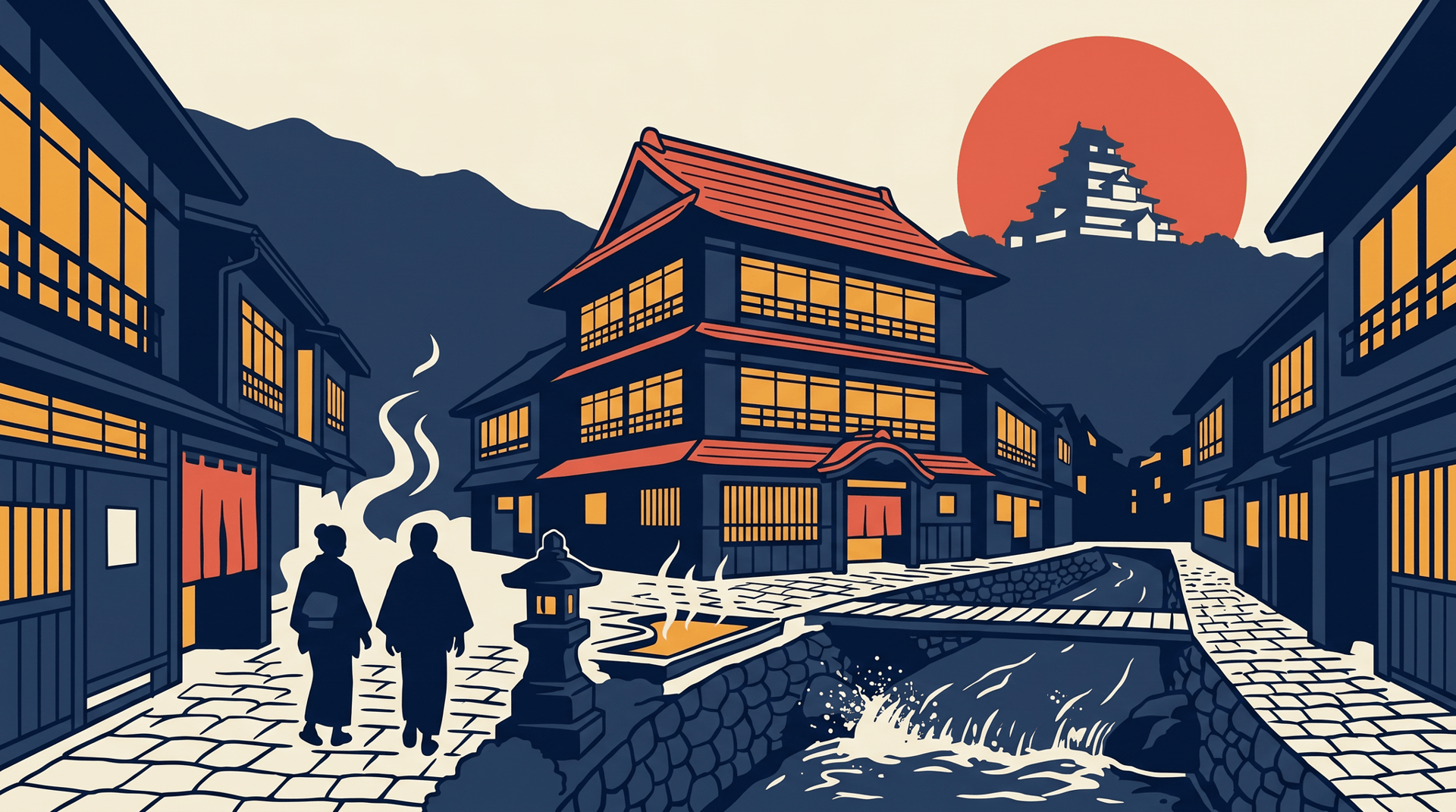
A narrow valley of wooden inns
The town runs east from the castle along the Yu river, a thin gorge tight enough that the inns line up wall to wall above the water. Several of them are pre-war wooden buildings; Mukaitaki, founded in the seventeenth century, is a Registered Tangible Cultural Property and still operates its original baths. The water comes out at 45–58°C, classified as calcium-sodium sulfate-chloride with simple-spring veins mixed in, and flows at roughly 1,500 litres per minute. Most houses run both indoor cypress baths and small open-air pools facing the river.
The Aizu-Wakamatsu side of the valley keeps a working geisha district: the karari-gisan of Higashiyama still perform parlour dances in the larger inns, one of the few places in Tohoku where the tradition survived the postwar slump.
What to do above the valley
Tsuruga-jo is fifteen minutes by car, rebuilt in 1965 with its distinctive red-tile roof and a thorough museum on the Aizu clan and the Boshin War. Iimoriyama, with the Byakkotai memorial and the hexagonal Sazae-do pagoda, is on the way back. The old castle town is also Japan's senior centre for lacquerware (Aizu-nuri) and a strong sake region; the Suehiro and Tsurunoe breweries run free tours within walking distance of the station.
Places in this area
13 places · Sorted by rating有馬屋旅館
Fukushima
伏見荘
Fukushima
向瀧
Fukushima
今昔亭
Fukushima
二洸旅館
Fukushima
御宿 東鳳
Fukushima
月のあかり
Fukushima
On the map
Loading map…
Nearby onsenchi
Within 50 kmSources
- Aizu Higashiyama Onsen Ryokan Association — official portalofficial— Aizu Higashiyama Onsen Ryokan Cooperative. Member-inn directory, geisha culture programming, history page.
- Higashiyama Onsen — Wikipedia (Japanese)— Source for the Gyoki founding date, the three-legged crow legend, water chemistry (calcium-sodium sulfate-chloride, 45–58°C, ~1,500 L/min), and the list of literary visitors.
- Mukaitaki — Aizu clan history pageofficial— One of the oldest standing inns at Higashiyama, designated a Tangible Cultural Property. The history page documents the spring's role as the Aizu domain's official bathing ground.
- Samurai City Aizu-Wakamatsu — The Boshin War and the Battle of Aizuofficial— Aizu-Wakamatsu City tourism. Reference for the 1868 siege of Tsuruga-jo and the Byakkotai episode at Iimoriyama.
- Higashiyama Onsen — Travel to Tohokuofficial— Tohoku regional tourism board. Notes the spring's classification as one of the three classic hot springs of the Ou region and its association with Hijikata Toshizo and Takehisa Yumeji.