
Nasu Onsen-kyo
那須温泉郷Onsen group along the foothills of Mount Chausu, with Nasu-Yumoto's milky sulfur waters at its heart.
A deer, a hunter, and 630 CE
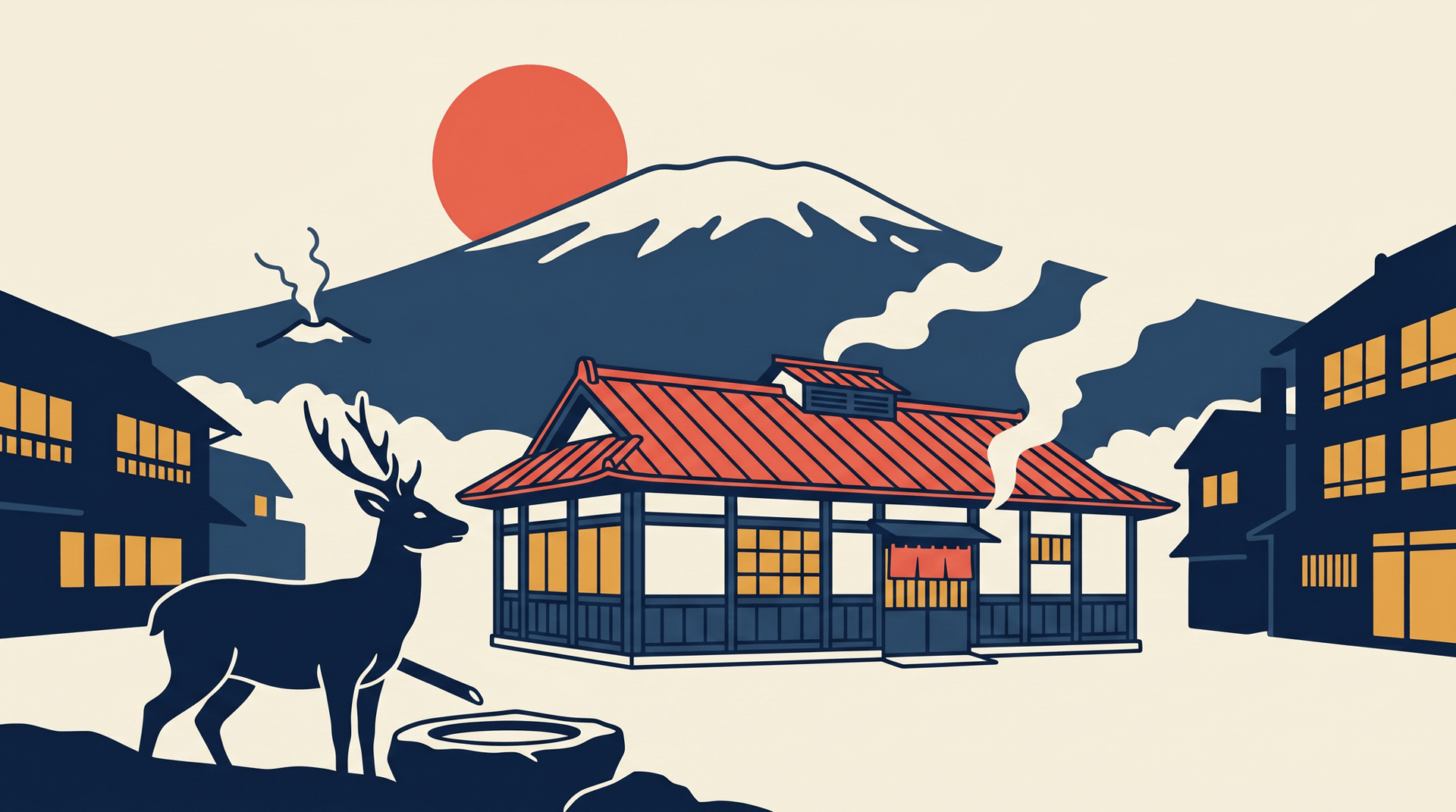
By the shrine record of Onsen Jinja in Nasu Yumoto, the springs were found in 630 CE by the hunter Kano Saburo Yukihiro, who tracked a wounded white deer up the southern flank of Mt. Nasu and found it healing in a sulfur pool. The bath that grew around that pool is Shika-no-yu (鹿の湯, "deer bath"), and it has been in continuous public use ever since, which places it among the oldest working bathhouses in Japan. The current wooden building dates from 1941, but the bathing protocol, short immersions in undiluted source water graduated by temperature, is the older inheritance. Minamoto no Yoritomo is recorded as having bathed here in 1193; Matsuo Basho passed through in 1689 on the road that became Oku no Hosomichi. By the late Edo period the informal national hot-spring ranking placed Nasu second in the east, behind only Kusatsu. The Nasu Imperial Villa, in use by the imperial family since 1926, sits a short distance below Yumoto on the same plateau.
Eight villages on the volcano's skirt
Nasu Onsen-kyo is not one town but a string of eight separate hamlets strung along the southern slopes of Mt. Chausu, each with its own source and its own water. Yumoto at the head of the valley is the acid-sulfur source, the white-clouded water that smells of struck matches and stings briefly on broken skin. Omaru, Hachiman, and Benten further down are simple thermal waters, gentler and clearer. Kita Onsen, reached on foot down a steep forest track, mixes simple, weak-salt, and iron springs in one nineteenth-century wooden inn. Takao carries sulfate and hydrogen sulfide; Asahi and Sandogo-ya round out the chain, the last requiring a hike past the ropeway's upper station. The eight share a postal code and almost nothing else, which is the point.
The plateau above the baths
The whole area sits inside Nikko National Park on Nasu-kogen, a broad volcanic plateau that has been a summer-house district for Tokyo since the Meiji era. Mt. Chausu is still an active volcano with fumarole vents visible from its summit trail, a short climb from the ropeway. Below the treeline the plateau is dairy country: cheese workshops, ice-cream stands, horse-riding stables and a thick layer of resort hotels and golf courses spread along the access roads from Kuroiso. The contrast, ancient sulfur bath at the top, weekend cheese platter halfway down, is most of what makes Nasu work as a destination.
Districts
4 sub-areas within Nasu Onsen-kyoPlaces in this area
22 places · Sorted by rating河原の湯
Tochigi
小鹿の湯
Tochigi
滝乃湯
Tochigi
雲海閣
Tochigi
On the map
Loading map…
Nearby onsenchi
Within 50 kmSources
- Nasu Onsen Ryokan Cooperativeofficial— Member ryokan, district overview and water types for Yumoto and the surrounding springs.
- Shika-no-yu, official site, historyofficial— Source for the 630 CE founding legend, Kano Yukihiro and the wounded deer, and the bath's 1,300-year chronology.
- Nasu Onsen-kyo, Wikipedia (Japanese)— Eight-district enumeration (Yumoto, Omaru, Hachiman, Kita, Asahi, Takao, Bentén, Sandogo-ya) and the Edo-period "second only to Kusatsu" ranking.
- JNTO, Nasu Onsen— Japan National Tourism Organization overview, cross-checked for the plateau context and Nikko National Park status.
- Nasu Kogen Visitor Center, historyofficial— Nikko National Park visitor center on the Nasu plateau, volcano, and the wider Nasu-kogen landscape.