
Senami Onsen
瀬波温泉On the Sea of Japan coast at Murakami in northern Niigata, Senami Onsen was discovered in 1904 when oil prospectors struck near-boiling water instead of crude. Its 95 °C sodium-chloride springs face straight out to sea, famous for sunsets sinking into the water beside the open-air baths.
Oil they sought, hot water they found
Senami's origin is unusually precise for an onsen. In April 1904 (Meiji 37) a crew was test-drilling for oil on the coast at what is now Funto Park (噴泉公園), and instead of crude they struck near-boiling water that gushed (噴泉) from the bore. The source still rises at around 95 °C, hot enough that the resort took the byname "hot water" (熱の湯), and seven springs together yield some eighteen hundred litres a minute. Local lore softens the geology with a fox: the night before the eruption, an o-kitsune-sama (お狐様) is said to have cried out to foretell the water's coming. The find sat just outside the old castle town of Murakami (村上), and when the railway reached Murakami station the following decade, bathhouses spread along the shore until the strip of ryokan that lines the beach today had taken shape.
A balcony over the Sea of Japan
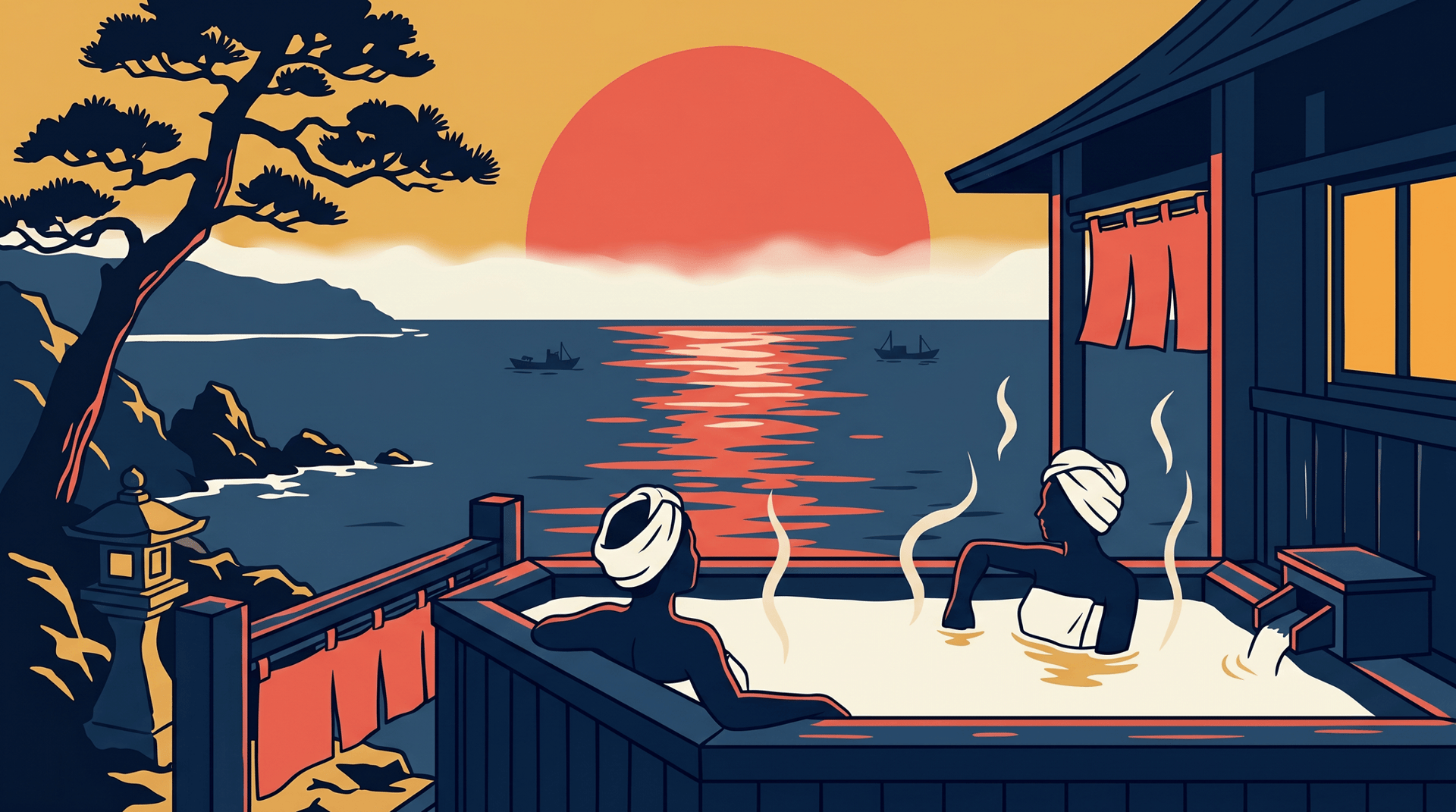
What fixes Senami in memory is the sunset (夕日). The springs sit right on the Sea of Japan, with no land between the bath windows and the horizon, so the evening sun drops straight into the water in front of the open-air baths and the beach. Over a year the point where it sinks tracks back and forth between the islands of Sado and Awashima offshore, and the imagined arc it traces is called the Yuhi no Komichi (夕日の小路), the sunset path. The water itself is a sodium-chloride spring, salty and slow to cool, the kind of brine that holds heat against the sea wind long after a soak. In 1937 the poet Yosano Akiko (与謝野晶子) stayed here and left forty-five verses, later cut into stone markers around the resort, a reminder that the view was drawing visitors well before the package-tour era.
Around the town
Senami is the coastal edge of Murakami, a town that wears its specialities plainly. It is salmon (鮭) country above all: the Miomote river runs the fish up each autumn, and the lanes of the machiya (町屋) merchant quarter hang shiobiki-zake (塩引き鮭), salt-cured salmon air-dried in the cold wind, from the eaves. The same town raises Murakami wagyu (村上牛) and grows Murakami tea (村上茶), reckoned among Japan's northernmost. North up the coast, the eleven kilometres of wave-cut rock, sea caves, and reefs known as Sasagawa Nagare (笹川流れ) form a nationally designated scenic spot, best seen from a sightseeing boat.
Places in this area
10 places · Sorted by rating野天風呂 湯元 龍泉
Niigata
くつろぎの宿 旅館 静雲荘
Niigata
大和屋旅館
Niigata
吉田や
Niigata
ゆ処そば処 磐舟
Niigata
温泉民宿 きくもと
Niigata
On the map
Loading map…
Nearby onsenchi
Within 50 kmNo nearby onsenchi within range.
Sources
- Murakami City — Senami Onsenofficial— Municipal tourism page covering the 1904 oil-prospecting discovery and the sunset over the Japan Sea.
- Senami Onsen Ryokan Cooperative Association — History & Efficacyofficial— Official association page on the gushing source, the 95 °C "hot water", the seven springs, and spring quality.
- Murakami City Tourism Association — Senami Onsenofficial— Regional tourism portal linking the resort to Murakami's salmon culture, tea, and the Sasagawa Nagare coast.
- Senami Onsen — Wikipedia (JA)— General reference for the discovery story, the sodium-chloride composition, source temperature, and scale.