
Sounkyo Onsen
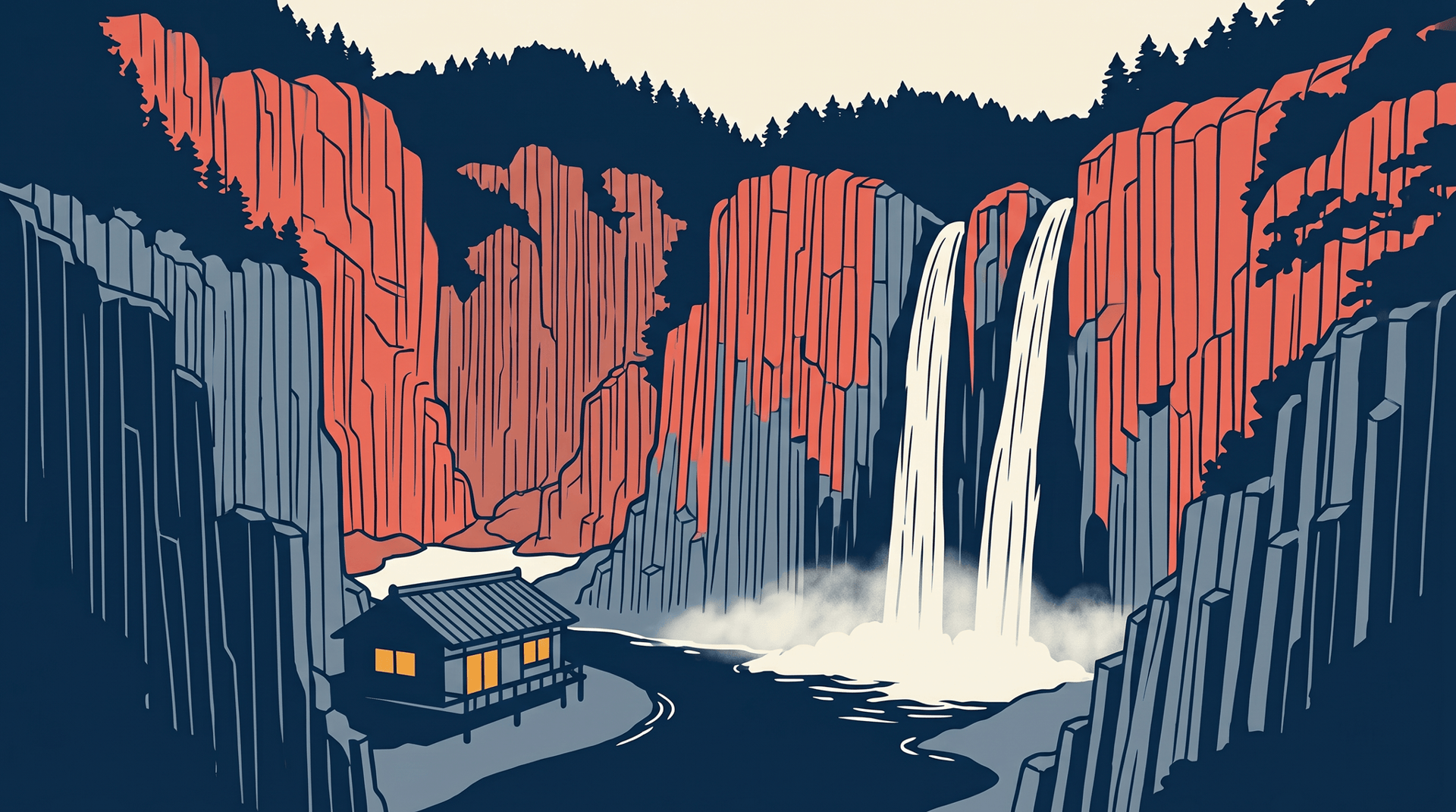
層雲峡温泉Gorge onsen at the entrance to Daisetsuzan, Hokkaido's largest national park. Sodium chloride springs at the foot of 100-meter columnar cliffs and the Ginga + Ryusei waterfalls.
A gorge the Ainu called the garden of gods
The Ainu walked the upper Ishikari long before any bathhouse stood on it, following bears into the Daisetsuzan highlands and naming the whole plateau Kamui Mintar, "the garden where the gods play". The hot springs at the mouth of the gorge first reach the written record around the turn of the twentieth century: Shioya Mizujiro is credited with bringing them to notice in 1900, and Kunisawa Kiyeemon developed the first proper inn here in 1913. When Daisetsuzan National Park was designated in 1934 as the largest national park in Japan, Sounkyo was the natural place for visitors to sleep, eat, and step into the mountain, and the postwar decades hardened the scatter of wayside huts into the resort village standing today.
Layered clouds, basalt walls, two waterfalls
The name 層雲峡 reads literally as "gorge of the layered clouds": the Ishikari has cut a twenty-four kilometre corridor through a plateau of welded tuff, leaving cliffs of columnar basalt rising several hundred metres on either bank. From the bathhouses it is a short walk or cycle to Ginga-no-taki, the "Milky Way Fall", and Ryusei-no-taki, the "Shooting Star Fall", a pair of cascades that drop in parallel from the rim; further upstream the road threads through the Obako and Kobako viewpoints, where the canyon narrows enough that the sky becomes a slot of blue overhead.
In winter the riverbed itself becomes the attraction. The Sounkyo Hyobaku Matsuri, the Icefall Festival, runs from late January into March on roughly ten thousand square metres of frozen Ishikari foreshore. It began in 1976 when the local shopping district invited the sculptor Takenaka Toshihiro to spray water onto trees and let the cold do the rest; today the structures are carved caverns and tunnels, lit at night in shifting colour, with an ice shrine and a thirteen-metre tower at the centre.
Up the rope into the alpine zone
From the village, the Kurodake ropeway lifts visitors out of the gorge in minutes and sets them down on the shoulder of Mt. Kurodake, inside the Daisetsuzan alpine belt. The peak catches the season early: each September the upper slopes turn before anywhere else in Japan, making Sounkyo the country's first stop on the year's southbound autumn-foliage front.
Places in this area
8 places · Sorted by ratingホテル雲井
Hokkaido
層雲峡 朝陽亭
Hokkaido
層雲峡ホステル
Hokkaido
湯元 銀泉閣
Hokkaido
On the map
Loading map…
Nearby onsenchi
Within 50 kmNo nearby onsenchi within range.
Sources
- Sounkyo Tourism Associationofficial— Town tourism office. Source for the Ainu name Kamui Mintar ("the garden where gods play"), seasonal programming, and the festival calendar.
- Japan Guide — Sounkyo Onsen— Reference for the gorge's position as the gateway resort of Daisetsuzan National Park and the layout of Ginga-no-taki and Ryusei-no-taki.
- Highlighting Japan — The Sounkyo Onsen Icefall Festival— Government of Japan feature. Used for the 1976 origin of the Hyobaku Matsuri and sculptor Takenaka Toshihiro's role.
- Wikipedia (JA) — Sounkyo Hyobaku Matsuri— Cross-check for the festival's 10,000 m² Ishikari riverbed venue and the 13 m observation tower.
- Wikipedia (JA) — Sounkyo Onsen— Background on the columnar basalt cliffs of the Ishikari gorge and the Kurodake ropeway link into Daisetsuzan.