
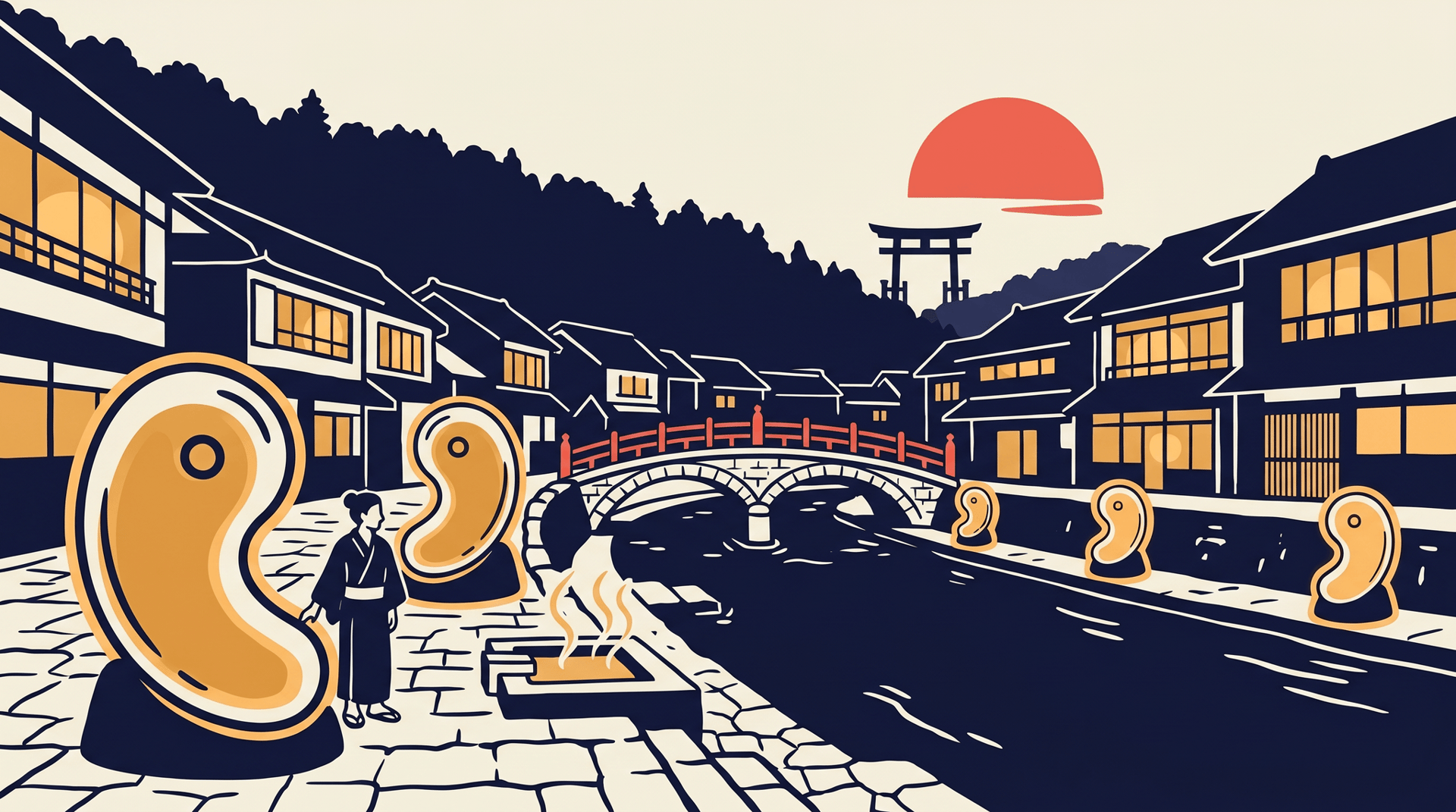

Tamatsukuri Onsen
玉造温泉Shimane onsen with 1300 years of recorded history. Mentioned in the Izumo Fudoki (733 CE) as 'the bath of the gods'.
A spring with a paper trail
Tamatsukuri is one of the handful of Japanese hot springs whose name appears in writing from the 8th century. The Izumo no Kuni Fudoki, the regional gazetteer completed in 733, already describes the bath in lines that locals still quote: enter once and one's appearance becomes radiant, enter twice and any ailment is cured. The same passage gives the spring its oldest nickname, Kami no Yu (神の湯), the Bath of the Gods. For more than thirteen centuries the water has been read primarily as a bihada no yu, a "beauty bath," and that framing still drives how the town presents itself today.
The place name is just as old. Tamatsukuri means "bead-making," and from the Yayoi period onward the surrounding hills, especially Kasen-zan, supplied the high-grade blue-green agate used to carve magatama, the curved comma-shaped jewels that became sacred regalia of the Izumo courts. Workshops here fed the ritual economy of ancient Izumo and, by tradition, the imperial treasury itself.
A small town on the Tamayu
The modern resort is compact: a single row of ryokan and shops strung along the Tamayu River in the Tamayu district of Matsue City, with stone lanterns and walking paths on both banks. The water emerges hot, around the sodium and sulfate end of the chemistry chart, and its famous slick, moisturising feel comes from that mineral mix rather than from any cosmetic additive. Free riverside ashi-yu foot baths punctuate the promenade, and the riverbed itself holds polished agate "wishing stones" that visitors touch as a small ritual.
The town has kept a strong shinise ryokan culture, around fifteen inns in total, several of them generations old. The atmosphere is quieter and more literary than the larger Shimane sights nearby.
Around the area
Tamatsukuri sits within easy reach of the Izumo cultural core. Izumo Taisha, one of Japan's oldest and most important shrines, is roughly an hour west; Matsue Castle, one of only twelve surviving original donjons, is a short ride north; and Lake Shinji spreads out just beyond the townline, famous for its sunsets. In the town itself, Tamatsukuri Yu Shrine (玉作湯神社) anchors the magatama lineage and runs craft workshops where visitors can string their own bead.
Places in this area
12 places · Sorted by ratingOn the map
Loading map…
Nearby onsenchi
Within 50 kmNo nearby onsenchi within range.
Sources
- Tamatsukuri Onsen Ryokan Association, official siteofficial— The local inn association. Source for the spring's "beauty bath" framing, the riverside layout along the Tamayu River, and the roster of around fifteen ryokan.
- Matsue Tourism Association: Tamatsukuri Onsenofficial— Matsue City tourism authority page. Confirms the 733 *Izumo no Kuni Fudoki* entry and the "Bath of the Gods" (神の湯) epithet.
- Tamatsukuri Onsen, Wikipedia— Background on the spring's sulfate composition, source temperatures around 50–70°C, and its place within Matsue's Tamayu district.
- 玉造温泉, Wikipedia (日本語)— Japanese-language overview covering the Kasen-zan agate quarries, the magatama craft tradition, and Tamatsukuri Yu Shrine.
- Rakuten Travel: Tamatsukuri Onsen Guide— Cultural context for the *Izumo Fudoki* quotation ("enter once and become beautiful, enter twice and any ailment is cured") and the magatama bead-making lineage.