
Yugawara Onsen
湯河原温泉Quiet Kanagawa onsen in the foothills of the Hakone outer rim, on the Manyoshu-era list of historic baths. Plum blossoms in February.
The only onsen in the Man'yoshu
Yugawara is the single hot spring named in the Man'yoshu, the eighth-century poetry anthology that defined classical Japan's poetic taste. The relevant verse opens with the words "ashigara no toi no kahara ni izuru yu no…" ("the water that rises in Toi-no-kahara of Ashigara"), fixing the valley as a named hot-spring site more than twelve centuries ago. From the Meiji period on, the same valley drew a long roster of writers in search of quiet rooms with a desk. Natsume Soseki wrote here while working on his last, unfinished novel Meian (Light and Darkness), breaking off in a Yugawara ryokan in 1916. Kunikida Doppo, Shimazaki Toson, Akutagawa Ryunosuke, Tanizaki Jun'ichiro and Yosano Akiko all stayed and worked here, and roughly thirty stone monuments along the path through Manyo-koen (Man'yo Park) carry verses composed on those visits.
A river valley between Atami and Hakone
Geographically Yugawara sits between two louder neighbours (Atami on the coast and Hakone on the ridge), and the comparison is what locals themselves draw. The town stretches along the Fujiki River as it cuts down a calm valley off the southern flank of the Hakone volcano, and most of the inns are spread thinly along the banks rather than stacked into a single strip. The water comes out of the ground at a moderate 30 to 88 °C and runs to simple, weak saline and gypsum chemistries: easy to sit in for a long bath, gentle on the skin, free of the sulphur signature of the bigger mountain resorts. The lodgings skew toward mid-size ryokan rather than mega-hotels, and the public soaking life is held together by Yugawara Soyu and by the long footbath at Dokuho no Yu inside Manyo Park.
Around the valley
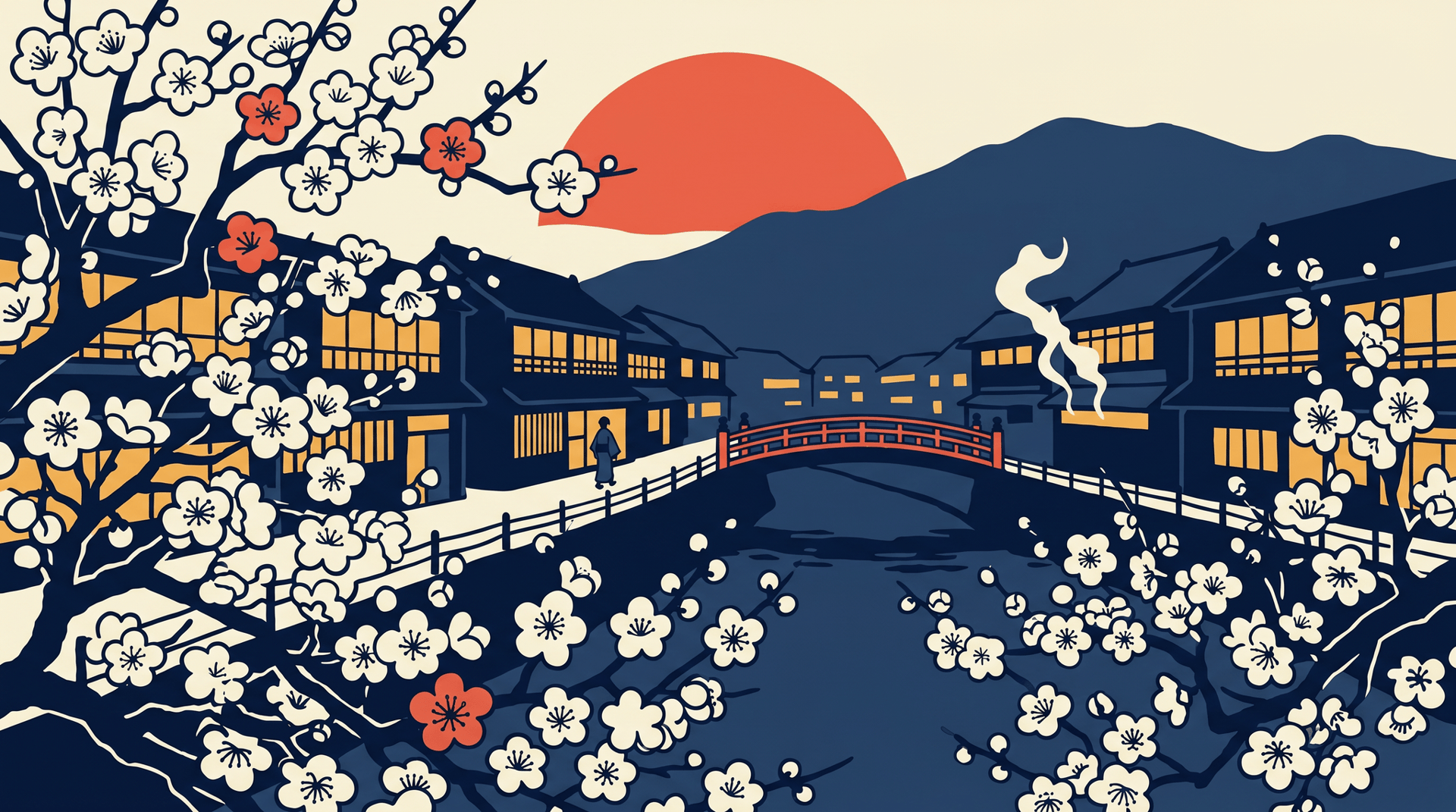
In mid-February through early March the slopes of Makuyama above the town turn red and white as around four thousand plum trees bloom for the Ume no Utage festival, one of the larger plum events near Tokyo, set on a hillside that doubled for the medieval Ishibashiyama battlefield in the 1180 Genji rising. Further up the valley a tributary of the Fujiki drops over the fifteen-metre Fudo-taki waterfall, with a small Fudo-myoo shrine at its base. Hakone's outer ring is half an hour up the road by bus.
Places in this area
5 places · Sorted by ratingホテル眺望山荘
Kanagawa
三輪 湯河原
Kanagawa
城山別館
Kanagawa
湯河原温泉 ふきや
Kanagawa
On the map
Loading map…
Nearby onsenchi
Within 50 kmSources
- Yugawara Onsen Tourist Associationofficial— Official portal of the town's tourism association, with lodging, seasonal events, and the Soyu public bath.
- Yugawara Onsen — Wikipedia (JA)— Reference for spring chemistry (simple, weak saline, gypsum), source temperatures of 30–88 °C, and the literary record.
- Makuyama Park & the Yugawara Ume Groveofficial— Tourism page documenting the roughly 4,000-tree plum grove and the February–March Ume no Utage festival.
- Fudo Waterfallofficial— Tourism page for the fifteen-metre falls on a tributary of the Fujiki River.
- Yugawara Soyu — Historyofficial— Background on the municipal public bath and the town's place in the Man'yoshu.