

Shuzenji Onsen
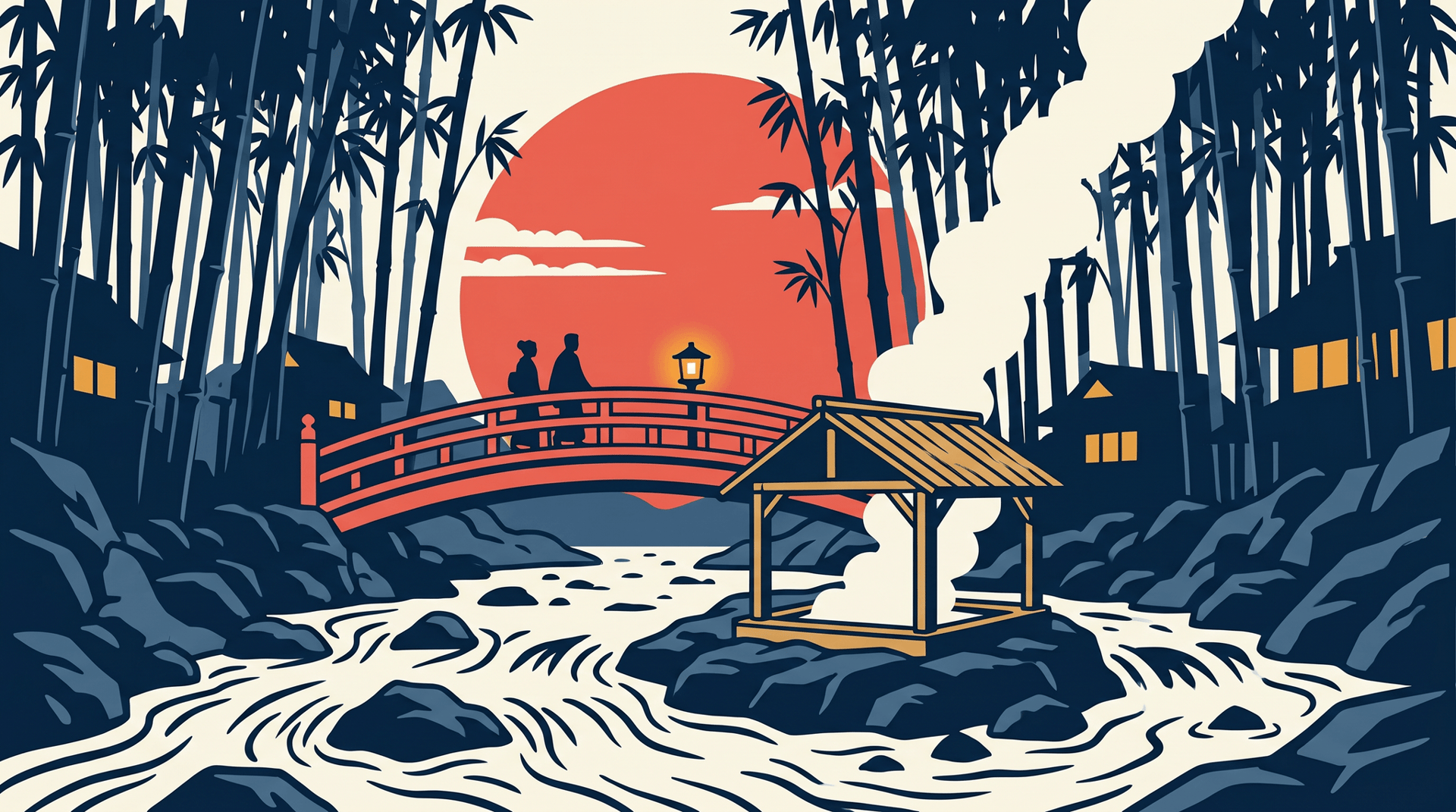
修善寺温泉1200-year-old onsen at the head of the Katsura River in central Izu. Bamboo grove, red bridges, the historic Shuzenji temple complex.
A staff strike against a riverbed rock
The founding tradition is dated to 807 (Daido 2) and assigned to Kukai (Kobo Daishi), the Shingon patriarch on his way through the Izu mountains. Seeing a boy washing his sick father in the cold Katsura, the monk is said to have struck a rock in the stream with his tokko (独鈷) ritual staff; hot water rose from the split, and the father's long illness lifted within days. The spring kept the staff's name as Tokko-no-yu (独鈷の湯), and the small Shuzen-ji temple that gives the town its name took shape around it. The temple later passed to the Soto Zen school, which still holds it.
Four centuries on, Shuzenji entered the political record by way of a killing. Minamoto no Yoriie, second shogun of the Kamakura bakufu, was confined here by his maternal Hojo kin after losing power, and assassinated in 1204 at the age of 23, traditionally while bathing. The grave and a small museum beside the temple keep the story present; the assassination of an heir of Yoritomo at a hot spring has fixed Shuzenji in the popular imagination ever since, most famously through Okamoto Kido's 1911 Shin-kabuki play Shuzenji Monogatari.
A small town wrapped around the Katsura
Shuzenji is inland Izu rather than coast: a compact ryokan town folded into the hills where the Katsura river (Shuzenji-gawa) cuts through. The Tokko-no-yu pavilion still sits out in the riverbed itself, a red-railed gazebo in the current; it was moved nineteen metres downstream in 2009 for flood-flow reasons, and is now for viewing rather than bathing. From there the Chikurin-no-komichi (竹林の小径), a short bamboo path lined with low benches and lit at night, runs along the bank toward the temple. The ryokan culture is classical: multi-generation inns, kaiseki dinners, indoor and outdoor baths of mild alkaline water around 60–65 °C, and the town stays walkable end to end in twenty minutes.
A literary convalescence
In August 1910, while staying at the Kikuya inn to recover from a stomach ulcer, Natsume Soseki suffered a massive hemorrhage, vomited a basin of blood, and lay unconscious for half an hour. He survived; the episode, which he later called the Shuzenji no Taikan (修善寺の大患), "the great illness at Shuzenji," gave him, in his own phrase, an unconditional gratitude for life, and shaped the late novels. A small memorial in town marks the room; the inn is still in business. Shuzenji makes a natural one- or two-night base for the rest of the Izu Peninsula, with the Izu-Hakone Sunzu line connecting in roughly two hours from Tokyo.
Places in this area
9 places · Sorted by rating
On the map
Loading map…
Nearby onsenchi
Within 50 kmSources
- Shuzenji Onsen Ryokan Cooperative Associationofficial— Member directory and official tourism portal for the inns of Shuzenji Onsen.
- Izu City Tourism — Tokko-no-yuofficial— Municipal page on the Tokko-no-yu spring, the Katsura river site, and the 2009 relocation.
- Shuzenji Onsen — Wikipedia (JA)— General reference for the 807 founding tradition, the spring chemistry, and the Izu Peninsula context.
- Natsume Soseki — Wikipedia (EN)— Source for the August 1910 "Shuzenji catastrophe" during his stay at Kikuya inn.
- Shuzenji Onsen — Japan National Tourism Organizationofficial— JNTO overview of the town, the bamboo path, and Shuzenji temple.