
Kamisuwa Onsen
上諏訪温泉A lakeside spa town on the eastern shore of Lake Suwa, where open-air baths face the water beneath the floating castle of Takashima, a timed geyser, five sake breweries, and the great August lake fireworks.
A spa town on the shore of Lake Suwa
Kamisuwa Onsen (上諏訪温泉) lines the eastern shore of Lake Suwa (諏訪湖), the largest lake in Nagano Prefecture, in Suwa city. The town had a name as a hot spring as far back as the Edo period (the 1817 spa ranking placed it among the eastern contenders) but it grew into a resort once the Chuo Main Line reached the lake in 1905 and Tokyo day-trippers began arriving by train. The water is largely a clear, colourless simple hot spring (単純温泉) with some sulphur springs (硫黄泉) in the mix, emerging hot enough that the ryokan and bathhouses pump it up rather than rely on a free-running flow. The defining pleasure is geography: the lakeside lodgings stack their baths toward the water, so that an open-air bath (露天風呂) looks straight out over the lake to the mountains beyond, and footbaths (足湯) sit along the shore and even on the platform of Kami-Suwa station.
The lake, the geyser, and the floating castle
Lake Suwa supplies most of Kamisuwa's set pieces. Near the lodging strip stands the Suwako Geyser Center (諏訪湖間欠泉センター): the geyser was struck by drilling in 1983 and once jetted naturally to spectacular height, and now it is sent up on a fixed daily timetable for visitors. A short walk inland is Takashima Castle (高島城), built at the close of the sixteenth century for the Suwa domain; with the lake once lapping at its walls it earned the name floating castle (浮城), and its keep still rises above a moat and a public park. In the depth of winter the lake produces its strangest sight, the omiwatari (御神渡り): pressure ridges of ice that buckle up across the frozen surface, read in local belief as the path of the Suwa deity crossing to the shrine on the far shore, though in recent warm winters the lake has often failed to freeze hard enough to form them.
Around the town
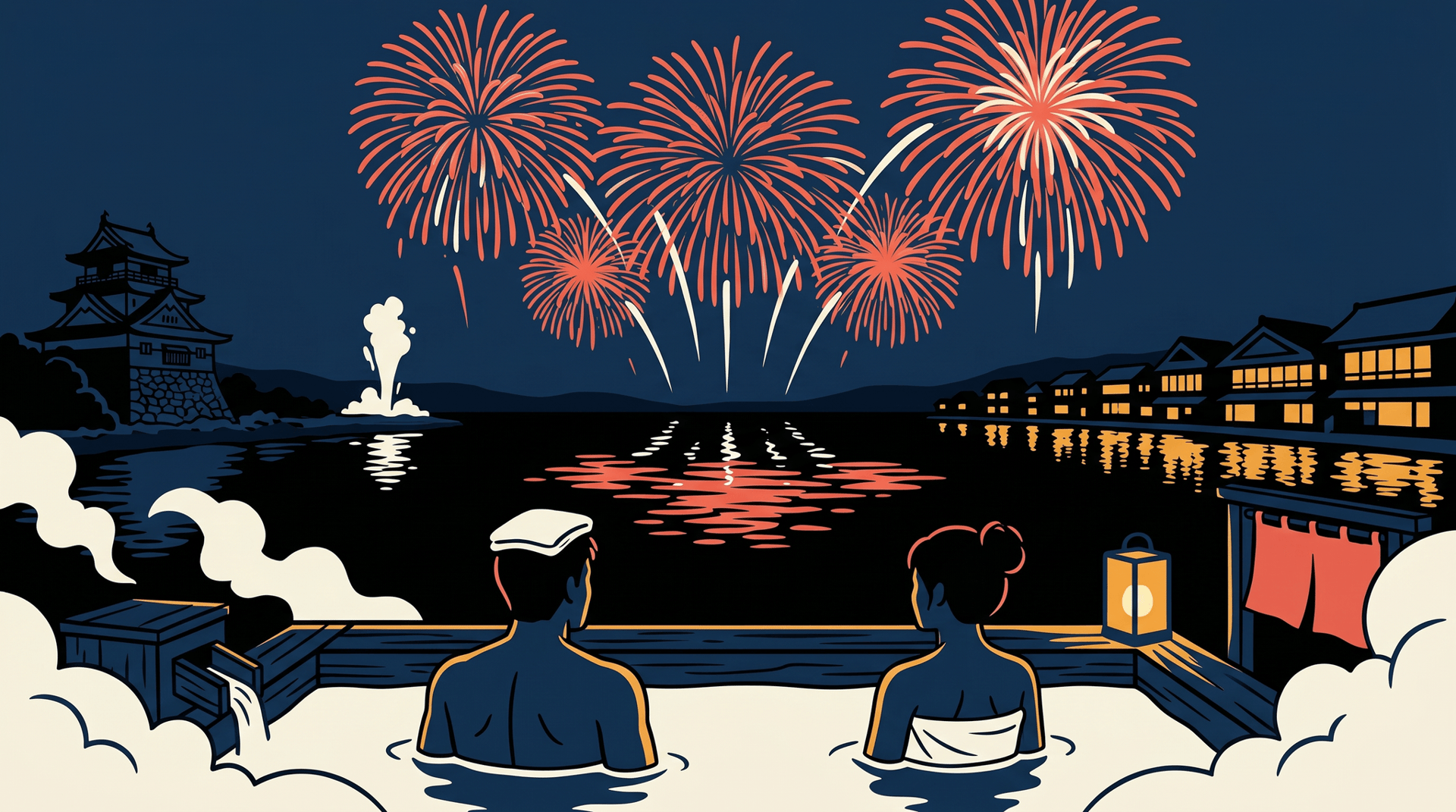
The Suwa basin is shrine and sake country. Suwa Taisha (諏訪大社), one of Japan's oldest shrines, spreads across four precincts around the lake and stages the Onbashira festival (御柱祭) in the years of the Tiger and the Monkey (once every six years) when great fir trunks are dragged down from the mountains and raised at the shrine corners. Along the old Koshu road in Kamisuwa, five sake breweries, among them Masumi (真澄), stand within a few hundred metres of one another, walkable as a tasting route known as the Suwa Gokura (諏訪五蔵). Closer to the water, Katakurakan (片倉館), a Western-style public bath opened in 1928 by the Katakura silk family, still fills its marble-lined Sennin-buro (千人風呂), the "thousand-person bath." On 15 August the town turns to the lake for the Suwako Festival Lake Fireworks (諏訪湖祭湖上花火大会), one of the largest fireworks displays in the country, launched from pontoons with the ring of mountains throwing the sound back across the water.
Places in this area
18 places · Sorted by rating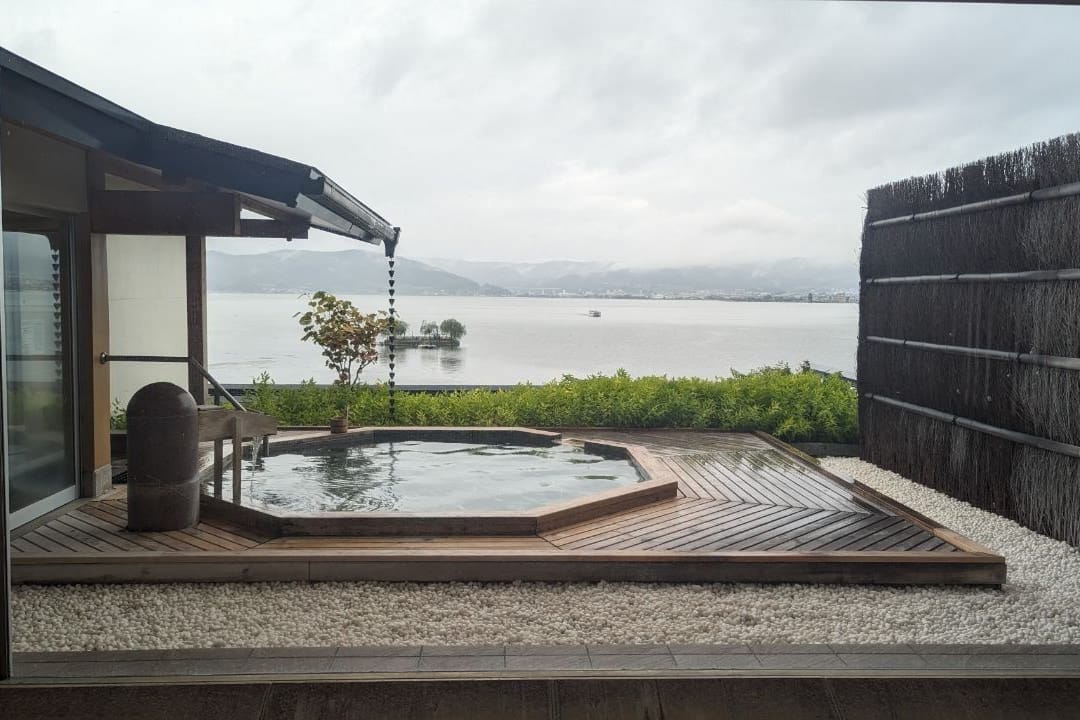 Other
Other諏訪別邸 朱白
Nagano
KKR 諏訪湖荘
Nagano
おんやど鯉住
Nagano
萃sui-諏訪湖
Nagano
On the map
Loading map…
Nearby onsenchi
Within 50 kmNo nearby onsenchi within range.
Sources
- Suwa Tourism Associationofficial— Official guide for Suwa city covering the lake, Takashima Castle, Suwa Taisha, and the five sake breweries.
- Suwako Onsen Ryokan Cooperative Associationofficial— Portal for the Kamisuwa lakeside lodgings, with the spring character and bath listings.
- Suwako Festival Lake Fireworksofficial— Official site for the August 15 fireworks staged from pontoons on Lake Suwa.
- Lake Suwa — Wikipedia (EN)— General reference for the lake's setting, the omiwatari ice phenomenon, and the surrounding geography.