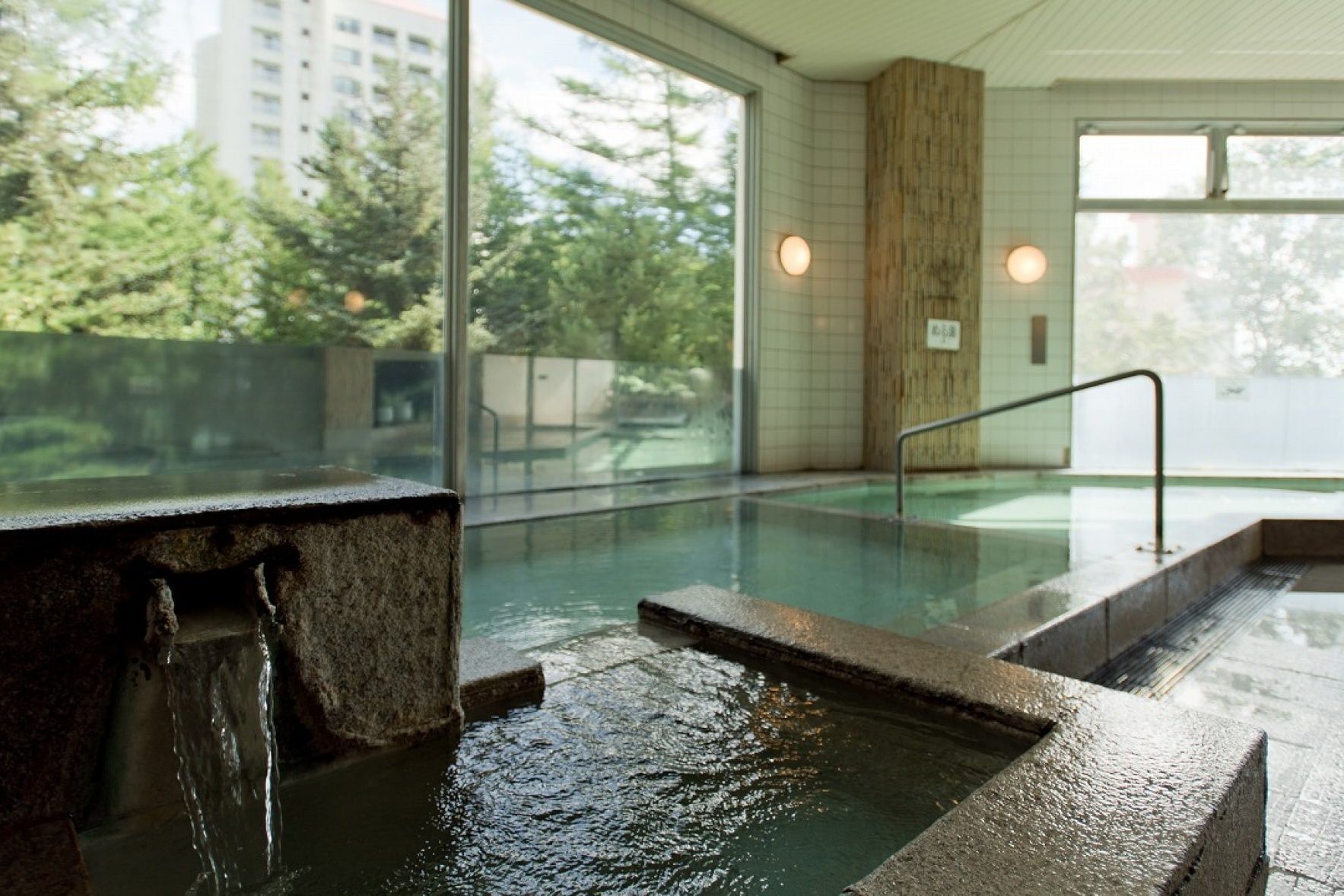

Kusatsu Onsen Hotel Village is a large family resort with three separate hot springs feeding two bathing buildings. The main building's indoor bath and rotenburo run on Yubatake-gensen (湯畑源泉), piped in from the Yubatake (湯畑) landmark in central Kusatsu and kept flowing fresh; the water is sharply acidic but surprisingly soft on the skin. A separate pool-and-onsen building, Terume Terume, adds two more springs: Bandaiko-gensen (万代鉱源泉), the town's highest-volume source with barely a trace of sulfur smell, and Wata-no-yu (わたの湯), a milky white bath with a smooth, soft feel. Wata-no-yu alternates between men's and women's hours through the day, and some slots can be booked for a private soak. Terume Terume also has jet baths, a standing waterfall bath, and a sauna. The resort sits on wooded grounds with plenty of family activities besides the baths, and the open-air bath itself catches birdsong and rustling leaves rather than town noise.
The Onsen Behind Spirited Away
At least seven hot spring ryokan are called the model for the bathhouse. What Studio Ghibli actually used is a stranger story.
Which onsen is the bathhouse in Spirited Away?
Spirited Away (Sen to Chihiro no Kamikakushi, 千と千尋の神隠し) is Hayao Miyazaki's 2001 film for Studio Ghibli. It won the Academy Award for Best Animated Feature, and for nearly two decades it was the highest-grossing film ever released in Japan. Almost all of it happens inside a hot spring bathhouse.
Ten-year-old Chihiro walks through a tunnel with her parents into a town that is empty by day and fills at nightfall with gods. Her parents eat food that is not theirs and turn into pigs. To survive, Chihiro takes work in the bathhouse standing over the town, a place called Aburaya (油屋), run by the witch Yubaba, who takes her name away and leaves her as Sen.
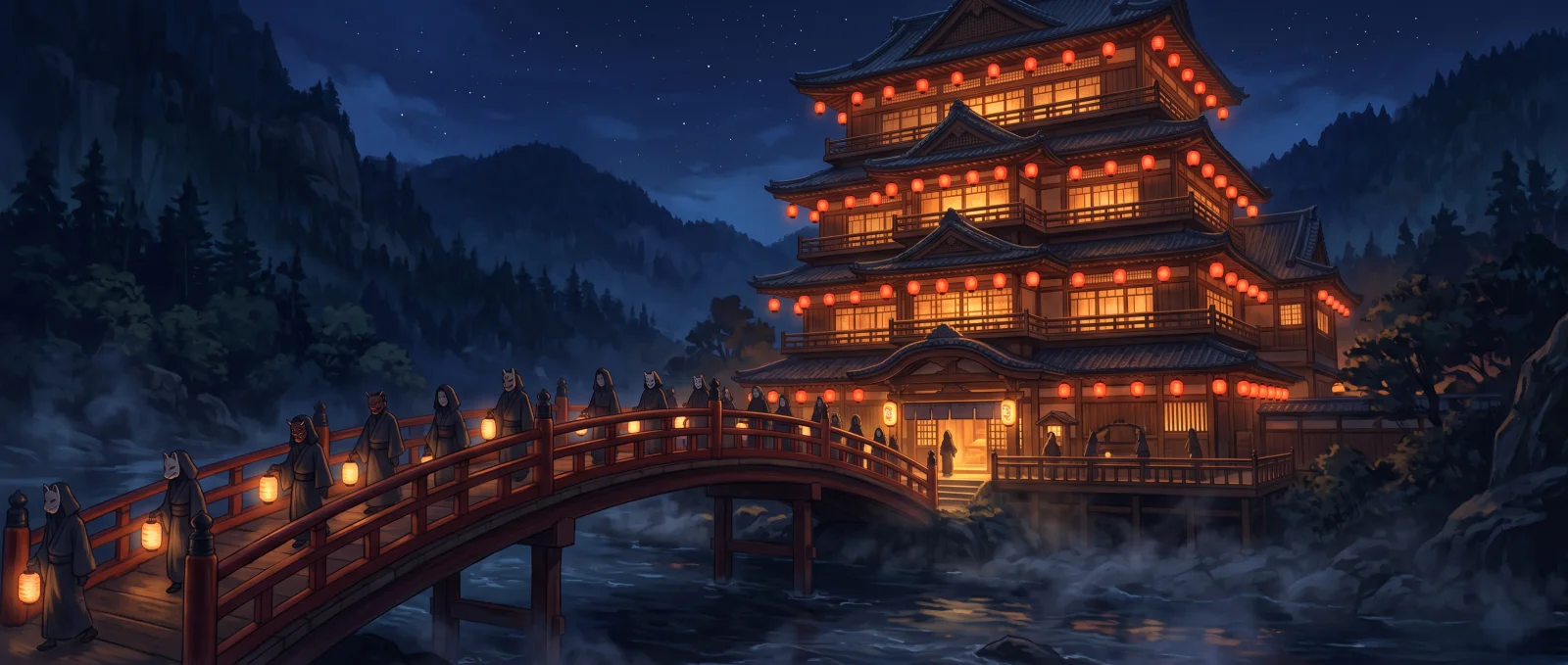
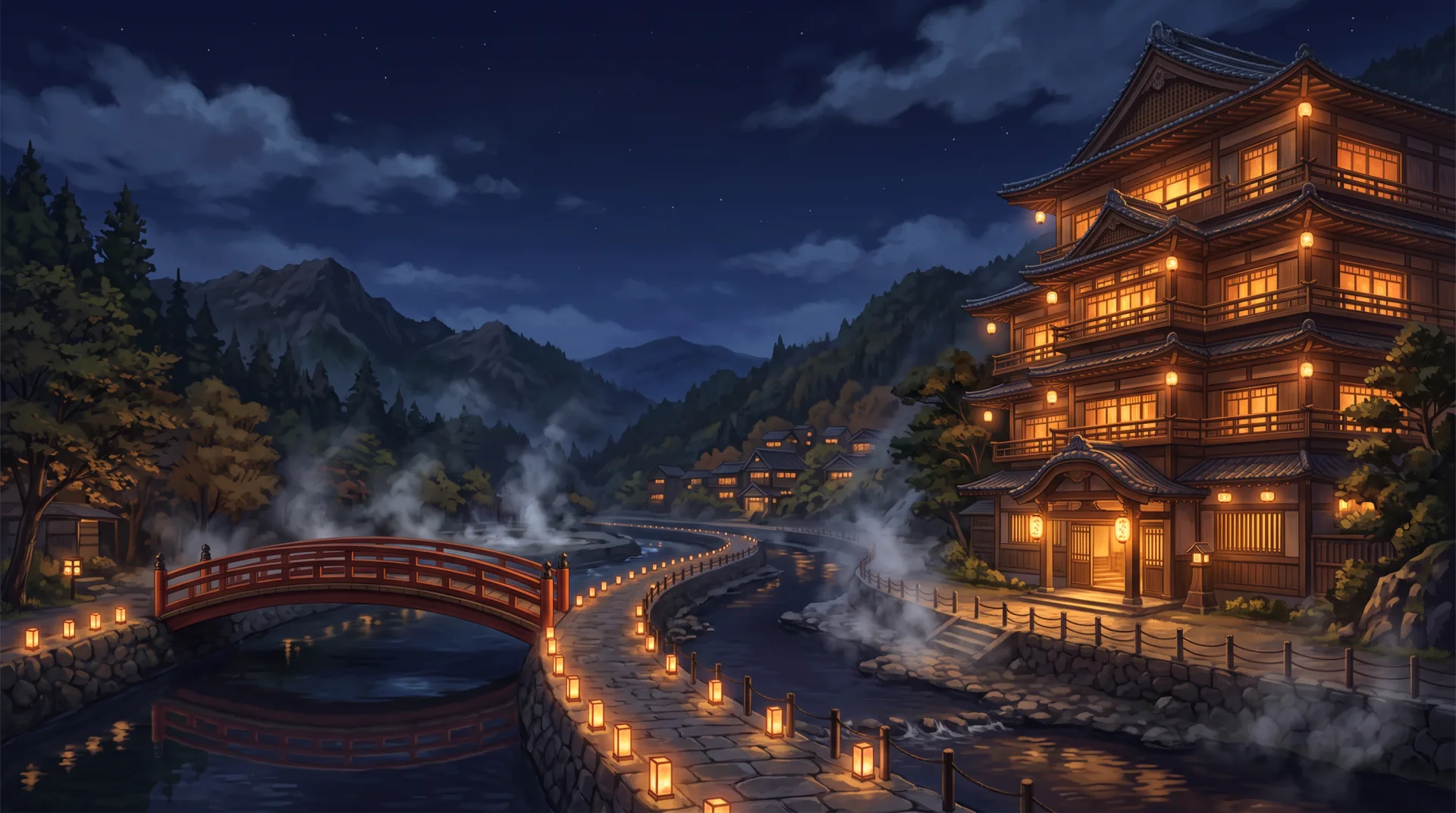
Aburaya is where the whole question starts. It is a wooden building of many storeys, red and gold and lit from inside, standing above a river and reached by a bridge, and it looks so much like a real Japanese onsen ryokan that people have been trying to find it ever since. Search for it and you will turn up at least seven inns, each introduced as the model, almost none of them by anyone who asked the studio. The ryokan themselves are usually more careful than the articles written about them.
Miyazaki has answered the question. His answer is a denial with exactly one exception.
Many different hot springs went into it. There is no one particular model, but Dogo Onsen is certainly in there.
色々な温泉が入っていて特定のモデルはないけれど、道後温泉は確かに入っている
Photo: Natasha Baucas, cropped (CC BY 2.0)
What the bathhouse in Spirited Away actually is
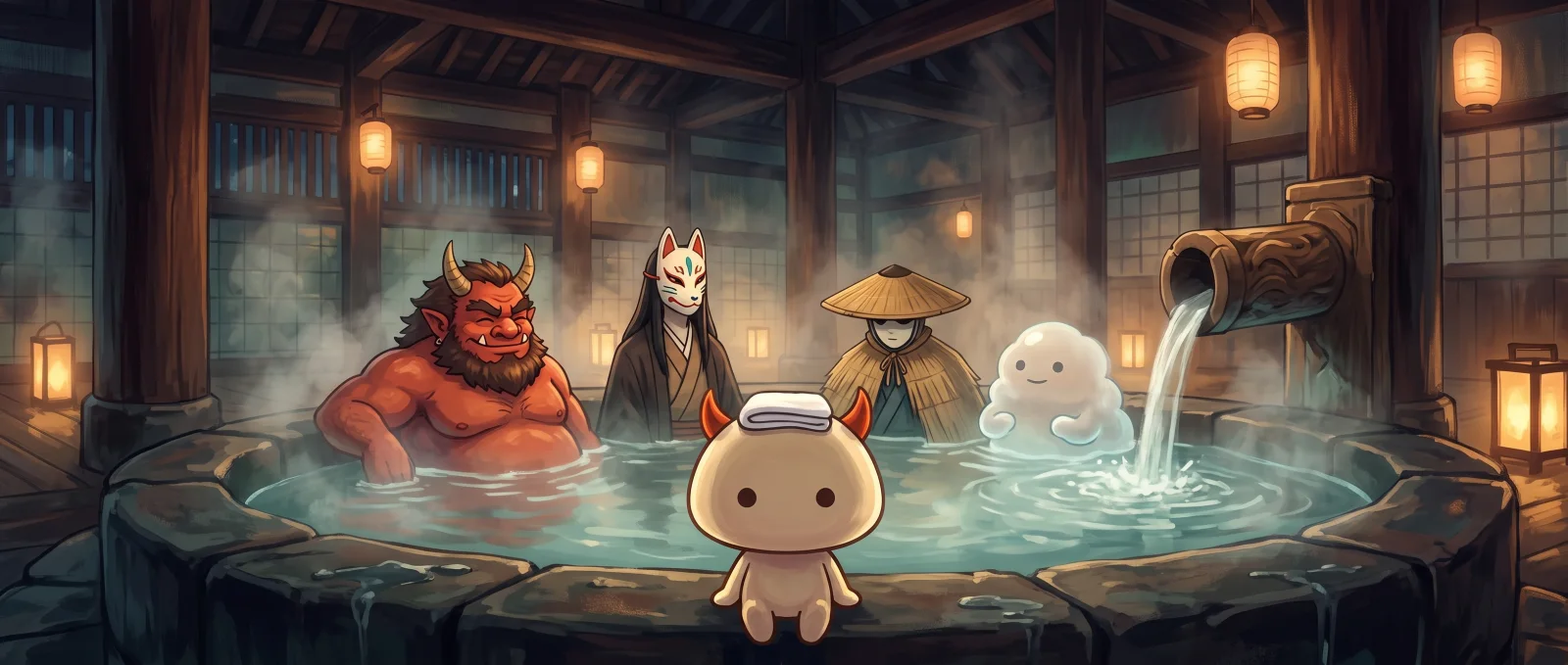
Aburaya is a yuya (湯屋), a bathhouse, and a very grand one: floors of guest rooms, a vast bath hall fed by a boiler room where Kamaji works a wall of herb drawers, and a clientele of gods who arrive by boat after dark, soak, eat, and are gone by morning. The name means oil shop, which is an ordinary old Japanese shop name and not an invention.
The premise is less made up than it looks. Japanese hot springs were places of cleansing long before they were places of leisure: washing to purify yourself before approaching a shrine (misogi, 禊), and long stays at an onsen to mend an illness or an injury (toji, 湯治). Gods coming to a bath to be washed is a very old idea in Japan, not a Ghibli one. Miyazaki has said the bathhouse drew partly on the kagura rites of Nagano and Shizuoka, where water is boiled in a great cauldron and flung over the crowd on behalf of the gods.
The river spirit is the clearest case. What drags itself into Aburaya as a reeking, nameless thing turns out to be a river god packed solid with the rubbish thrown into him, and the bath cleans him, and he leaves laughing. A hot spring that can wash something that filthy and send it out clean is exactly what an onsen in Japan has always claimed to do.
The four places the film really used
Four places have a link to Spirited Away you can actually trace. Only one is an onsen people make pilgrimages to. Another is a pair of hot spring ryokan that nobody puts on the list at all.
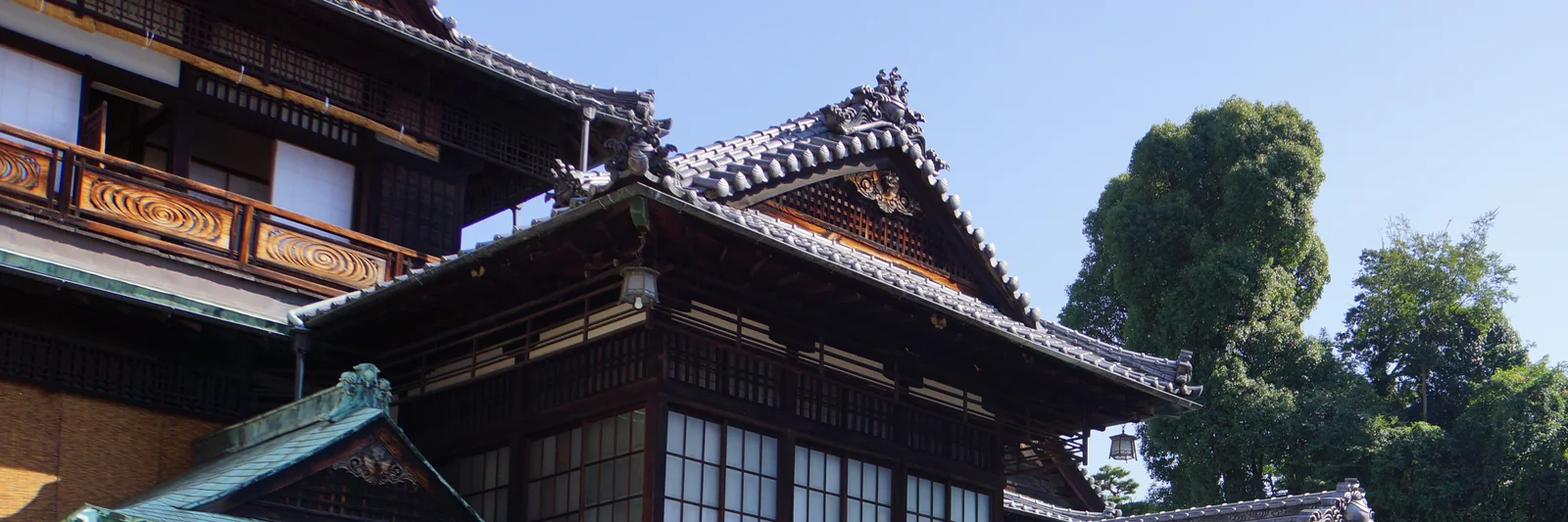
Dogo Onsen Honkan, Ehime: the exterior
The one Miyazaki names. Art director Yoji Takeshige saw it on a studio trip and drew on it for the outside of the bathhouse, the heavy stacked roofs and the little tower on top. Dogo is also among the oldest hot springs in Japan, it is an Important Cultural Property, and it came out of a long restoration in 2024. It is a public bathhouse, so unlike most places on this page, anyone can walk in and bathe.
Photo: lienyuan lee, cropped (CC BY 3.0)
Dogo Onsen Main Building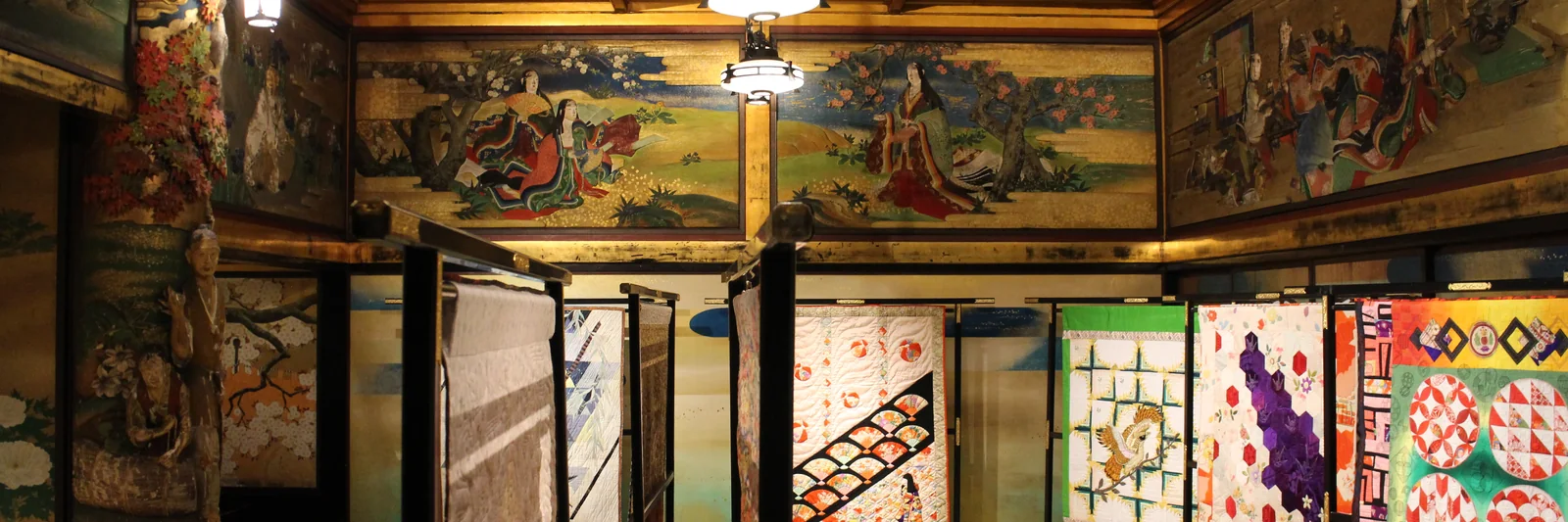
Meguro Gajoen, Tokyo: the interior
Nobody heading for Gunma or Nagano expects this one. The inside of the bathhouse, the gold and lacquer excess of Yubaba's floor, comes from a Tokyo banquet hall: the Hyakudan Kaidan, a wooden hundred-step staircase lined with painted rooms, finished in 1935 and now a Tokyo cultural property. It is not an onsen and it never was.
Photo: Suicasmo, cropped (CC BY-SA 4.0)
Official site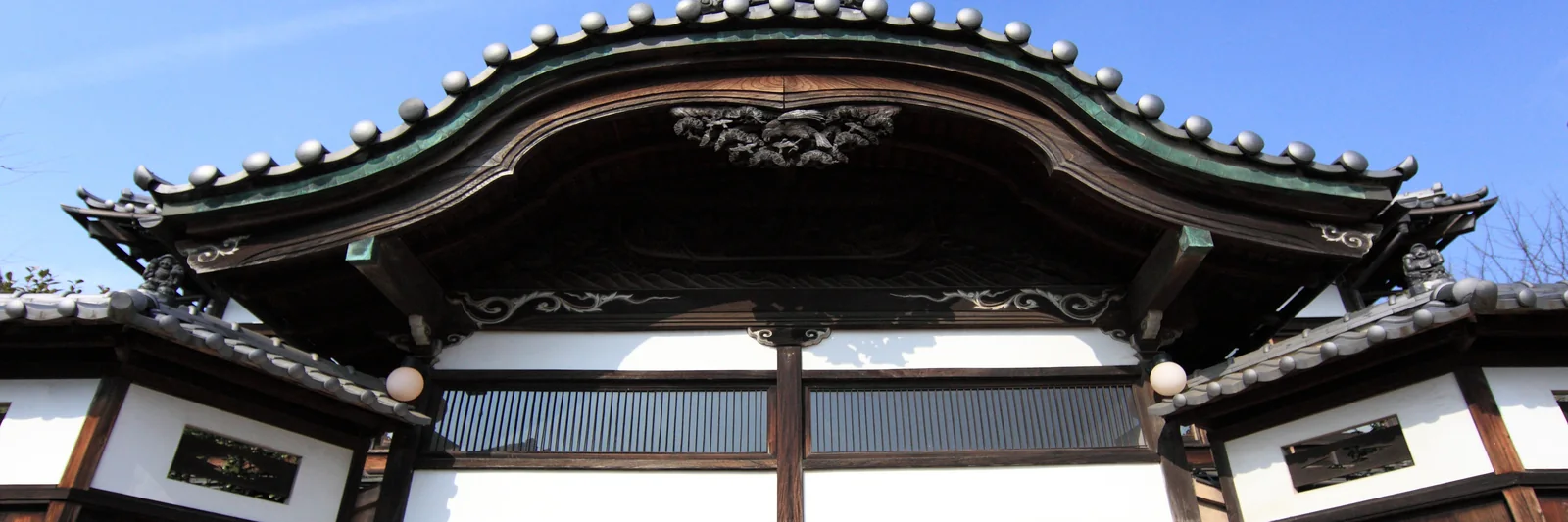
Edo-Tokyo Open Air Architectural Museum, Koganei
The one Studio Ghibli itself points at. It is a park of rescued buildings a few minutes from the studio, and Miyazaki drew its mascot. Kodakara-yu, a 1929 bathhouse with a temple-style front, stands behind the bathhouse entrance; the wall of small drawers in Takei Shosendo, a stationer's shop, stands behind Kamaji's boiler room; Kagiya, a tavern, stands behind the street where Chihiro's parents stop to eat.
Photo: TANAKA Juuyoh, cropped (CC BY 2.0)
Official site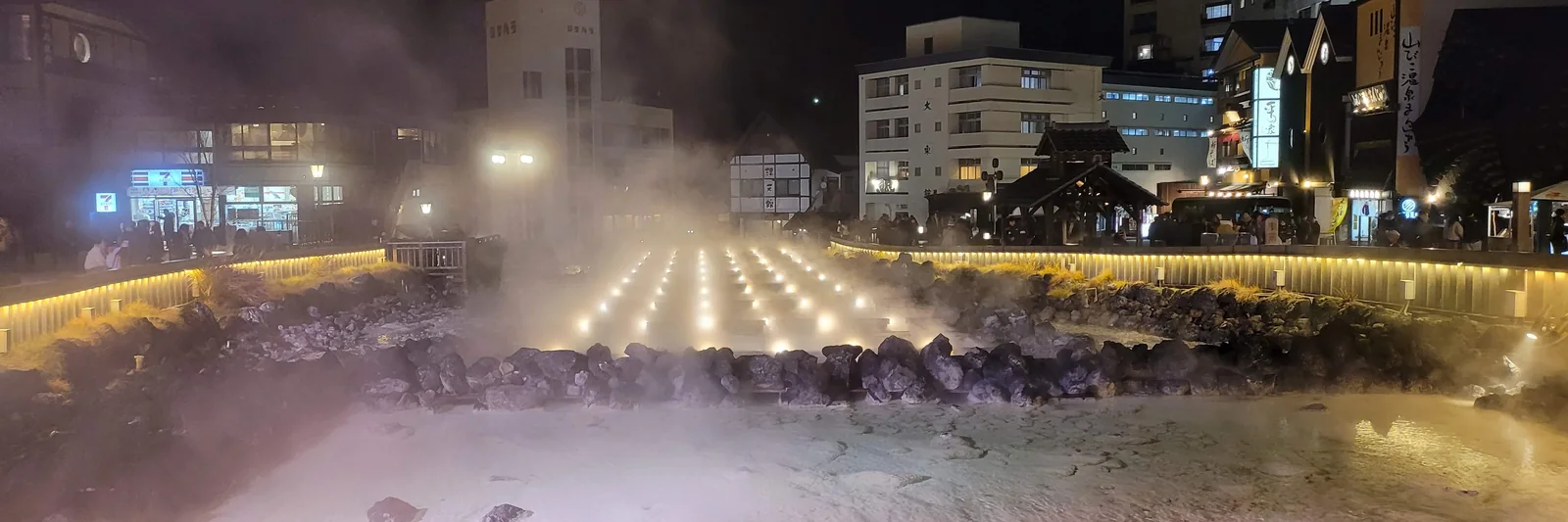
Kusatsu Onsen, Gunma: the sound
This is the part almost nobody writes down. Two Kusatsu ryokan appear in the end credits of Spirited Away under recording cooperation, because the water you hear in the bathhouse was recorded in their baths. They are the only onsen whose names are actually in the film, and they turn up on no pilgrimage list anywhere.
Photo: Aspere, cropped (CC0)
Kusatsu Onsen on Onsen OniFor the bathhouse where Chihiro ends up working, we drew on Meguro Gajoen as well.
千尋が働くことになる湯屋は目黒雅叙園も参考にしています
Photo: Natasha Baucas, cropped (CC BY 2.0)
The two onsen ryokan whose water you can hear
The sound team went to Kusatsu and recorded the real thing rather than building it in a studio, which is why the bathhouse sounds like a hot spring and not like a swimming pool. Here is what the two of them are when nobody is recording.
Hotel Village is a large resort on the edge of town with three separate springs feeding two bathing buildings, one of them running on water piped from the Yubatake itself. Kiyoshigekan is the opposite: a small inn up a quiet backstreet on the hillside above the Yubatake, where the baths run kakenagashi (掛け流し) straight off the Bandaiko source, unheated and undiluted, and two of them are free to use any time with no reservation. Neither markets itself on the film.
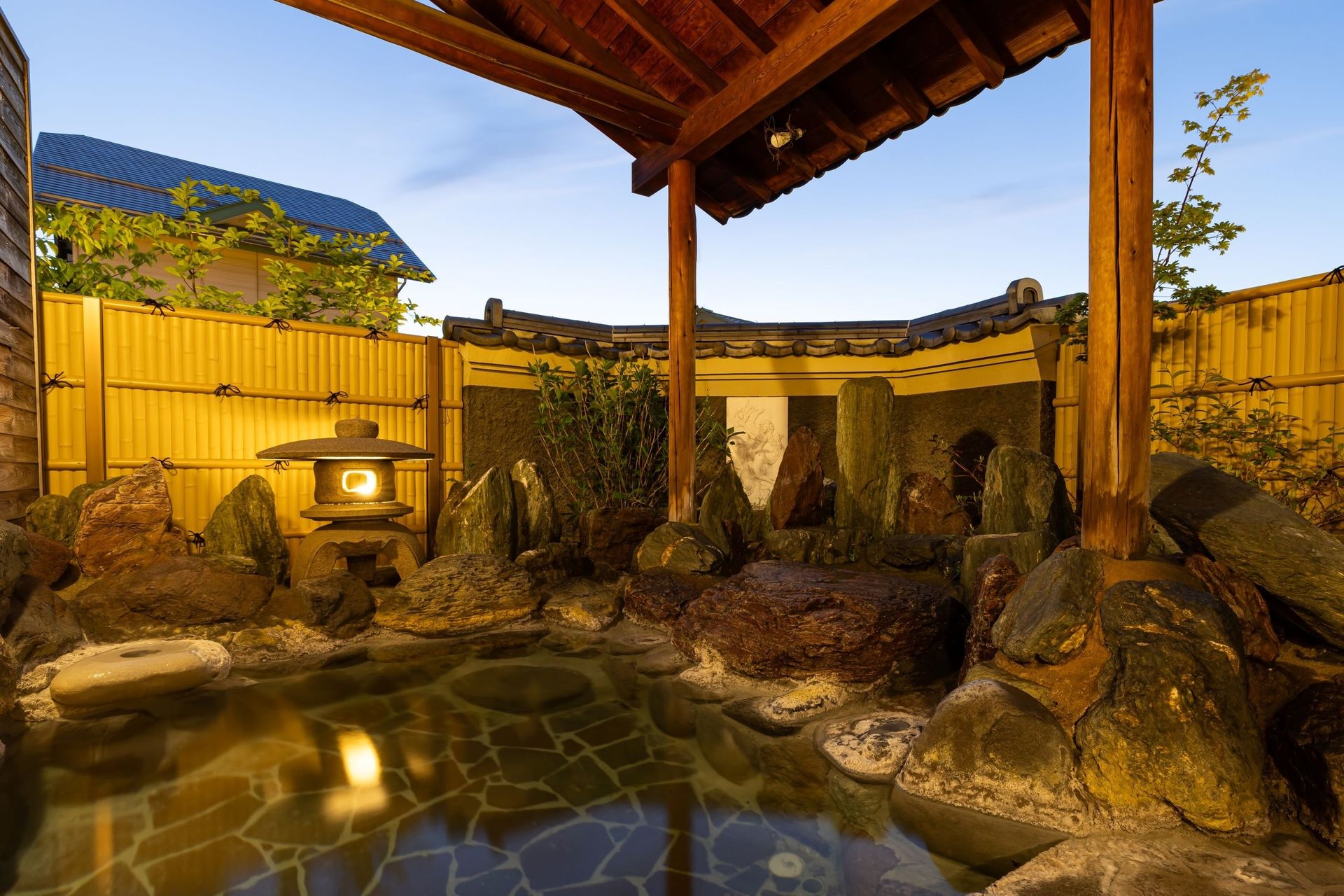
The shared bath is split by gender, indoor and outdoor, the outdoor side set with colorful stone. Water runs kakenagashi (掛け流し), straight from Kusatsu's Bandaiko (万代鉱) source, unheated and undiluted. Two more baths, an indoor one and an open-air one, are free to use any time, no reservation: if nobody's in, just lock the door behind you. There's also a foot bath out in the garden. Kiyoshigekan sits up a quiet backstreet on a hillside above Yubatake, about a ten-minute walk from the geyser field, with the mountain range along the prefectural border in view. The building is older and the inn is family-run, a room-only stay with no meals included.
The five ryokan called the Spirited Away onsen
Ordered by how much evidence sits behind them. Only the first is named by Miyazaki, and only the second has published an honest account of where its own story came from.
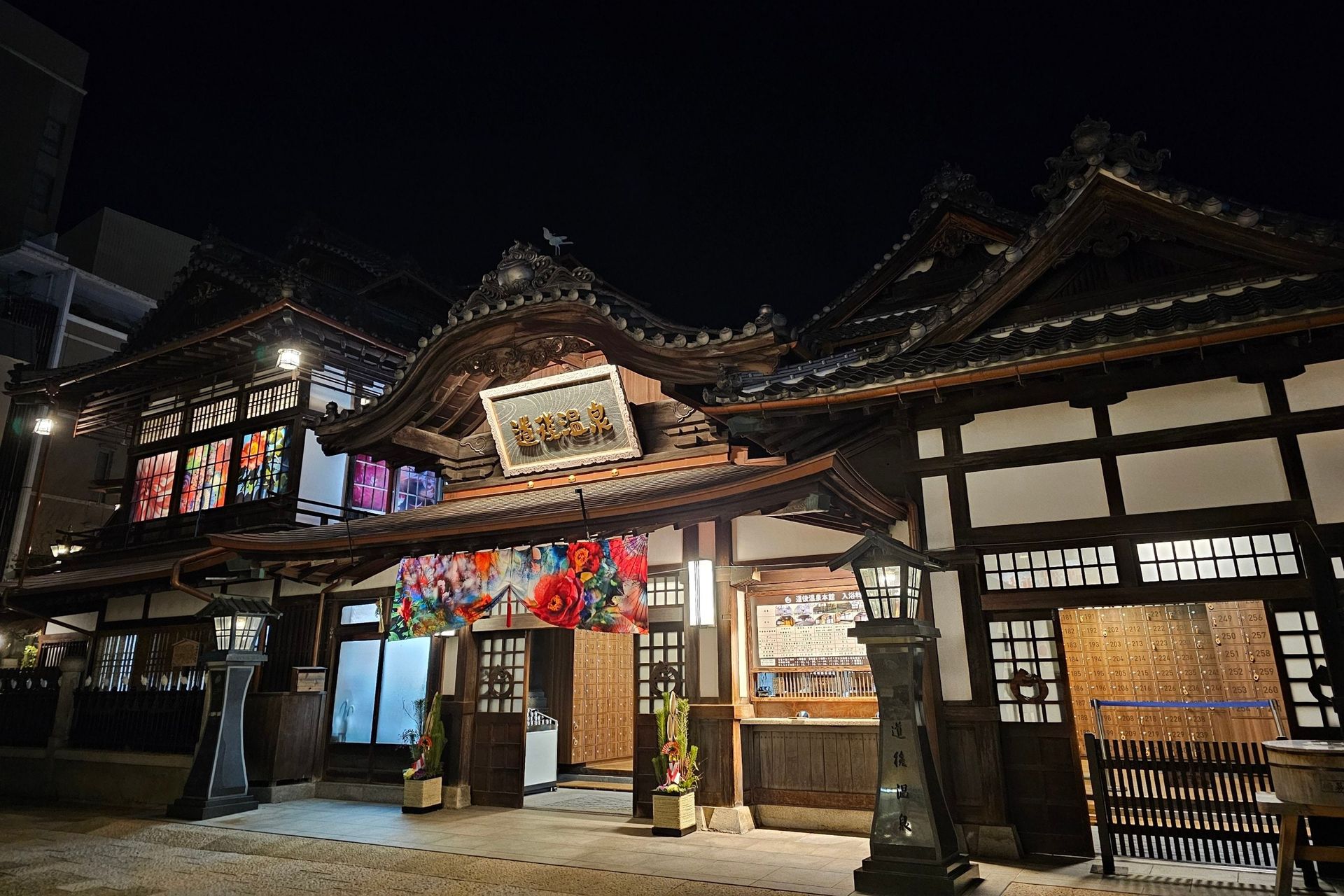

The grand wooden bathhouse at the heart of Dogo, one of Japan's oldest hot springs. Rebuilt in 1894, the castle-like three-storey building is a designated Important Cultural Property, crowned by the Shinrokaku (振鷺閣) drum tower with its red glass and a white heron (shirasagi, 白鷺) finial that recalls the spring's founding legend. Inside are the everyday Kami-no-Yu (神の湯), the quieter Tama-no-Yu (霊の湯), and the Yushinden (又新殿), the only imperial bathing suite in Japan (viewing only). The source water flows unheated and undiluted.
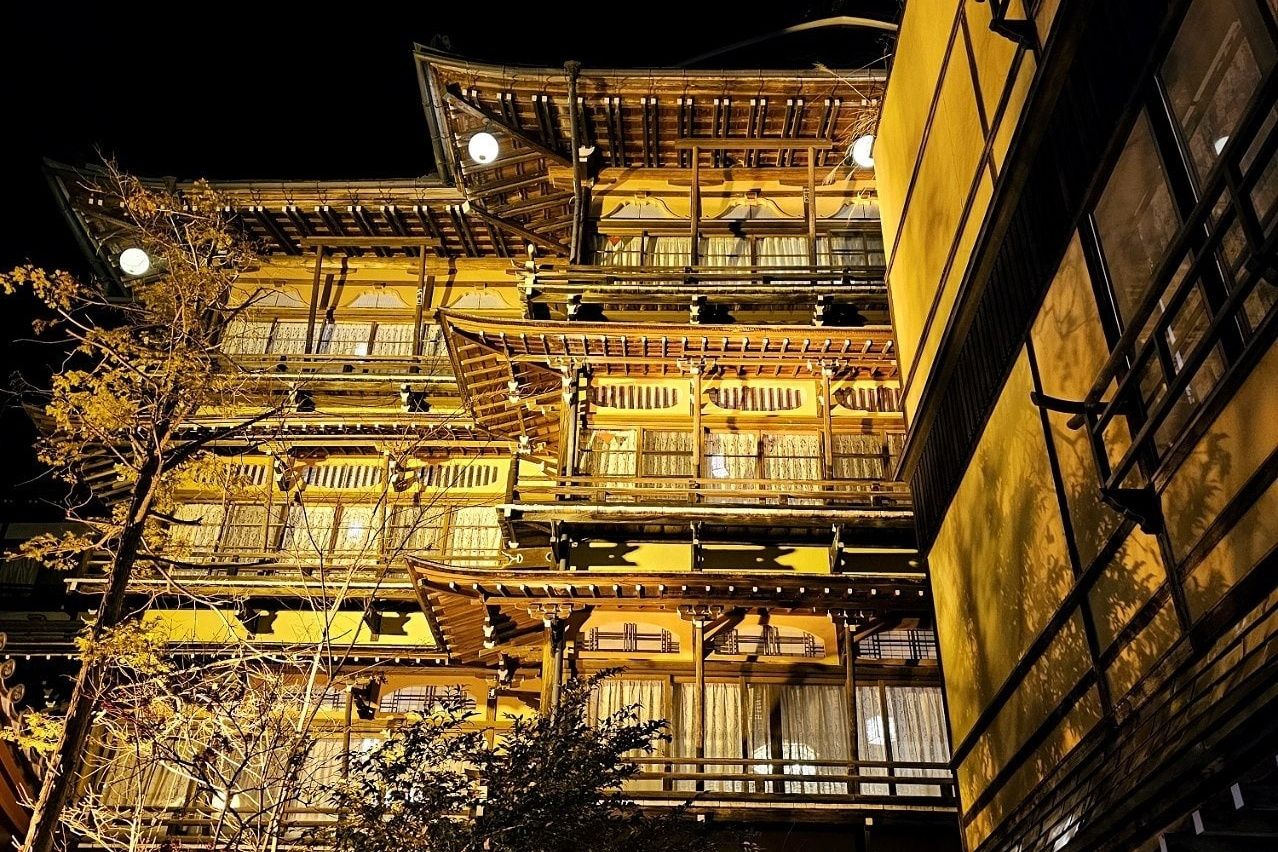

Eight baths, all fed from the inn's own four springs, with the water arriving unheated and undiluted from the spouts and even from the taps. Three are large baths, a men's and women's rotenburo and two indoor baths that swap by gender; the other five are private baths, free and needing no reservation. Among them are Gankutsu-no-yu (岩窟の湯), a cave bath, and Funaburo (舟風呂), a tiled tub genuinely shaped like a boat with Mount Fuji painted at one end. Kamakura-buro (鎌倉風呂), on the ground floor of the old tower, is built after Kamakura-period carpentry and carries white flakes of yunohana (湯の花); Roman-buro (浪漫風呂), the inn's first Western-style bath from 1950, has a fountain and arched stained-glass windows. The building is what people come for. Saigetsuro (斉月楼), a wooden four-storey tower finished in 1936, and the great hall beside it were registered as tangible cultural properties in 2003, and staying guests can join the inn's own walk through them in the early evening.
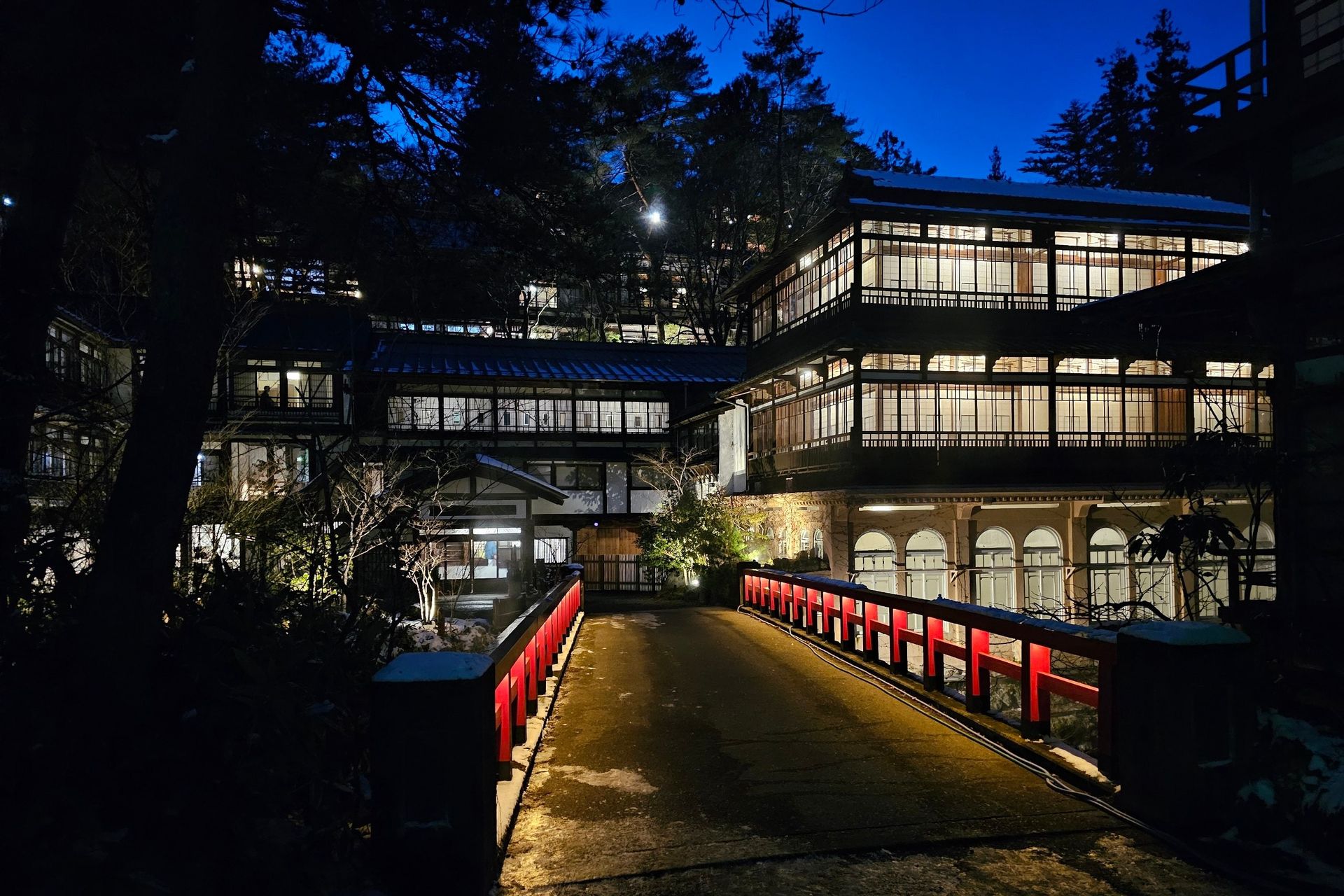

The main building here was constructed in 1694 and is designated an Important Cultural Property, making it the oldest surviving hot spring inn building in Japan. Miyazaki Hayao visited multiple times, and the place is widely cited as one of the inspirations for the bathhouse in Spirited Away. The water is a sodium-calcium chloride-sulfate spring flowing at 62.9°C from the source. The iwaburo (岩風呂, rock bath) serves as the mixed bath, though this has been suspended at times. The wooden corridors, red bridges, and riverside setting have a weight to them that photographs can't quite catch.
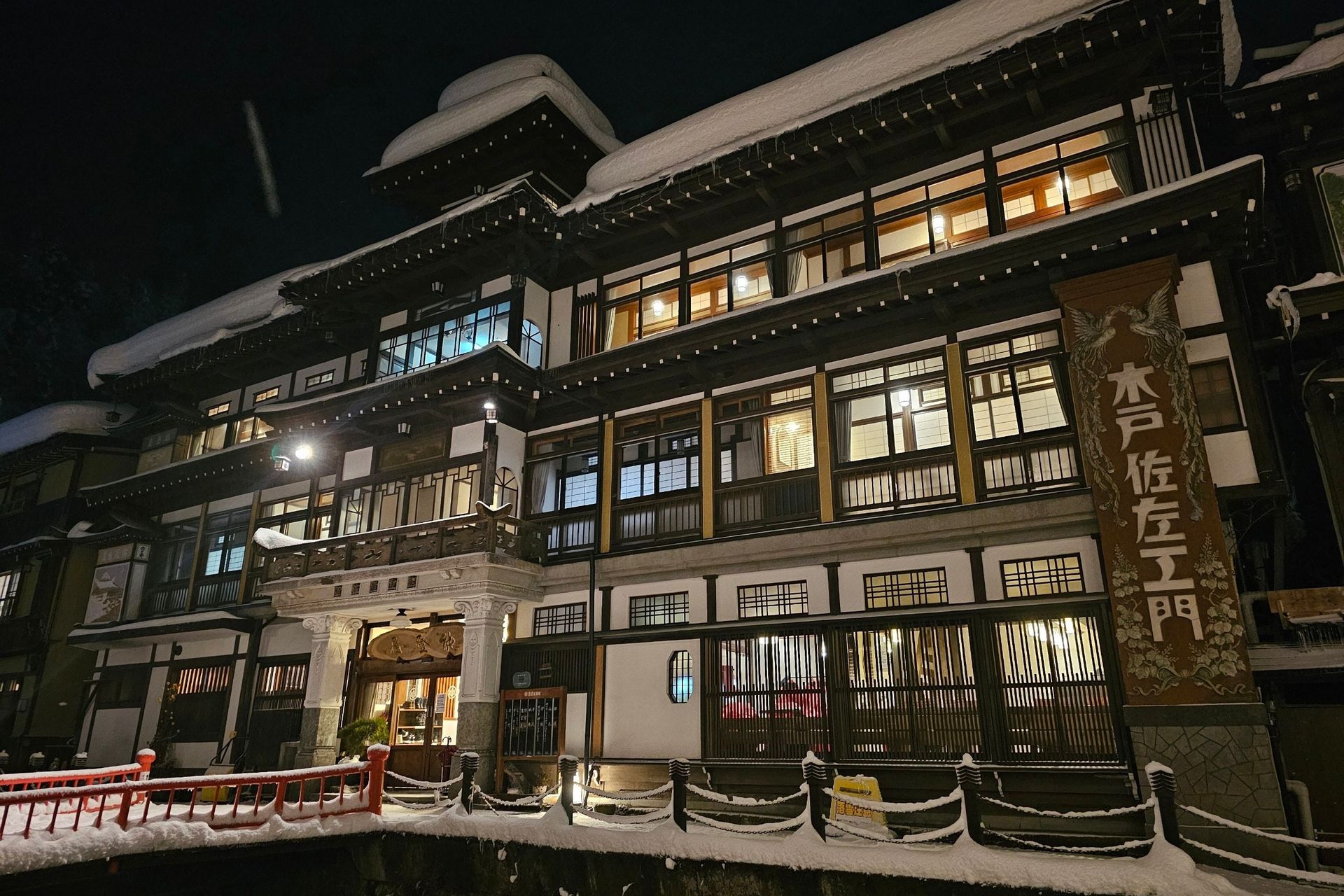

Notoya sits on Ginzan Onsen's small riverside street in a wooden main building completed in the Taisho era (1921), now a nationally registered tangible cultural property. The signature bath is the cave bath, dokutsu-buro (洞窟風呂): the inn's original spring source, used since it opened and today run as a private, reserved bath, with salty, sulfur-tinged water. There are also separate large indoor baths for men and women, each with its own attached outdoor bath. A hillside bath overlooking Shirogane Falls, Shirogane-no-taki (白銀の滝), sits up a long staircase; it closes through the winter, roughly December to April, when the snow shuts the path. Notoya belongs to the Nihon Hitou wo Mamoru Kai (日本秘湯を守る会), the association for Japan's secluded hot-spring inns, and its gaslit, Taisho-style facade is part of what gives Ginzan Onsen's riverside row its look after dark.
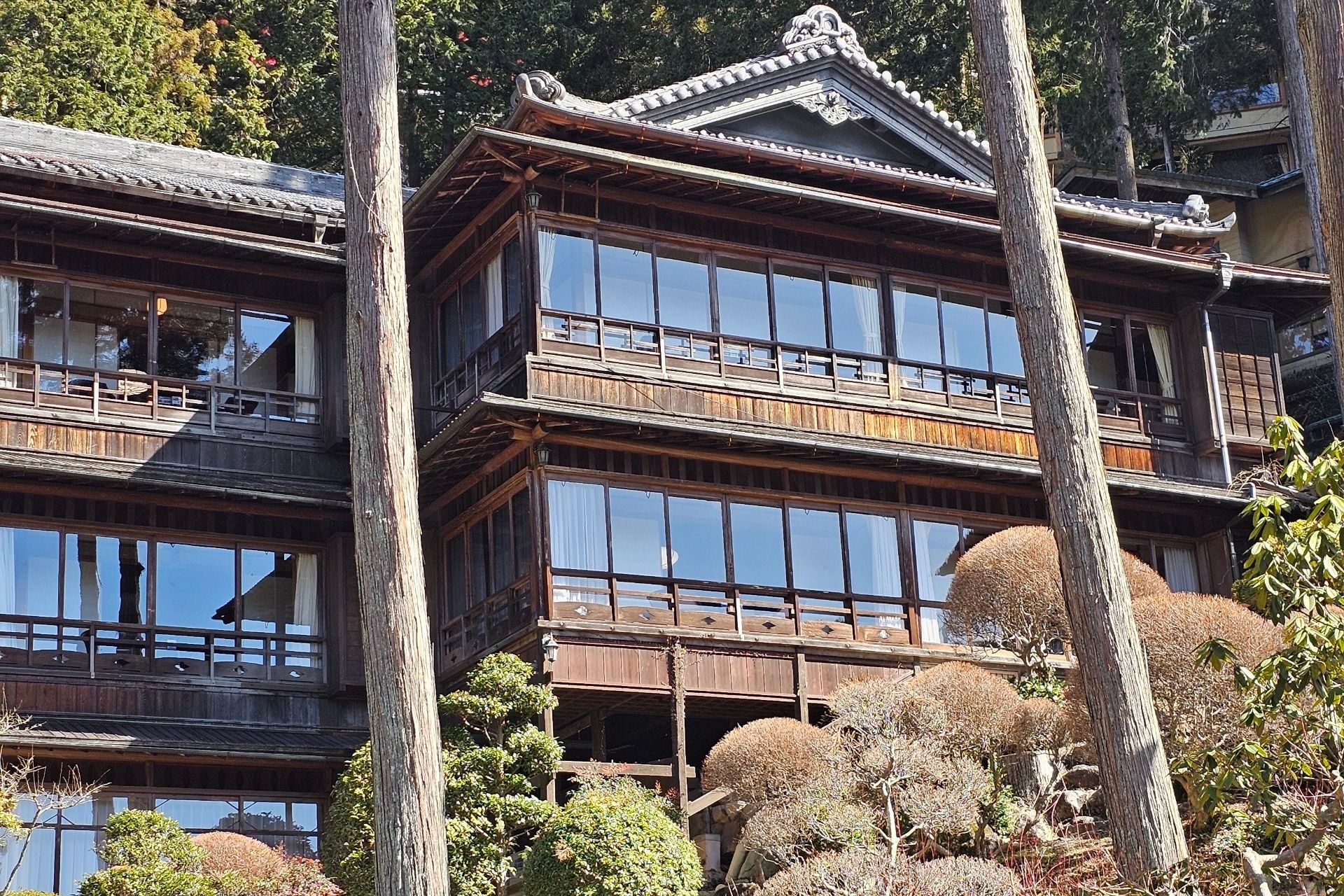

Yunoshimakan sits partway up the hillside above Gero, with two large view baths and an open-air bath looking out over the town and the Hida River. The water runs straight from the source into every bath here, from those main baths to four separate family baths and, in several room types, a private cypress tub or open-air bath, and it leaves the skin noticeably smooth. A foot bath along one of the indoor walking routes draws on the same water. The building dates to 1931, and part of the main wing, its entrance hall, connecting corridor and three-story wooden lodging block, was registered as a national tangible cultural property in 2010. The corridors climb the slope in a way guests often describe as maze-like, past a 1930s ballroom and sunroom in the annex, giving the whole place the feel of a prewar inn still standing above the modern hot-spring town.
Buildings like that were everywhere, once.
あのような建物はどこにでもあったのだ
Photo: Natasha Baucas, cropped (CC BY 2.0)
Why so many onsen ryokan look like the Spirited Away bathhouse
Kanaguya, the ryokan in Shibu Onsen named more often than any other, has published the most useful account of this, and it is a polite refusal. An animator on the film stayed there in 2018 and explained that Miyazaki had shown the team photographs of real buildings, Kanaguya among them, as a reference for the architectural style rather than as a model to copy.
The ryokan's own argument is better than the rumour it declines. Its 1936 tower, Saigetsuro, is gikoyofu (擬洋風建築): a Japanese carpentry tradition that borrowed Western forms, stacked storeys high and put the elaborate work where guests could see it. Japan built a great deal of it. The railways reached the hot spring valleys through the Meiji and Taisho years, the onsen towns filled with visitors who came for days at a time, and the inns grew upward in timber because timber was what the local carpenters knew.
Then it stopped. Postwar fire rules made tall wooden buildings hard to permit and harder to insure, the boom years paid for concrete, and an onsen ryokan that wanted more rooms put up a tower block instead. Most of these buildings burned, were pulled down, or were replaced by their own owners. The handful still standing are registered cultural properties precisely because they are the last of something.
So the bathhouse in Spirited Away does not look like any one onsen. It looks like an entire way of building that Japan gave up, and every surviving example resembles the film for the same reason. That is why the list of candidate ryokan keeps growing, and why each one is worth the trip whether or not anyone at Studio Ghibli ever looked at it.
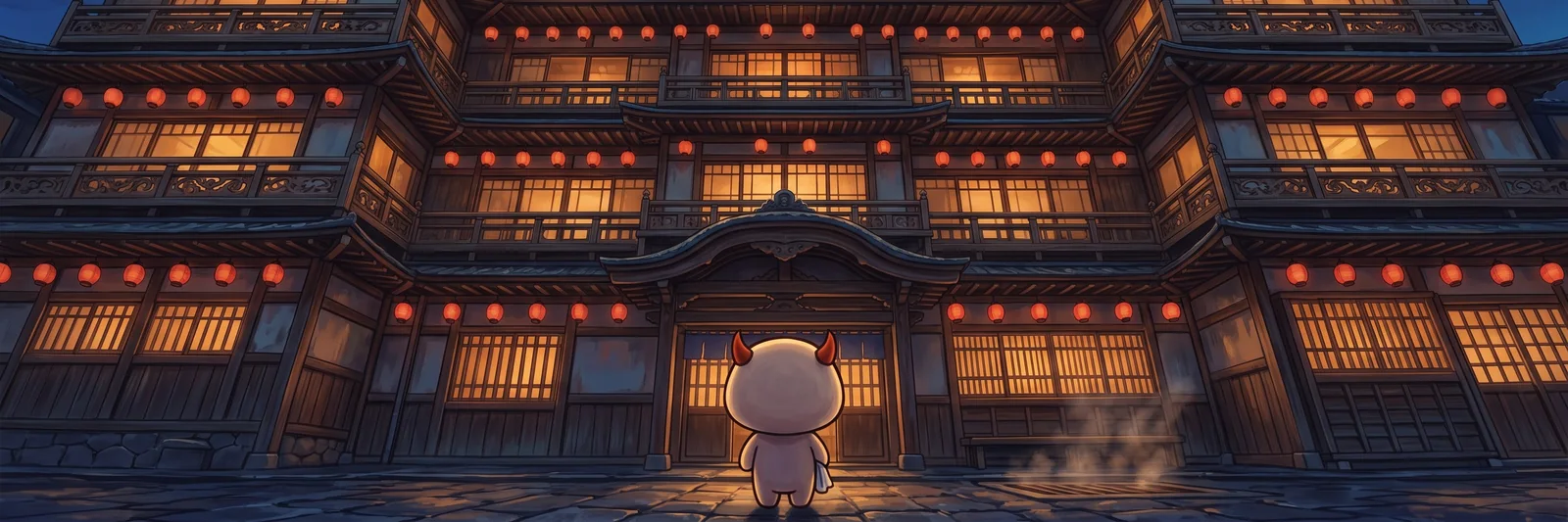
Other related ryokan
Four onsen ryokan that belong on this page for four different reasons.
Genroku Hatago Aburaya, Okayama
The name. This is a hot spring inn founded in 1688 that is actually called Aburaya, which is the name of the bathhouse in the film. Nobody arranged that: it sold lamp oil to travellers on the road, and that was an ordinary thing for an inn to be called. Its spring rises directly under the building.
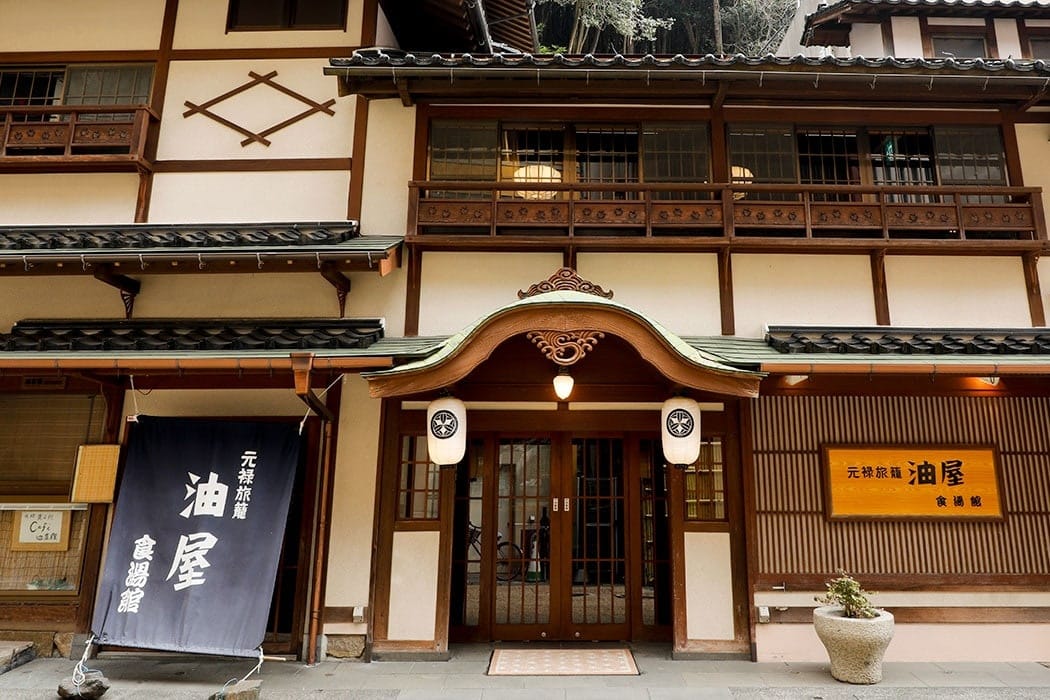
One of Yubara Onsen's three sources rises directly under the building, so the water reaches the baths about as fresh as it gets in this town, running through without heating or dilution and feeling noticeably soft on the skin. There is a large indoor bath, an open-air bath and a private bath, and every guest room has an onsen bath of its own. The inn was founded in 1688 and took its name from the lamp oil it once sold to travellers on the road. It stands on the Asahi River, a short walk from Yubara's open-air riverside bath, Sunayu (砂湯). The separate Shokuyukan (食湯館) building takes day visitors in for a bath, with a meal if you want one.
Yunushi Ichijo, Miyagi
The architecture. A wooden onsen ryokan built through the Taisho and early Showa years, the same period and much the same carpentry as Kanaguya's tower, in a quiet cave-spring hot spring almost nobody has heard of. If you want the building without the pilgrimage, this is the closest thing on the page.
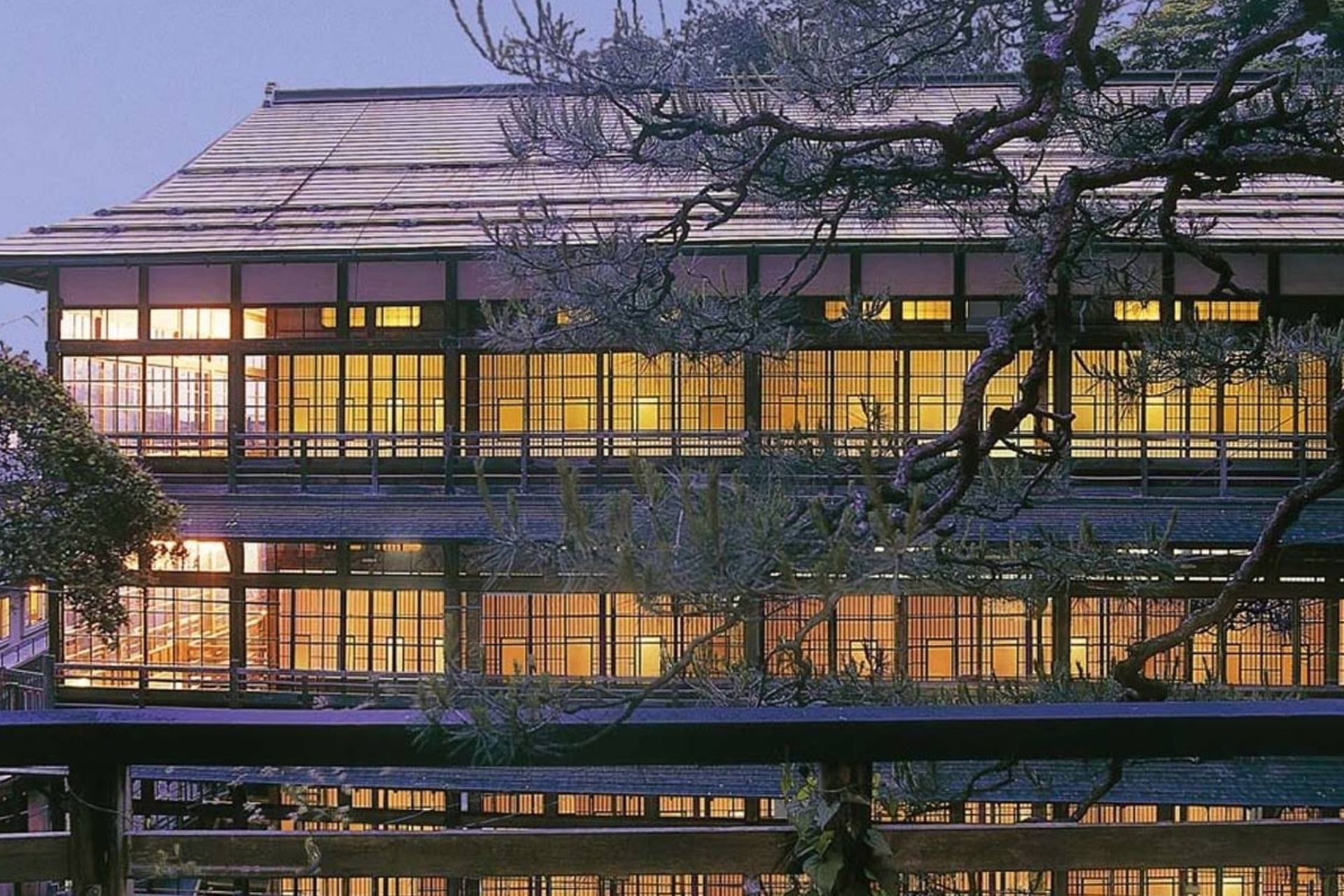
The baths here draw from a natural cave spring (Dokutsu-no-yu, 洞窟の湯), and the water comes out clear and noticeably smooth on the skin. There is a communal indoor bath, an outdoor bath with a forest view, and a private kashikiri (貸切) bath that also uses the cave-spring water, available for lodging guests. Select suites have their own rotenburo. The main building dates from the Taisho and early Showa periods, and the atmosphere inside reflects that age. No day use; overnight stays only.
Asaya, Tochigi
Not the architecture, and worth saying plainly. It is a 192-room hotel-ryokan in Kinugawa and looks nothing like a wooden tower. It is here for the bath on its roof, the highest in Kinugawa Onsen, and because it is the one place in this list you can usually book at short notice.
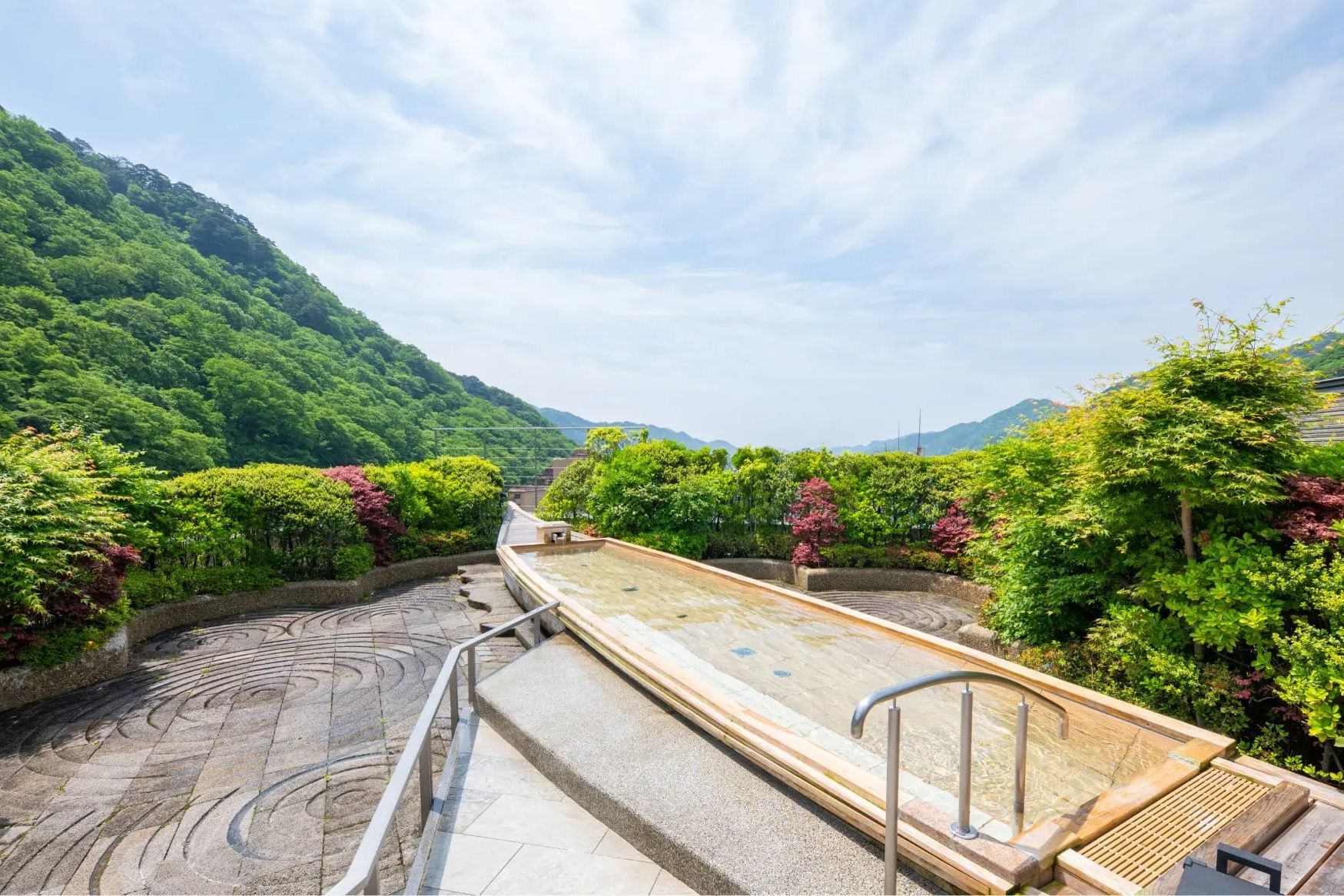

Asaya is a large hotel-style ryokan split across two wings, Shuhoukan and Hachibankan, with 192 rooms, every one plumbed with the hotel's own onsen water and some opening onto their own kakenagashi view bath or an attached outdoor tub. The showpiece is the rooftop sky garden bath at the top of Shuhoukan, the highest bath in Kinugawa Onsen, laid out as several small tubs, among them a standing bath honoring a dragon guardian of a nearby gorge and a boat-shaped tub, funayu (舟湯), modeled on the boats used for the river's line-boat rides. Each wing also has its own large indoor bath with a loyly steam sauna and a nano-mist sauna, plus four small reservable private baths in granite, rock, hinoki and red granite tubs, themed around a lucky mallet said to grant wishes. The water is an alkaline hot spring from Asaya's own source, drawn from a stretch of the Kinugawa valley long said locally to be good for healing burns and cuts. Inside, the hotel opens into a tall atrium of chandeliers and glass elevators with a pipe organ playing in the lobby, more grand hotel than quiet mountain inn.
Kosekiya Annex, Yamagata
The architecture and the street. An old wooden inn standing on Ginzan's row a few doors from Notoya, so you get the same gas-lit frontage that put Ginzan on every list. It is also the room you can often still get when Notoya is full.
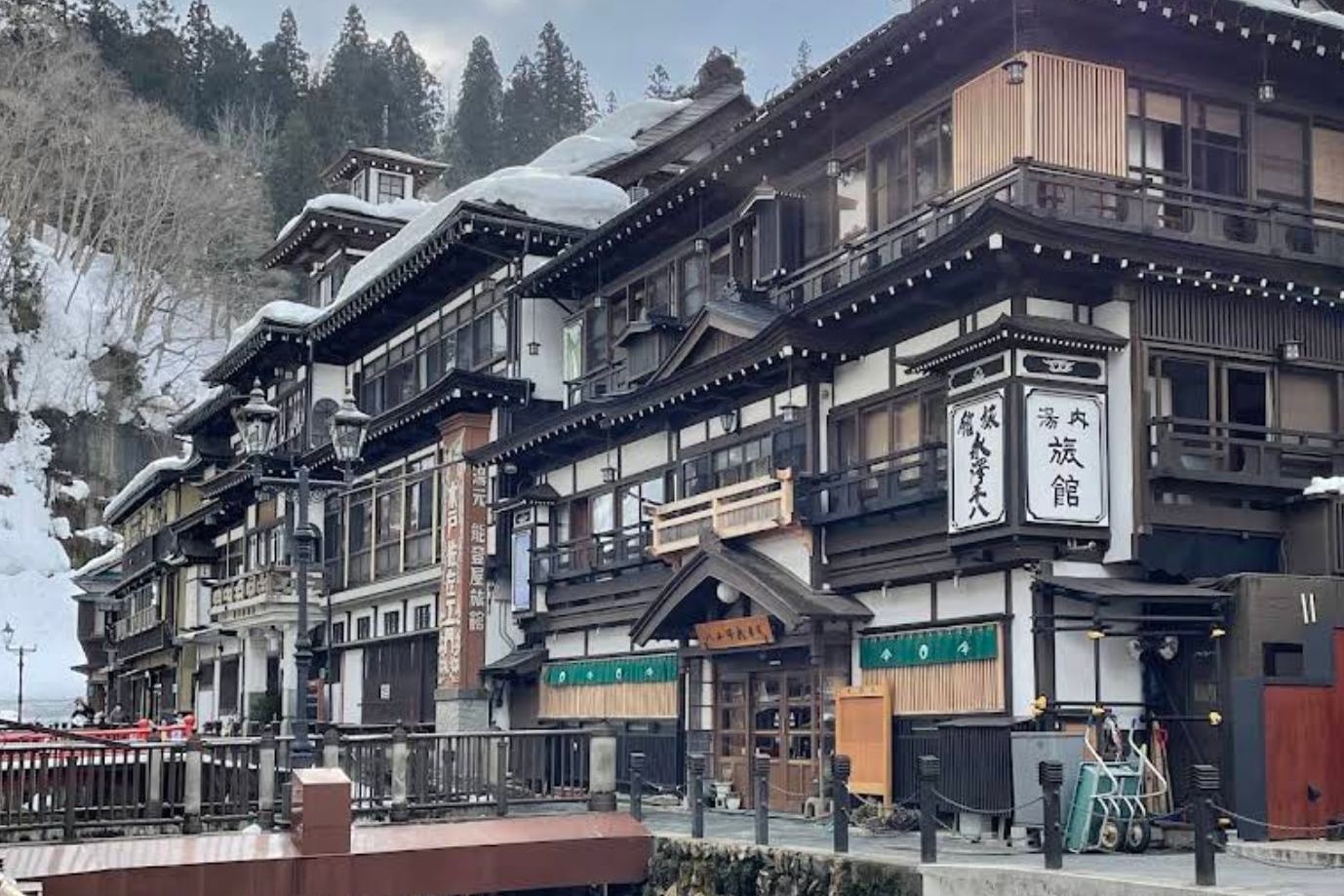
Kosekiya Annex has two indoor baths, Hokkori no Chika-yu and Nukkuri no Kintaro-yu, small rooms with an old-fashioned feel where the men's and women's sides swap through the day. The water comes straight from the spring and stays fresh, the kind that warms you through even after you've stepped out. There's no outdoor bath at the annex itself, but guests can use the rotenburo at the sister property Ginzanso for free, and a foot bath sits on the bridge by the entrance. The ryokan is an old wooden building on Ginzan Onsen's Taisho-era street, where gas lamps come on after dark and the river runs below. Rooms are simple, meals and the river view are part of the draw, and the retro streetscape is what most guests remember.
Two misconceptions
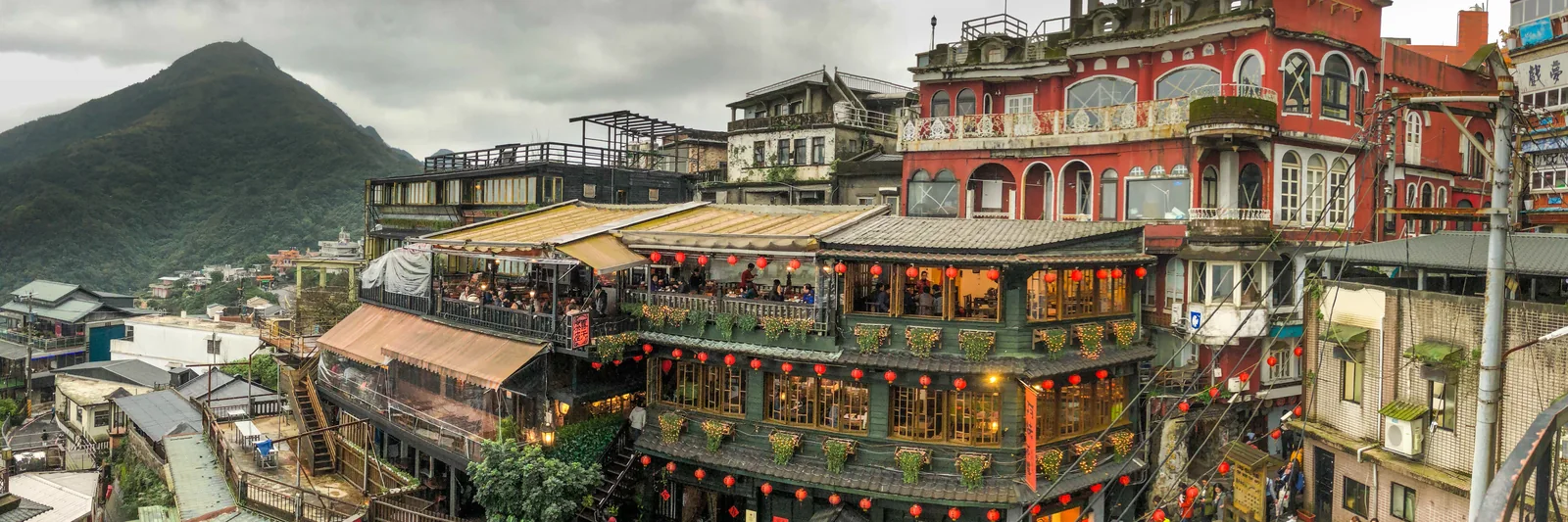
Jiufen, Taiwan
The lantern-hung hillside town in northern Taiwan is the most repeated claim about Spirited Away, and Miyazaki has denied it. Studio Ghibli has never listed it. It is a beautiful place and it is not in the film.
What Ginzan Onsen is really famous for
Ginzan was a destination long before 2001, for something else entirely: NHK's morning drama Oshin, broadcast in 1983 to an average audience share of 52.6 percent. That is what filled the street and made the name known across Asia. Spirited Away arrived eighteen years later, at a hot spring town that was already busy.
The crowds are why that street now has a gate on it. For 79 days, from 20 December 2025 to 1 March 2026, day visitors leave the car at Taisho Roman-kan and ride a shuttle in, entry is ticketed, and the evening lighting is by reservation. Worth knowing before you book a February trip on the strength of a film that was never shot there. And the buildings along it are working onsen ryokan with people asleep inside, so photograph the street rather than the guests.
Common questions
Is there a real Spirited Away bathhouse you can visit?
No single building is the bathhouse. Miyazaki has said there is no one model, and Studio Ghibli has never named a ryokan. The closest thing is Dogo Onsen Honkan in Ehime, which Miyazaki says is certainly in the design. It is a public bathhouse, so anyone can walk in and bathe.
Which onsen did Miyazaki actually name?
Dogo Onsen, in Matsuyama, Ehime. His words are that many hot springs went into the bathhouse and there is no one particular model, but Dogo is certainly in there. He has also said the interior drew on Meguro Gajoen in Tokyo, which is a banquet hall and not an onsen.
Can you stay at the ryokan people call the Spirited Away inn?
Yes. Kanaguya in Shibu Onsen, Sekizenkan in Shima Onsen, Notoya in Ginzan Onsen and Yunoshimakan in Gero Onsen all take overnight guests, and the buildings themselves are the reason to go. Day-use bathing is limited or unavailable at several of them, and the historic wings are usually open to staying guests only.
Is Jiufen in Taiwan the model for Spirited Away?
No. Miyazaki has denied it and Studio Ghibli has never listed it. It is the most repeated claim about the film and there is nothing behind it.
Which onsen are actually in the film?
Two, by name. Kusatsu Onsen Hotel Village and Kiyoshigekan appear in the end credits of Spirited Away under recording cooperation, because the sound of the water in the bathhouse scenes was recorded in their baths.
Go and find your own
Shibu, Shima, Ginzan, Gero, Dogo, Kusatsu and Yubara are all onsen areas in our catalog, with every hot spring ryokan in them on the map.
Browse onsen areasSources
- Studio Ghibli, Spirited Away (official work page, Japanese)official
- Kanaguya, 「千と千尋と金具屋たてもの論」 (the ryokan's own essay on the rumour, Japanese)official— The 2018 animator account, and the inn's own position that it was a style reference and not a model.
- Edo-Tokyo Open Air Architectural Museum, the buildings Ghibli referenced
- Ginzan Onsen, winter access and entry control 2025-2026 (Japanese)official— Park-and-ride, ticketed day entry and reserved evening lighting.
- Dogo Onsen Honkan (official, Japanese)official
- ciatr, 『千と千尋の神隠し』のモデルはどこ? (Japanese)— Collects the Miyazaki and art-director statements about which places went into the design.
- THE GATE, 『千と千尋の神隠し』聖地17選 (Japanese)