
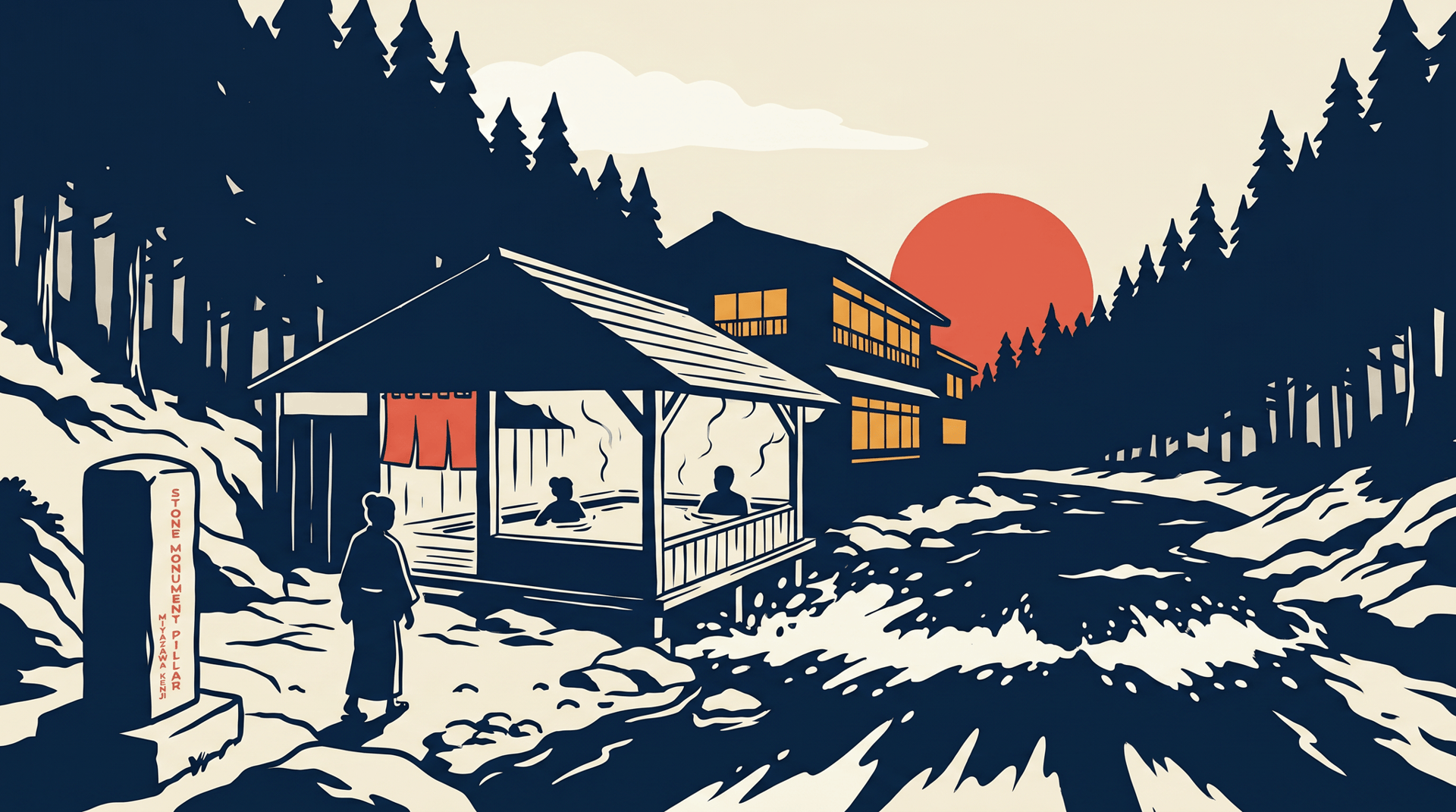

Hanamaki Onsen-kyo
花巻温泉郷Iwate onsen group along the Toyosawa River, famously associated with the poet Miyazawa Kenji. Twelve onsen districts within a few kilometers.
Old bath valleys, one young resort
Hanamaki Onsen-kyo is less a single resort than a long thread of bathing hamlets along the upper Toyosawa and Dai rivers, on the western edge of Hanamaki city in Iwate. The older settlements, Osawa, Dai, Namari, Shidotaira, Watari, all trace their lineages to the Heian or early Edo period. Osawa Onsen is the deepest of these, with a founding legend that attributes its discovery to the general Sakanoue no Tamuramaro during the eastern campaigns of the early ninth century; the wooden self-catering wing Tojiya, still in use, was built more than two hundred years ago, and the open mixed bath of Osawa-no-yu sits directly on the Toyosawa.
The youngest member of the family is the Hanamaki Onsen resort proper, opened in 1923 by the Morioka entrepreneur Kindaichi Kunishi, who piped water down from Dai Onsen and set out to build "the Takarazuka of Tohoku", complete with hotels, a zoo, tennis courts and one of Japan's first night-lit ski runs. Hanamaki was also the home of the poet and children's-story writer Miyazawa Kenji (1896 to 1933), who knew several of the older baths intimately and was brought to Osawa as a child by his devout father for Buddhist study sessions.
Wood, tatami, rose garden
The character of the area splits cleanly. Up the valley, Osawa and Dai preserve the wooden inn culture of the Tohoku toji tradition, long-stay therapeutic bathing in self-catering wings, communal kitchens, thin futons, deep pH-9 alkaline water that turns the skin smooth. Namari is famous for Shirosaru-no-yu, a standing rock bath cut into the river floor and said to be the deepest self-flowing natural bath in Japan. The 1923 resort closer to the plain is a different register: four large hotels clustered around a five-thousand-tsubo rose garden of some 450 varieties that opened in 1960 on the site of a south-facing flowerbed Kenji himself had designed.
The climate is inland and cool. Winters bring heavy snow into the valley and the mountains stay white well into spring.
Iihatobu, around the corner
Hanamaki city is the literary heart of Kenji's imagined Iihatobu. The Miyazawa Kenji Memorial Museum sits on a hill above the town, and the nearby Ihatov-kan and the poet's old school grounds round out the pilgrimage. South across the hills lies Tono, the folktale country recorded by Yanagita Kunio in Tono Monogatari, an easy detour for anyone already drawn this far into rural Iwate.
Districts
5 sub-areas within Hanamaki Onsen-kyoPlaces in this area
13 places · Sorted by ratingOn the map
Loading map…
Nearby onsenchi
Within 50 kmSources
- Hanamaki Onsen (official)official— Operator of the four flagship hotels on the 1923 resort grounds and of the rose garden where Miyazawa Kenji's south-facing flowerbed once stood.
- Hanamaki Tourism Association, the 12 baths of Hanamakiofficial— Umbrella reference for the twelve constituent springs (Hanamaki 12-yu), with water type and pH for each.
- Osawa Onsen, official history pageofficial— Source for the 1,200-year founding legend, the Edo-era Nanbu patronage, and the Miyazawa Kenji and Takamura Kotaro episodes.
- Wikipedia, Hanamaki Onsen (Japanese)— Backs the 1923 founding by Kindaichi Kunishi, the "Takarazuka of Tohoku" ambition, and the 1960 rose garden built on Kenji's flowerbed site.
- Nippon.com, From one hot spring to another in Iwate— Editorial cross-reference for the Toyosawa river bath culture and the Miyazawa Kenji landscape.