
Ashinomaki Onsen
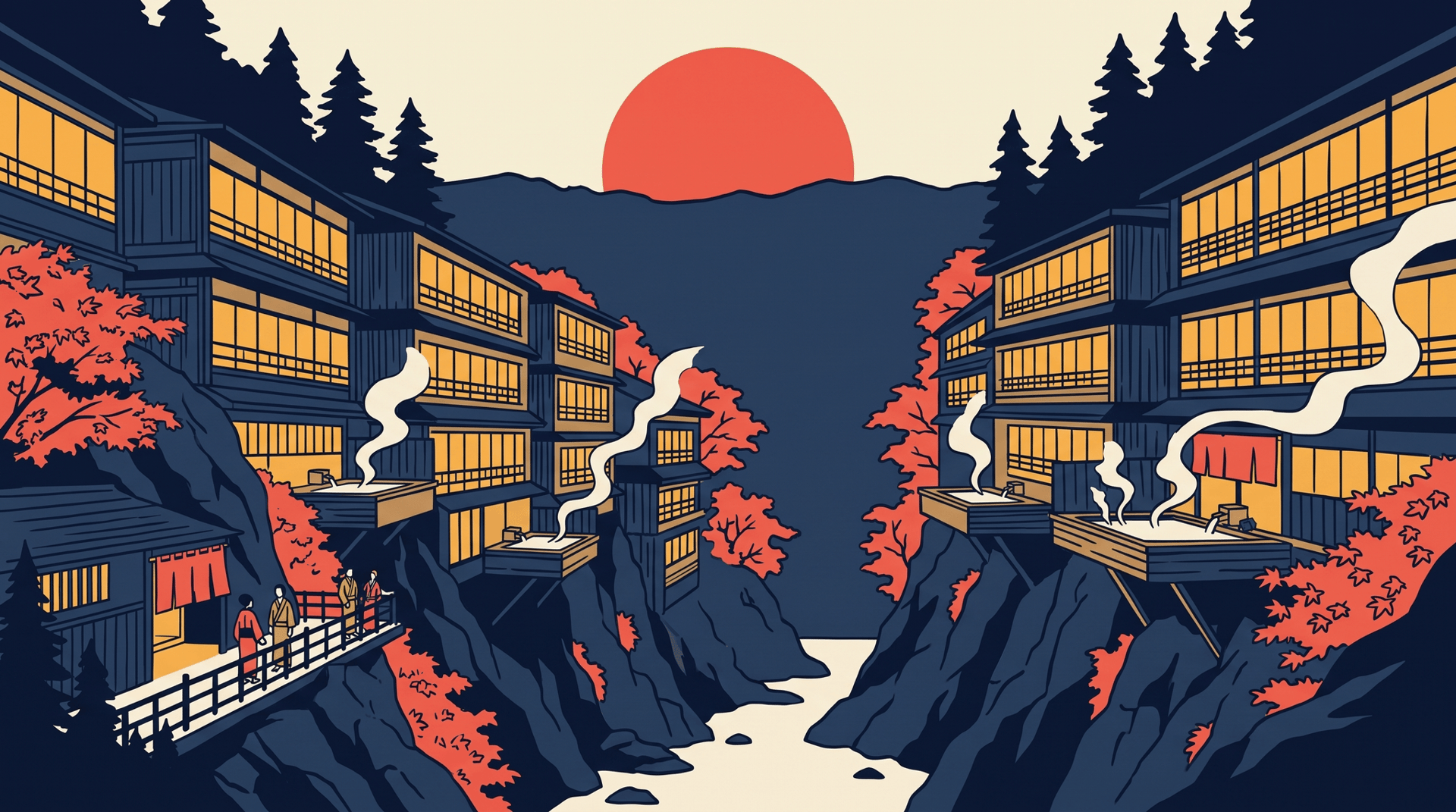
芦ノ牧温泉A gorge town south of Aizu-Wakamatsu, where tall inns stand along the cliffs of the Okawa river and their open-air baths hang straight over the water. Tradition credits the priest Gyoki with finding the spring some twelve centuries ago, and the calcium and sodium sulfate-chloride water still rises hot enough to need cooling. Three free foot baths mark the walking route, and the branch-line station at the edge of town keeps a cat as its stationmaster.
A priest, a horse pasture, and a river
Ashinomaki tells its own beginning two ways. In one telling the wandering priest Gyoki found the water some twelve centuries ago; in another the credit goes to Kobo Daishi. Aizu's old gazetteers are less romantic and more useful: they record the spring plainly, noting that people came to it for eye complaints. The name is likewise contested. It may come from the maki (牧), the horse pastures the Ashina clan kept here when they ruled Aizu from Tsuruga castle, or from the whirlpools the Okawa turns in the rock below the town.
For most of its life this was a bathing place for people who lived nearby, not a destination. That changed in 1902, when a road finally reached the valley. Inns went up, then grew, then grew again through the resort boom of the 1960s and 70s until the cliffs carried buildings six and seven storeys tall. The bubble years ended badly here, as they did in a lot of Japanese onsen towns, and a few concrete hulls still stand empty above the river. What survives is a small, working association of seven inns.
Water hot enough to need cooling
The town sits on a shelf above the Okawa, the local name for the upper Aga river, where Route 118 crosses the gorge south of Aizu-Wakamatsu. The water is a calcium and sodium sulfate-chloride spring, and it comes up hot, above sixty degrees at source, hot enough that the houses cool it before it reaches a bath. It is the salty, heat-holding kind, long used against rheumatism, stomach trouble and skin conditions.
What the inns do with the geography is the point. The valley wall is steep enough that a building can put its lobby at road level and still have six floors below it, so the baths hang out over the water rather than beside it. Ookawaso is the one people photograph, a tiered atrium with a floating stage where a shamisen is played over the gorge; it picked up a second audience entirely when readers noticed how much the interior resembles the Infinity Castle from Demon Slayer. Senkyokaku is the opposite in scale, a fifteen-room house on its own free-flowing spring, and a member of the association that looks after Japan's hidden hot springs.
Three foot baths and a cat
The town is walkable end to end in half an hour, and three free foot baths are spaced along the route: Ashi-poppo in the middle of the street, Kodakara-no-yu beside the small Konsei shrine, and one in Kagayaki park with the view. A souvenir centre at the east end runs a plain day-use bath that has nothing to do with any inn.
Four kilometres away, on the Aizu Railway, Ashinomaki Onsen station is kept by volunteers and staffed, in the honorary sense, by a cat. Bus took the post in 2008, Love followed in 2015, and Sakura has held it since 2023. The line carries on south from there toward the thatched post town of Ouchi-juku and the eroded river cliffs of To-no-Hetsuri, which is how most visitors end up seeing all three in a day.
Places in this area
12 places · Sorted by rating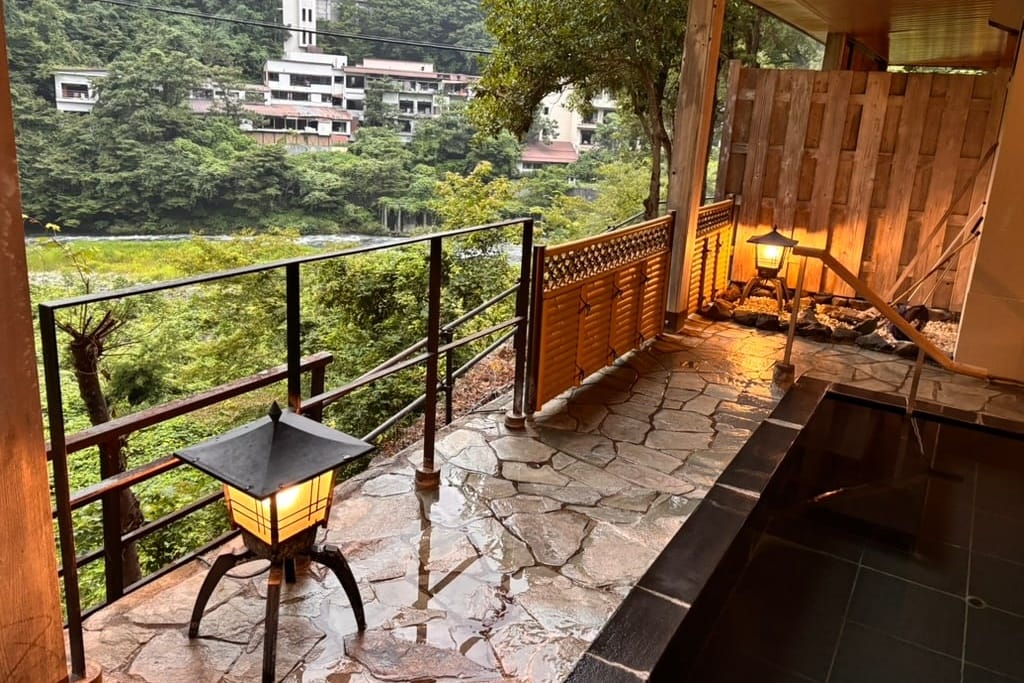 Lodging
不動館 小谷の湯
Fukushima
芦ノ牧ドライブ温泉
Fukushima
足湯 足ポッポ
Fukushima
渓流の宿 渓山
Fukushima
Closed & restricted
1
On the map
Loading map…
Nearby onsenchi
Within 50 kmSources
- Aizu Ashinomaki Onsen Tourism Associationofficial— Official association site: the member-inn directory, the day-use bathing list, the walking course with its three foot baths, and the founding legend.
- Ashinomaki Onsen — Wikipedia (JA)— Reference for the two founding legends, the two readings of the name, the 1902 road opening, the spring chemistry, and the post-bubble closures.
- Ashinomaki Onsen Station Preservation Societyofficial— The volunteer group that runs the station and keeps its cat stationmasters. Source for the succession from Bus to Love to Sakura.
- Aizu Wakamatsu Tourism Bureau — Ashinomaki Onsenofficial— Regional tourism board page covering the gorge setting, access from the castle town, and the surrounding sights.