


Inatori Onsen
稲取温泉A fishing port on a cape of the Izu Peninsula's east coast, where saline cliffside baths look out over the Pacific. Famous for branded kinmedai snapper and the Hina no Tsurushi-kazari hanging-doll festival, one of Japan's three great tsurushi displays.
A fishing port that became a spa
Inatori sits on a small cape jutting into the Pacific on the east coast of the Izu Peninsula, in Higashiizu town (東伊豆町), Shizuoka. Compared with the older resorts up the coast it is a latecomer: hot water was struck here only in 1956, rising at around 57 °C, and the saline coastal spring soon turned a working fishing harbour into a hot-spring town. The two identities never separated. Roughly thirty inns and guesthouses cling to the cliffs around Inatori port (稲取漁港), most of them with open-air baths angled out over the water, and the same harbour that supplies the bathers' dinner still sends some sixty boats out each morning. The flagship catch is kinmedai (金目鯛), golden-eye snapper, and Inatori's day-return, single-line Inatori Kinme (稲取キンメ) is a recognised brand that commands a premium over ordinary landings, usually met at the table as kinme no nitsuke, the whole fish simmered in sweet soy.
Hanging dolls and a golden plateau
Inatori's signature is the Hina no Tsurushi-kazari (雛のつるし飾り), the hanging-doll display flanking the Doll's Festival hina tiers. The custom is said to have begun with mothers of modest means who stitched small figures (flowers, peaches, rabbits) from scraps of old kimono and strung them together as a wish for their daughters' health and happiness; it is reckoned to be more than a century old here, and ranks alongside Yanagawa's sagemon and Sakata's kasafuku as one of Japan's three great tsurushi displays. From late January through the end of March the festival fills several venues, the main one being the Bunka Koen Hina no Yakata (文化公園雛の館), where well over ten thousand hand-sewn ornaments hang together; a separate venue dresses the long stone staircase of a hillside shrine in tiered dolls. In autumn the focus shifts inland and uphill to Hosono Kogen (細野高原), a broad pampas-grass plateau that turns to a sea of silver-gold susuki from October into December, with views back over Sagami Bay and the Izu Islands.
Getting there
Inatori is a stop on the Izu Kyuko line (伊豆急行), which runs down the east coast from Ito; the gateway is Izu-Inatori station (伊豆稲取駅), about an hour south of Atami and within easy reach of limited-express services from Tokyo.
Places in this area
11 places · Sorted by rating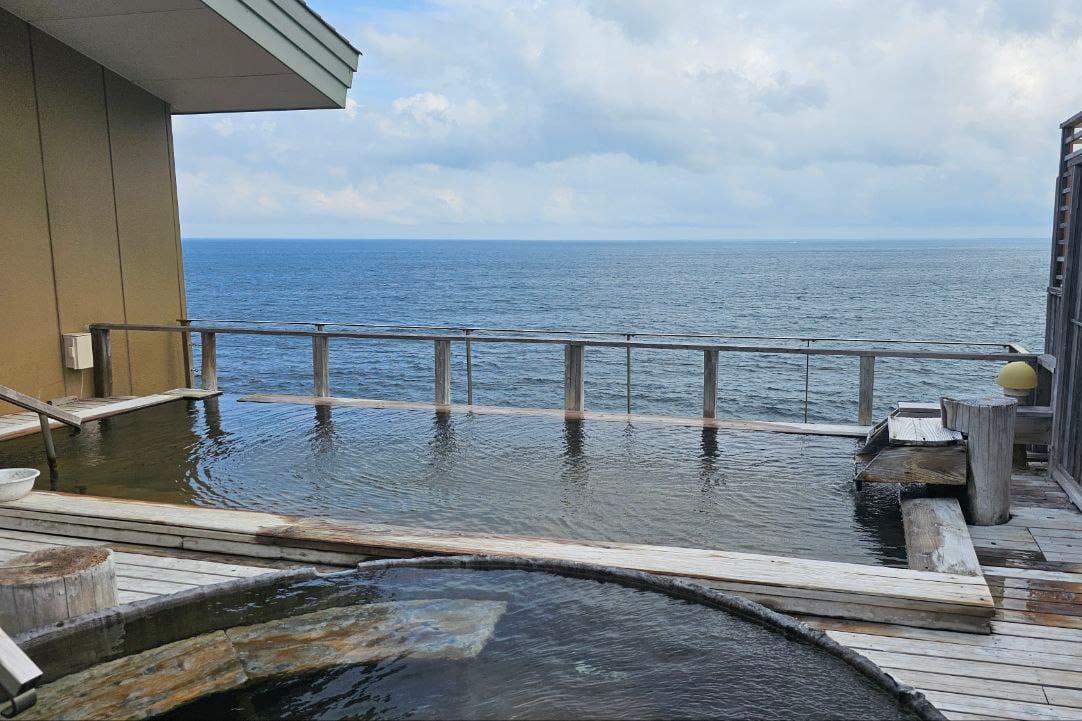 Lodging
石花海
Shizuoka
食べるお宿 浜の湯
Shizuoka
宝栄丸
Shizuoka
稲取赤尾ホテル
Shizuoka
海一望絶景の宿いなとり荘
Shizuoka
On the map
Loading map…
Nearby onsenchi
Within 50 kmSources
- Inatori Onsen Ryokan Cooperative Association — About the Springsofficial— Official portal for the local lodging association, covering the saline springs, the cape setting, and the resort's history.
- Inatori Onsen — Hina no Tsurushi-kazariofficial— Association page on the hanging-doll tradition, its century-plus local history, and its place among Japan's three great tsurushi displays.
- Higashiizu Town — Inatori Kinmeofficial— Municipal page on the branded line-caught golden-eye snapper landed day-fresh at Inatori port.
- Izu-Inatori Station — Wikipedia (EN)— General reference for the Izu Kyuko line, the station's location, and access along the east coast of the Izu Peninsula.