
Shimoda Onsen
下田温泉Port town at the southern tip of the Izu Peninsula, famous as the site of Commodore Perry's 1854 landing. Sulfate springs and Pacific-coast ryokan with views of the Izu islands.
The port the Black Ships forced open
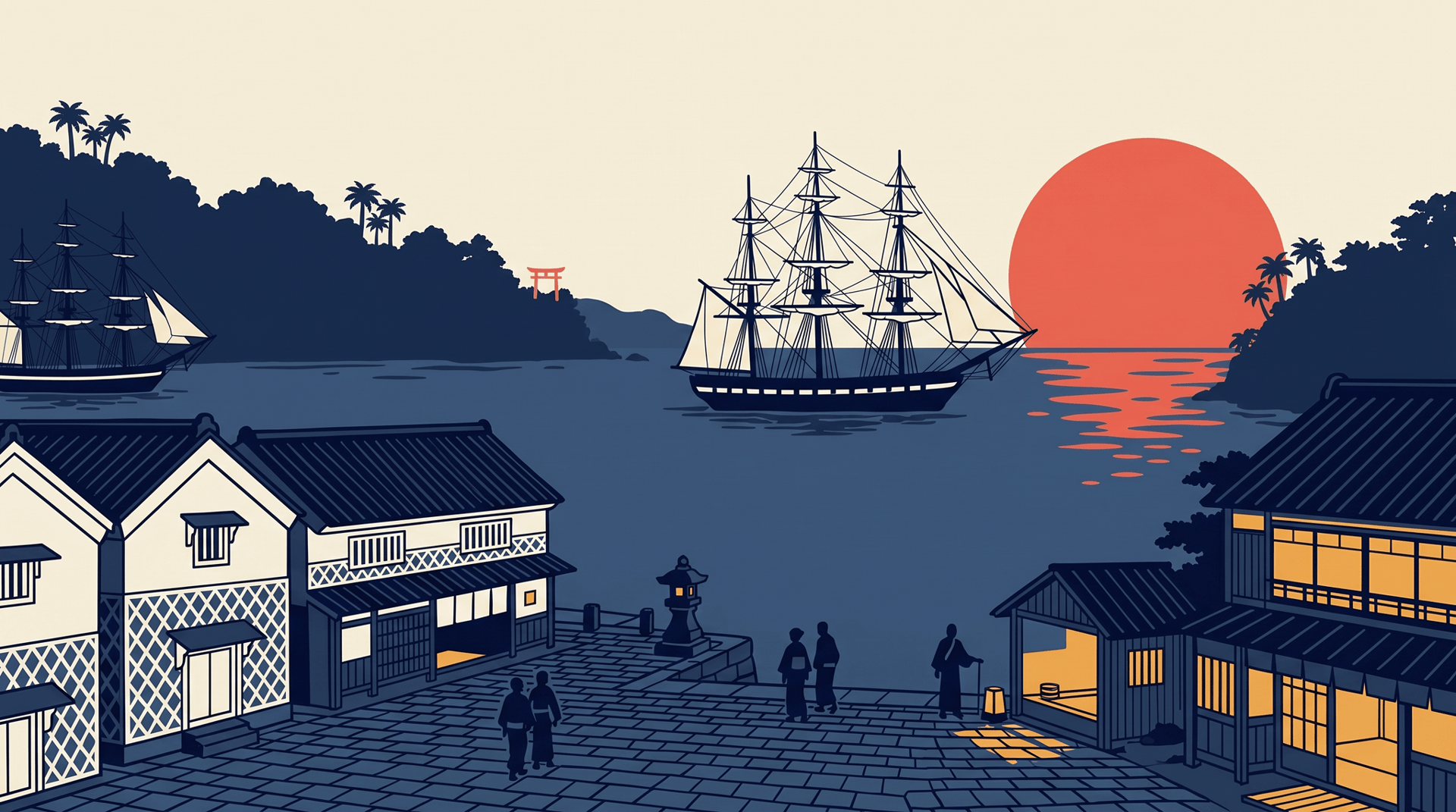
Shimoda is the town where Japan stopped being closed. In 1854 Commodore Matthew Perry returned to Edo Bay with a squadron of nine warships, and the Treaty of Kanagawa signed that March named Shimoda, then a quiet harbour at the southern tip of the Izu peninsula, as one of two ports through which the United States would be admitted. Perry sailed south to inspect his prize, and a supplementary convention of thirteen articles, the Shimoda Treaty, was negotiated at Ryosen-ji that June. Two years later Townsend Harris stepped ashore as the first American consul and took up lodging at Gyokusen-ji, a Soto Zen temple at the north edge of town whose grounds were already being used as a foreign cemetery for sailors who had died in port. The temple was designated a National Historic Site in 1951. The bathhouses that grew up around the harbour and in the surrounding hamlets of Rendaiji, Shirahama, Kannon, Kawachi, and Aitama draw on water that had been used by locals long before any of this, and several of the family ryokan in those quarters trace their houses back to the late Edo and Meiji decades.
Whitewashed walls and Pacific blue
The town that holds these stories is small, sea-facing, and warm enough through the year for palms to line the streets. The old harbour district keeps its namako-kabe walls, lattices of black tile set in white mortar, a Bakumatsu merchant style preserved most thickly along Perry Road, the lantern-lit lane between the landing memorial and Ryosen-ji. Hot saline water rises from fifteen separate sources at around 55 degrees, distributed across the five constituent quarters rather than concentrated in a single resort strip, so the ryokan landscape is dispersed: river-valley inns at Rendaiji, oceanfront resorts at Shirahama, quieter houses tucked into Kannon and Kawachi. Two of the cleanest beaches on the Pacific side of the peninsula, Shirahama Ohama and Tatadohama, are minutes away by bus, the first a seven-hundred-metre arc of white sand and shrine torii, the second a surfers' cove.
Perry Road and the May festival
A short walking circuit links the major sites of the opening: the landing park, Perry Road, Ryosen-ji, and the Hofuku-ji museum to Saito Okichi, the young woman associated with Harris. Every May the city hosts the Kurofune Matsuri, a three-day commemoration first staged in 1934 that brings a US Navy delegation, a costumed parade through the old streets, and fireworks over the harbour.
Places in this area
16 places · Sorted by rating
源兵屋
Shizuoka
温泉民宿浜屋
Shizuoka
ホテル伊豆急
Shizuoka
ホテル山田屋
Shizuoka
民宿 亀屋
Shizuoka
割烹民宿 小はじ
Shizuoka
黒船ホテル
Shizuoka
龍神の湯
Shizuoka
下田大和館
Shizuoka
On the map
Loading map…
Nearby onsenchi
Within 50 kmSources
- Shimoda Onsen Ryokan Cooperativeofficial— Member directory and water-quality notes for the five bath quarters.
- Gyokusen-ji (Wikipedia)— National Historic Site that housed the first US consulate under Townsend Harris.
- Perry's Black Ships, Shimoda (Japan Guide)— Visitor overview of Ryosen-ji, Perry Road, and the Kurofune Matsuri.
- History of Shimoda (Izu Shimoda Tourism Guide)— City tourism office's chronology from the bakumatsu opening onward.
- Kurofune Matsuri (Black Ship Festival)— Festival programme and history of the May commemoration.