Nuru-yu: The Lukewarm Onsen You Sit In for Hours
When we talk about onsen we call them hot springs, and that really is the literal reading of the characters: 温 on, hot, plus 泉 sen, spring. A mineral bath is supposed to be hot.
And plenty of springs in Japan are hot on their own, with no help at all. Some are hot enough that they have to be cooled before anyone can get in. But that is plenty of them, not all of them. There are springs rich in minerals that come out of the ground merely warm, and very often they get heated to match what a visitor expects. Only a few offer the water as it arrived. Which is a shame, because that is usually when it is doing the most.
Let's take this in order.
How hot is "hot", exactly?
Japanese law has a precise answer. The Mineral Spring Analysis Guidelines (kosen bunsekiho shishin, 鉱泉分析法指針), which sit under the Hot Spring Law, sort springs by their temperature at the wellhead into four bands:
- Cold mineral spring冷鉱泉 reikosenbelow 25°C
- Low temperature低温泉 teionsen25 to 34°C
- Warm温泉 onsen34 to 42°C
- High temperature高温泉 koonsen42°C and up
The two even have separate names. Everything above is senon (泉温), the temperature of the source at the wellhead, while the water you actually sit in is yuon (湯温). A 54°C source can be cooled down to a gentle 38°C bath, and a 31°C source can be piped into the tub exactly as it is. Both give you a warm bath, and on paper they are two entirely different springs.
So what is nuru-yu?
Nuru-yu (ぬる湯) is not a legal category. The term appears nowhere in the law. It is a bathing word, from the adjective nurui, lukewarm, and it describes the bath rather than the source: roughly 32 to 40°C. Slightly below body temperature, or barely above it.
Around 35 to 36°C sits what Japanese bathing culture calls fukan ondo (不感温度), the "temperature of no sensation": water that registers as neither hot nor cold, where the heat your body makes and the heat it sheds roughly cancel out. Pulse, blood pressure and breathing barely move. Which is exactly why time passes differently in nuru-yu.
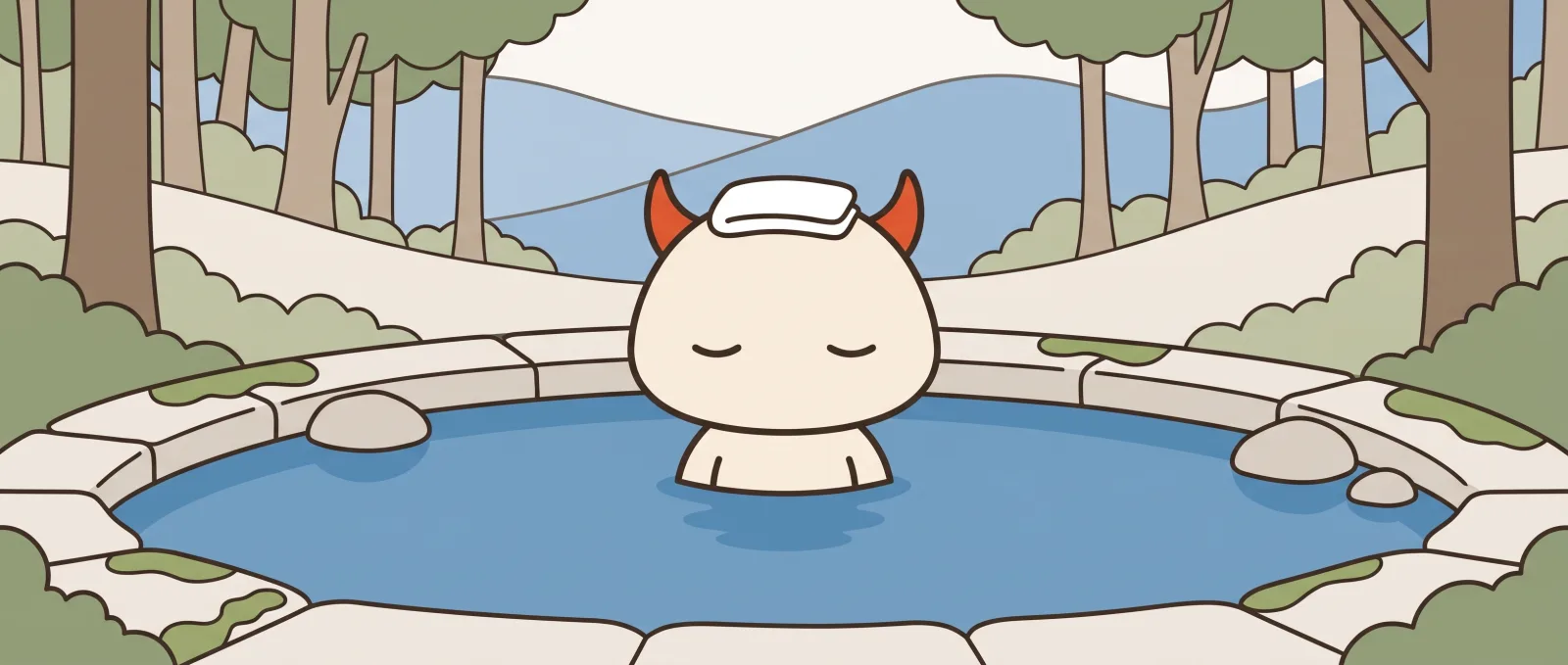
Cool water used to be treated as a defect worth hiding. The stubborn assumption that a mineral spring must be hot made it seem like merely warm water could not be doing anything. It is the other way round, for three reasons.
Why nuru-yu often does more
First, time
You can stay in cool water far longer than in hot water, and that is not a footnote. It is the main mechanism.
The Ministry of the Environment's booklet on safe onsen use, produced with the Japanese Society of Balneology, Climatology and Physical Medicine, recommends this for an ordinary hot bath: while you are still getting used to it, 3 to 10 minutes, once or twice; once you are used to it, 15 to 20 minutes, two or three times.
Now compare nuru-yu. At Tochiomata (栃尾又) in Niigata, a radon spring whose wellheads measure 35.4°C and 28.5°C, the traditional way to bathe is to sit there not for ten minutes but for one to two hours, with everything dissolved in that water working on you the whole time.
Second, the load on your body
A hot bath is not rest. It is work. Research by Otsuka Yoshinori of Hokkaido University's Health Management Center puts numbers on it: ten minutes at 42°C raises blood pressure by 20 to 40 points, pulse by around 40 beats per minute, and body temperature by 2°C. The sympathetic nervous system fires and blood vessels constrict.
The same Ministry of the Environment booklet is blunt about it: older bathers, people with high blood pressure or heart disease, and anyone who has had a stroke should avoid baths above 42°C. That is not a tip. It is the contraindications section.
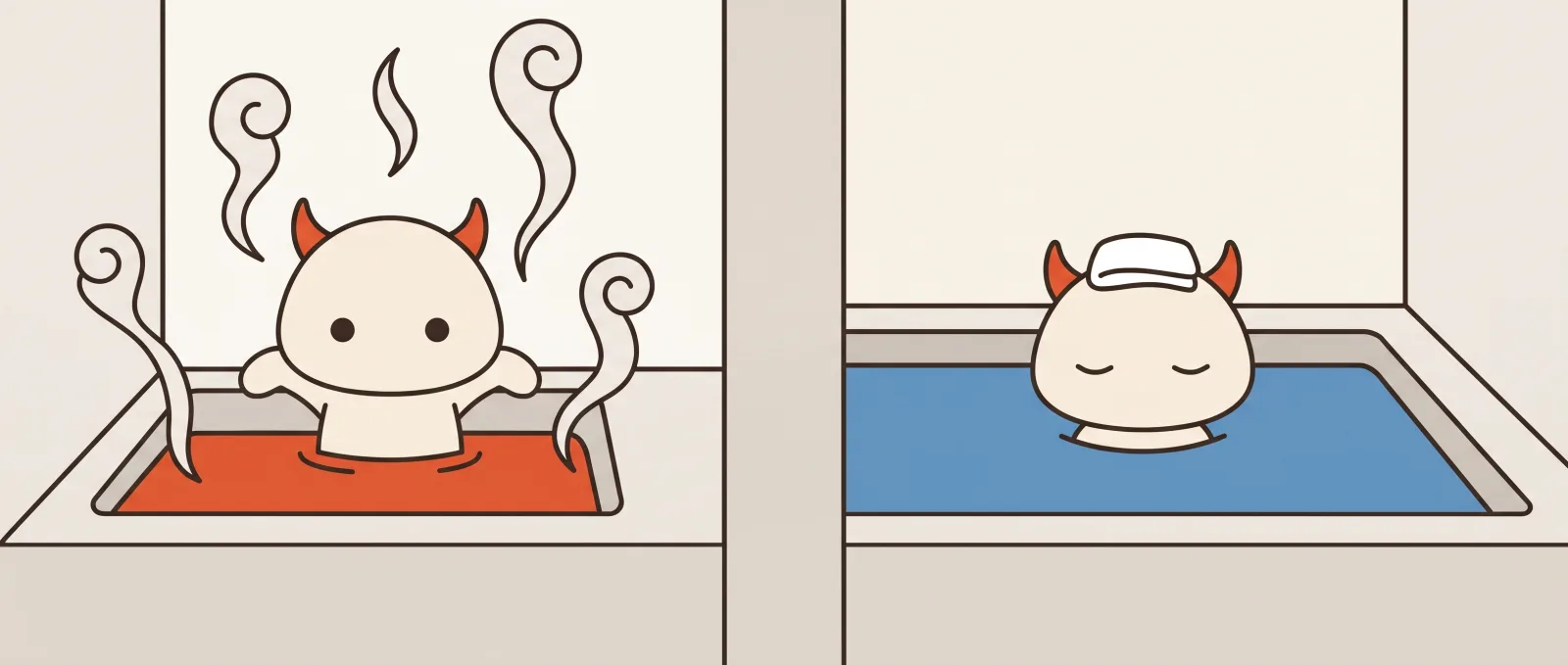
Japan can measure what this costs, and it is not a story about people who cannot swim. The mechanism is the heat: in a hot bath the body overheats and blood pressure swings, the bather loses consciousness and slips under the water. The statistics record that as drowning. In 2023 the vital statistics counted 6,073 people aged 65 and over who died that way in a bath at home or in a care facility, against 2,116 of the same age killed in traffic accidents: close to three times as many. And that is only the share written down as drowning. Working from ambulance records, a Ministry of Health research group put bath-related deaths at roughly 19,000 a year once the heart attacks and strokes that happen in the tub are counted too.
Nuru-yu stays under that threshold. Instead of sympathetic activation you get the parasympathetic side: vessels open, the pulse stays where it was, the body lets go. That is where the sense comes from that a nuru-yu visit is more meditative. You are given the time to notice how you feel, and to notice where you are.
Third, the water itself
This is the interesting part, and the real argument against heating.
That same booklet calls onsen water namamono (なまもの), fresh produce, the perishable kind, and it names what perishes: hydrogen sulfide, iron, carbon dioxide and radon. All unstable, and all of them leave the water faster the hotter it is.
Carbon dioxide is the clearest case, and you can read it straight off one building's own wall. To count as a therapeutic carbonated spring, water has to carry at least 1,000 mg of free carbon dioxide per kilogram. At Ramune Onsenkan in Nagayu, the outdoor bath sits at 32°C and measures 1,400 mg/kg. The indoor bath, same building, same source area, runs at 42°C and measures 911. Ten degrees warmer, and it has slipped below the threshold that made it a therapeutic spring in the first place.
Heat a cool mineral spring and you are boiling off the thing people came to sit in.
Awatsuki: the bubbles you can see
Carbonated springs have one side effect nobody mistakes for anything else. Sit down and the gas comes out of solution against you; within a minute you are wearing a dense coat of tiny bubbles. This is awatsuki (泡付き), and the ministry's own booklet uses the folk name for these springs: awa no yu, the bath of bubbles. The gas is absorbed through the skin and opens the blood vessels, which is why a 32°C bath does not feel as cold as it sounds.
Because CO₂ will not stay in hot water, volcanic Japan has frustratingly few natural carbonated springs, and they are nearly all cool and nearly all famous. Nagayu (長湯温泉) in Oita is the best known. Shichirida Shitan-yu (七里田温泉 下ん湯), also in Oita, runs unheated at around 37°C and carries so much gas that bathing there is closer to getting into a glass of soda.
Toji: none of this is new
Japan worked all of this out long before anyone had a thermometer. Written records of using hot springs run back about 1,300 years, and toji (湯治), the extended cure at a spring, grew out of them.
Toji had its own arithmetic, settled early. By the medieval period (roughly the 12th to 16th centuries) a week counted as one cycle, hito-mawari (一廻り), and a proper course meant at least three of them: twenty-one days. The Ministry of the Environment still says two to three weeks is about right.
Now try that at 44°C. Two or three immersions a day, for three weeks. No body survives that schedule. Toji was only ever possible because warm water existed, and the places that lived on it are still open: Tochiomata with its four hundred years, Nuruyu Onsen (微温湯温泉) in Fukushima, a 32°C spring known since the Kyoho era (1716–1736) for treating the eyes, and Yachi Onsen (谷地温泉) in Aomori, whose lower bath rises through the floor of the tub at 38°C.
Warm does not mean risk-free. The Ministry of the Environment booklet describes yuatari (湯あたり): roughly three days to a week into a course, you may get malaise, insomnia, digestive trouble or a skin rash. When that happens you stop bathing, or cut back, and wait to recover. Long soaks also dehydrate you more than they feel like they do, so drink before and after. And do not rinse the minerals off afterwards, just pat yourself dry with a towel (the exception being acidic and sulfur springs if your skin is sensitive).
Where to find nuru-yu
The good news is that finding them got easier. We tag nuru-yu in the catalog, and there are now 291 places in the Onsen Oni database with lukewarm baths.
GuideThe nuru-yu guideAll of them on one map, where they cluster, and a dozen worth starting with.
The industry is warming to the subject too. In July 2026 the Shizuoka Prefecture Onsen Association held a nuru-yu summit (ぬる湯サミット2026) in Umegashima under the banner "connect gently, open up deeply", where lukewarm water was discussed not only as tradition but as a business case: the energy you do not spend on heating, wellness travel, and longer stays. That same summer the association launched its nuru-yu stamp rally across twelve baths in the prefecture.
None of this is an argument for cooling down the springs that arrive at 42 to 45°C. It is an invitation to meet Japanese mineral springs from another side, and to enjoy the range of temperatures they come in.
Going to a nuru-yu is a bit like eating for the flavor rather than to be full. There is nowhere to be, and that is the whole point.
Sources
- 環境省「あんしん・あんぜんな温泉利用のいろは」(平成31年3月)official— bathing duration guidance, the 42°C threshold, yuatari, onsen as "namamono"
- 環境省 — 温泉法に関する通知・ガイドラインofficial— the Hot Spring Law and the Mineral Spring Analysis Guidelines
- 日本温泉気候物理医学会 — 新禁忌・注意事項及び適応症— contraindications and indications as revised in 2014
- 東京都浴場組合 — 42℃以上の「熱いお湯」に入浴するのはいいのか悪いのか?— the blood pressure, pulse and body temperature figures (from research by Otsuka Yoshinori, Hokkaido University)
- 消費者庁 — コラムVol.12 高齢者の事故 ―冬の入浴中の溺水や食物での窒息に注意―official— 2023 figures for bath drownings vs traffic deaths, aged 65 and over
- 厚生労働科学研究「入浴関連事故の実態把握及び予防対策に関する研究」— the estimate of roughly 19,000 bath-related deaths a year, from ambulance data
- ラムネ温泉館 — 世界屈指の炭酸泉— the 32°C / 42°C baths and their free-CO₂ readings
- 七里田温泉「下湯(下ん湯)」— Shichirida Shitan-yu: around 37°C, unheated, free-flowing
- 栃尾又ラジウム温泉 自在館 — ラジウム温泉の泉質・適応症— Tochiomata wellhead temperatures and the multi-hour bathing tradition
- 国立国会図書館「本の万華鏡」— 湯治場としての温泉official— toji history: the Izumo Fudoki, the one-week cycle, and the 1805 one-night toji
- 静岡県温泉協会official— the 2026 nuru-yu summit and stamp rally
Written by
Dinara Lipinskaya(Onsen Passport)opens in a new tab
Onsens are my happy place. I love exploring them, learning their history and the traditions behind them, and sharing what I find with anyone curious enough to ask.