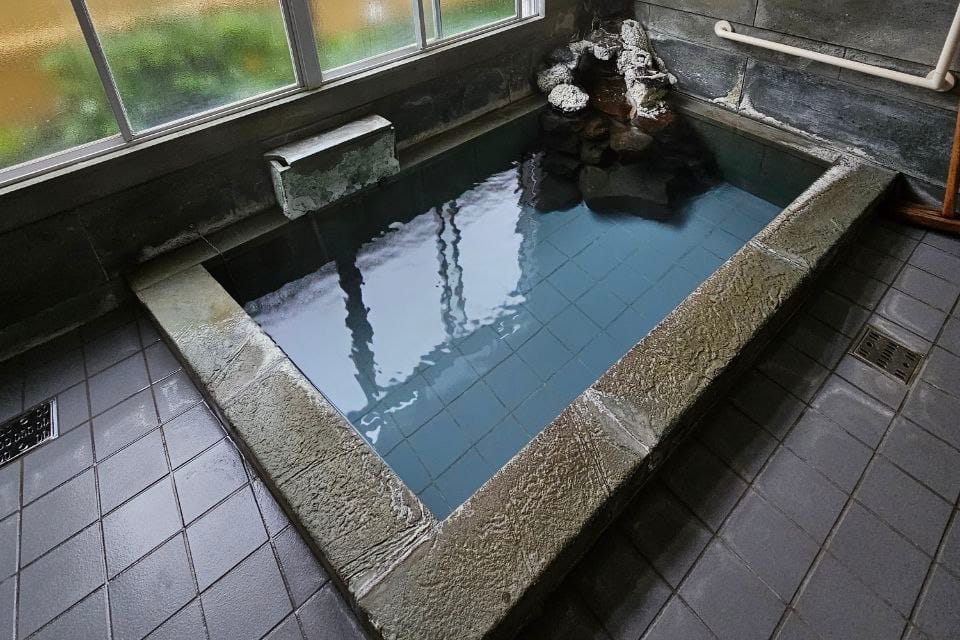
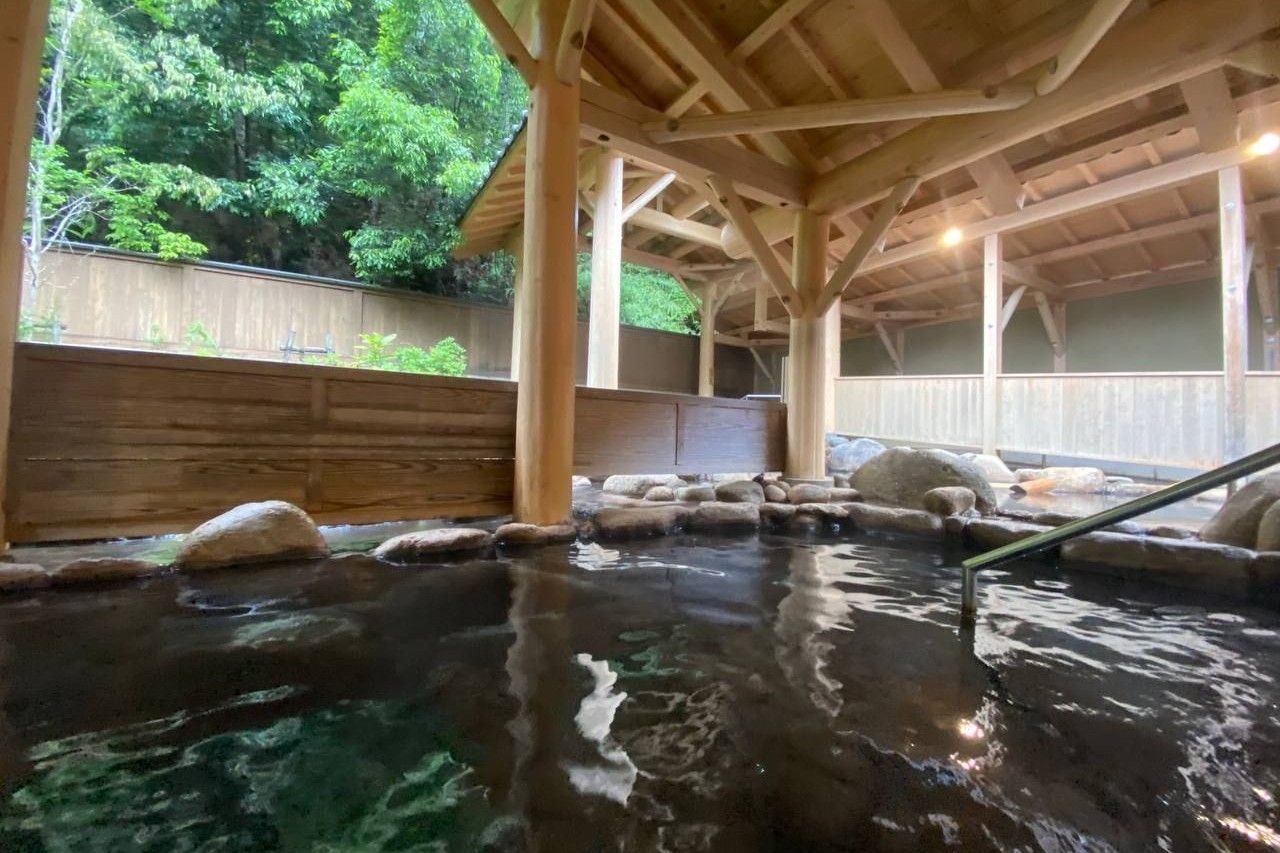
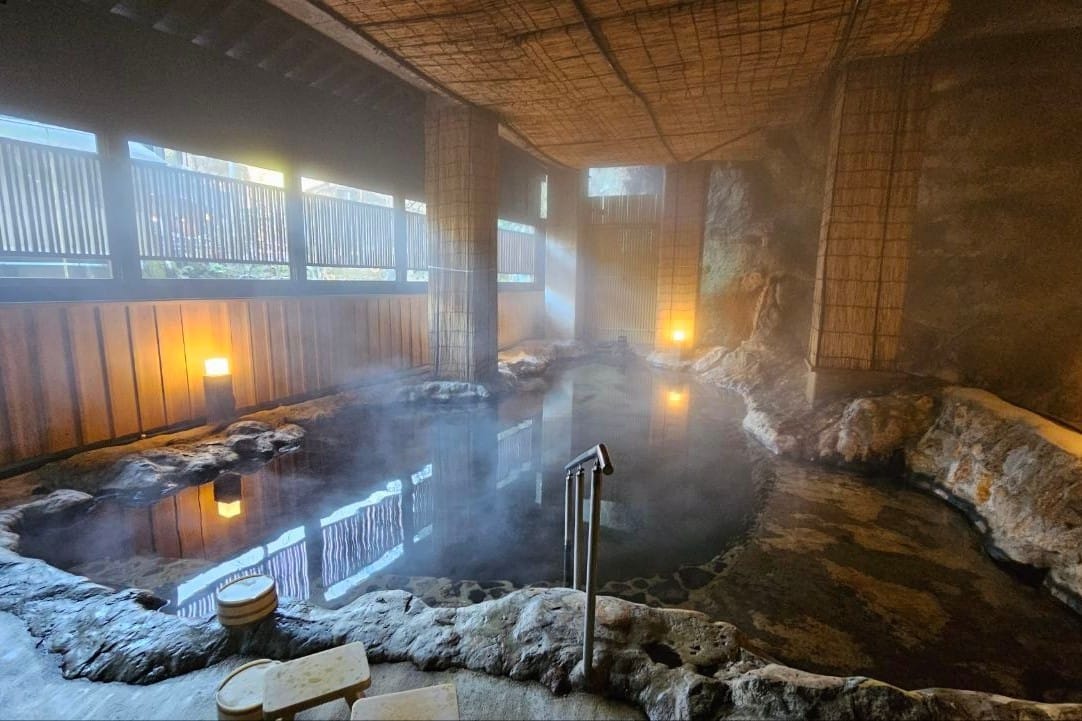
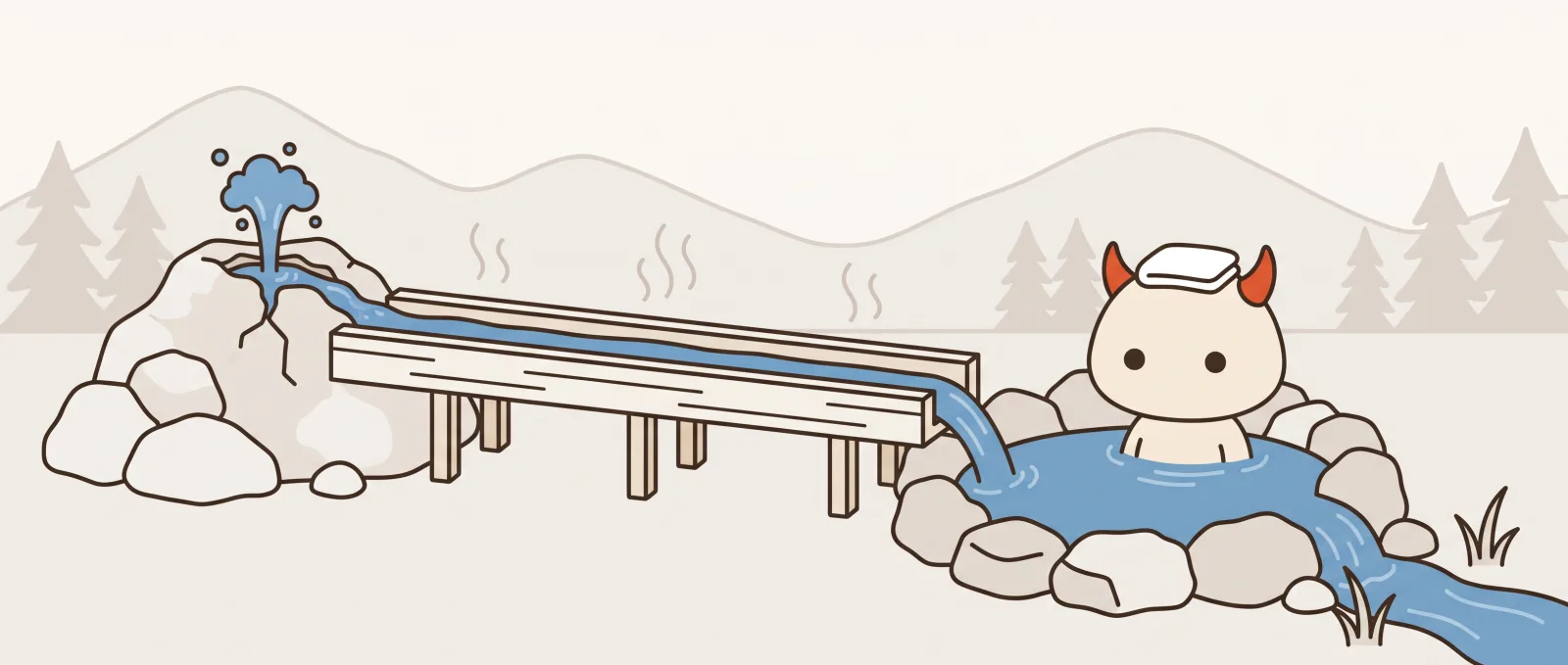
Water that runs from the source into the bath and away, never round again: what the word promises, and what it leaves out.
掛け流しかけながしkakenagashi
What kakenagashi means
Kakenagashi (掛け流し) is a way of running a bath: hot spring water flows into the tub and fills it, and the water that spills over the rim goes away instead of being pumped back in. Dictionaries define it as filling the bath with water from the source as it comes, or with only its temperature adjusted, and letting the overflow go without recirculating it. You will often see it as gensen kakenagashi (源泉掛け流し), which stresses that the water is the source's own, and just as often written partly in kana, かけ流し.
The bath sense grew out of an everyday one: the same dictionary gives kakenagashi for simply letting something run off. Today it is a label bathers look for and inns value. In Ureshino in Saga, where the source comes out close to boiling, the Japan Tourism Agency's guide explains that mixing in cold water would count against an inn's claim to it, so some inns cool the spring water in tanks instead and blend it with freshly drawn water to reach a bathing temperature.
源泉げんせんthe source: the spring where the water comes out of the ground
掛けかけpouring, from the verb kakeru (掛ける), to pour over
流しながしletting it run away, from the verb nagasu (流す), to let flow
What it promises, and what it doesn't
Strictly, kakenagashi says one thing: the water in the tub is not used again. Everything else is a separate question, and the notice a bath must post when it does any of them names each one.
Not recirculated (循環ろ過)
This is the heart of the word. A recirculating bath, which Japan's health ministry describes as one built to use less spring or tap water, draws the water out, catches hair, disinfects it, filters it, reheats it and pumps it back. A kakenagashi bath lets it go.
Not ruled out by every use of the word. Some places cool a very hot spring with water, and the rules count hot water, ice and snow as added water too. Where the label is prized, as in Ureshino, added water counts against it, but only the posted notice tells you for sure.
The dictionary allows a bath whose temperature has been adjusted, and a cool spring is often warmed to bathe in. If the water still passes through only once, that can be kakenagashi, but the place has to post that it heats the water, and why.
Disinfection (消毒)
Free-flowing water can still be chlorinated. The national hygiene guideline asks for chlorine in bath water in general, and some prefectures now require it in kakenagashi baths too: more on that below.
Something can still be added. The rules name bath additives that colour or scent the water or boost its effect, and the council behind them included anything that dissolves out of sight, from salt to milk. Yuzu or iris leaves floating where you can see them need no notice.
Overflow is not proof
Water pouring over the rim looks like kakenagashi, but some recirculating baths are built to overflow: the spilled water is collected and sent back through the filter. The health ministry's manual notes that this is done partly for the look of a bath brimming with water.
How the word became a promise
In the summer of 2004 a run of cases shook trust in onsen. At Shirahone Onsen in Nagano, some baths had used a bath additive without saying so, and the prefecture warned four businesses, the inns' association among them, over misleading labelling. In Ikaho in Gunma and at a public bath in Fukuoka, heated tap or well water had been passed off as onsen, and in Miyagi an inn operator was arrested for using a spring without a permit.
That September the Ministry of the Environment surveyed some 20,000 onsen facilities. Among the more than 60 percent that replied, 32.5 percent had a bath with added water, 51.4 percent a heated bath and 50.4 percent a recirculating one, while the shares that said so on a sign were 16.1, 19.2 and 16.0 percent.
The answer, on the advice of the ministry's Central Environment Council, was a new posting rule. Since 24 May 2005, a place that offers onsen water for public bathing and adds water to it, heats it, recirculates it (and filters it), or adds anything to it or disinfects it has had to say so, with the reason, beside the analysis of its water. A missing or false notice can be fined up to 300,000 yen. The Japan Spa Association launched a voluntary sign the same month, grading among other things how the bath is fed and drained and how much water is added, on a five-step scale, but it ended in 2019. The legal notice is what remains.
Reading the notice
The notice hangs where bathers can see it, and the ministry suggests the changing room. It is often on the same board as the onsen bunsekisho (温泉分析書), the analysis of the water. This is what to look for.
Four lines
加水 (added water), 加温 (heating), 循環 or 循環ろ過 (recirculation, with filtering), and 入浴剤 or 消毒 (additives or disinfection). Each is answered 有 or あり, yes, or 無 or なし, no.
A reason for every yes
The ministry's examples: water added because the source is too hot or too acidic or runs short, heating to keep a bathing temperature, recirculation to spare the spring and for hygiene, and chlorine for hygiene or to meet the prefecture's bathing ordinance.
No lines at all
A place that did none of the four did not have to change its notice in 2005, so an older board may say nothing about them. It may be one of those places, but the board does not say so. If it matters to you, ask.
Several baths
Where baths are run differently, the notice has to show which is which, sometimes with a small plan of the bathing room. One place can have a free-flowing tub and recirculate the rest.
Water you add yourself
If you run the cold tap at the edge of the bath to cool it, that is not the place adding water, and no notice covers it.
Why fresh water matters
The Ministry of the Environment calls onsen water namamono (なまもの), something perishable: from the moment it leaves the ground it starts to change, most of all in springs that carry hydrogen sulfide, iron, carbon dioxide or radon. Its advice is about drinking the water where it rises, but the same thinking lies behind the posting rule.
The council that drew up the rule spelled it out. Heating can drive off the water's volatile components and make iron and calcium settle out; recirculation loses more of those volatile components, and a filter can catch iron and change the water. It was just as clear that neither way of running a bath is better in itself: how a bath is at any moment depends on how much fresh water goes in, how many people are in it and how it is kept, and a well-kept filter spares a limited spring and keeps a busy bath clean.
Chlorine, Legionella and the recirculating bath
The health worry behind all of this is Legionella, a bacterium that lives in small numbers in soil and rivers but can multiply in warm water in man-made systems. People catch Legionnaires' disease, a pneumonia, by breathing in fine droplets of contaminated water. In Japan, the health ministry's manual says, baths are the most common source of infection, and older people, heavy smokers and drinkers, and people with diabetes, lung disease or weak immunity are most at risk.
A recirculating bath sends the same warm water through a filter and pipes, where bacteria build a slimy biofilm that shields them from disinfectant. That is why the ministry treats chlorine as a given for a filtered bath that runs day after day, and why its national guideline asks for free chlorine of about 0.4 mg per litre in bath water, and no more than 1 mg, while its manual asks for the filter to be backwashed and the pipes disinfected at least once a week.
Free-flowing baths are not exempt. The guideline's chlorine rule covers bath water in general, with exceptions for very acidic springs, where chlorine would give off a toxic gas, for water rich in organic matter, and for baths with so much fresh water flowing in that no chlorine level can be held. Some prefectures go further: since June 2021 Wakayama has required disinfection in every bath, kakenagashi included. So a free-flowing bath may smell of chlorine, and a notice that says no disinfection is telling you something.
In the bath
A bath that no machine reheats or cools changes with the spring, the weather and the number of bathers. A few things help.
It may be hotter or cooler than you expect
With no heater to hold it steady, the temperature drifts. Yunokuchi Onsen in Mie, whose notice says it adds no water and does not heat, recirculate or filter, asks guests in English to understand that it is hard to keep the water at the same temperature all the time.
How a hot spring is cooled
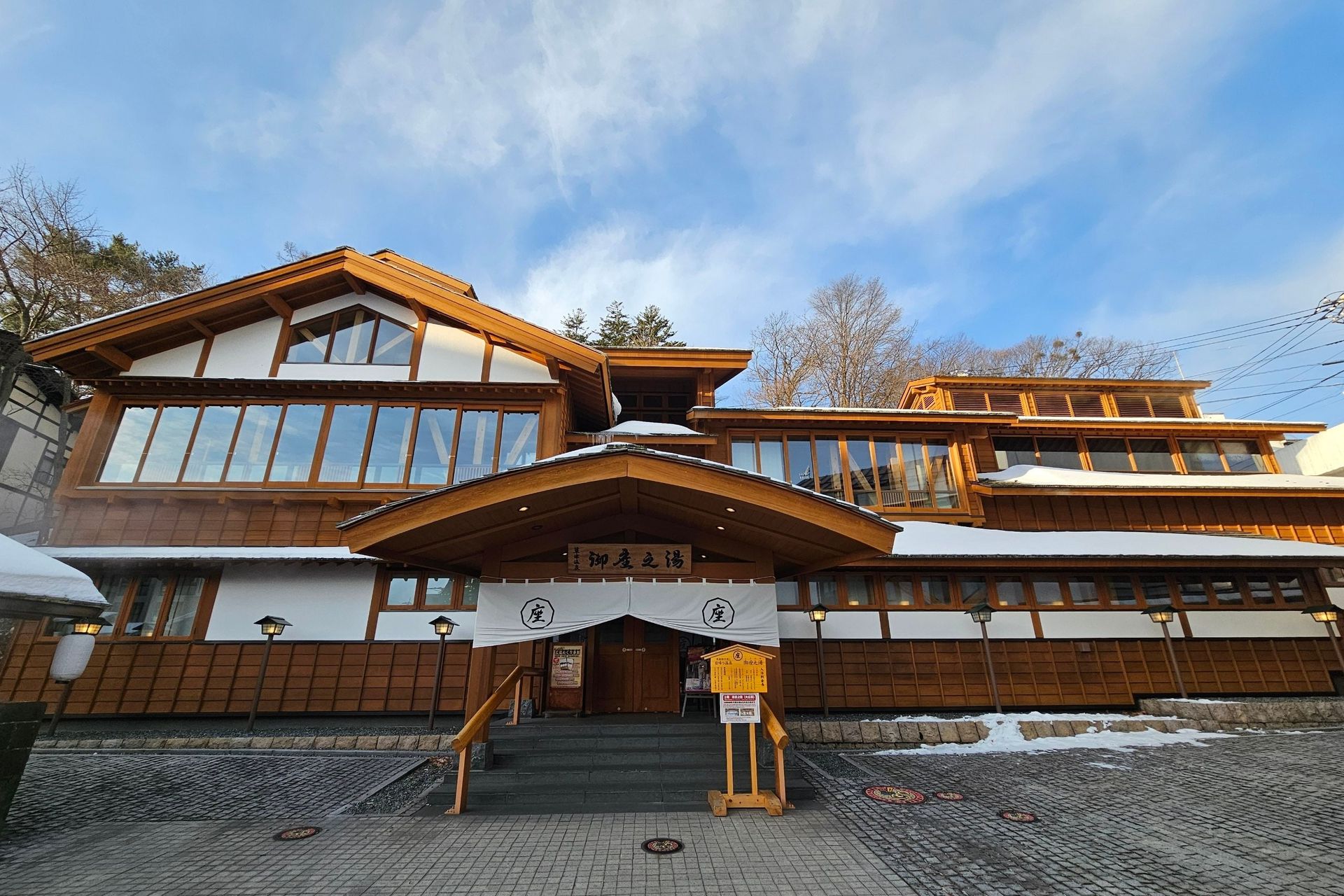
Where the source is very hot, water is the easy answer and not the only one. In Kusatsu, the Japan Tourism Agency's guide says, the springs gush out at more than 32,000 litres a minute and need neither dilution nor reheating, and the near-boiling water has long been tamed by yumomi, stirring it with paddles. The notice at Goza no Yu, by the Yubatake, gives its source at 94.6°C, the bath at 42°C, and no water added.
Cooling it yourself
At some communal baths you may cool a hot tub with the cold tap. Nozawa Onsen's sotoyu usually run at 45 to 49°C, and the Japan Tourism Agency's guide says you can add cold water, but check first that the others in the bath don't mind.
Ask
If the notice is missing or hard to read, ask at the desk which baths are free-flowing. It is an ordinary question.
Kakenagashi in the catalog
Onsen Oni does not take a place's word for it. Where we have a photo of a place's posted notice, we record its answers on five counts, added water, heating, recirculation, disinfection and bath additives, each as yes, no or not disclosed, and show them on the place's page under Water treatment, in its hot spring section and on its water page.
There is no map filter for it. There was one once, but a place's own gensen kakenagashi claim and its posted notice disagree often enough that only the notice counts as evidence, and so far we have read the notices of only some places. From the five answers, the page draws one verdict:
Not recirculated, no water added, no additive and no disinfection, all as the notice states. Heating alone does not change this verdict: a cool spring warmed to bathe in still passes through once.
Lightly treated
Free-flowing, but disinfected.
Treated and recirculated
The notice says the water is recirculated or diluted, or has an additive.
Not disclosed
The notice does not say whether the water is recirculated or diluted. We show that as unknown, never as pure.
The places below
Every place in the list below answers no on all five counts, heating included.
Where to try it
Places whose posted notice says no added water, no heating, no recirculation, no disinfection and no additives, from Naruko in Miyagi to Kurokawa in Kumamoto.
No. The Hot Spring Act defines what counts as onsen, but neither the Act nor its rules use the word kakenagashi. What the law requires is a notice from a bath that dilutes, heats, recirculates or disinfects its water or adds anything to it, saying which and why.
Does kakenagashi mean no chlorine?
Not necessarily. Free-flowing water can still be chlorinated, and some prefectures require disinfection in every bath. Look at the disinfection line of the posted notice.
Is kakenagashi always better than a recirculating bath?
Not in itself, said the council that wrote the posting rule: it depends on how much fresh water flows in, how many people use the bath and how it is kept. Water that is not reused keeps more of what changes after it leaves the ground, and a well-kept filtered bath can be perfectly clean.
Can a kakenagashi bath be heated or diluted?
It can. Dictionaries allow the temperature to be adjusted, and some places cool a very hot spring with water. Either way the notice must say so and give the reason. When a notice says no to both, the bath is the source water as it comes.
How can I tell if a bath is kakenagashi?
Read the notice by the changing room, next to the water analysis: it states whether the water is recirculated, diluted, heated or disinfected. On Onsen Oni, a place's page shows what its notice says wherever we have read it.
If water overflows the tub, is it kakenagashi?
Not always. Some recirculating baths collect the overflow and send it back through the filter, partly so the bath looks full to the brim. The notice is the reliable sign.

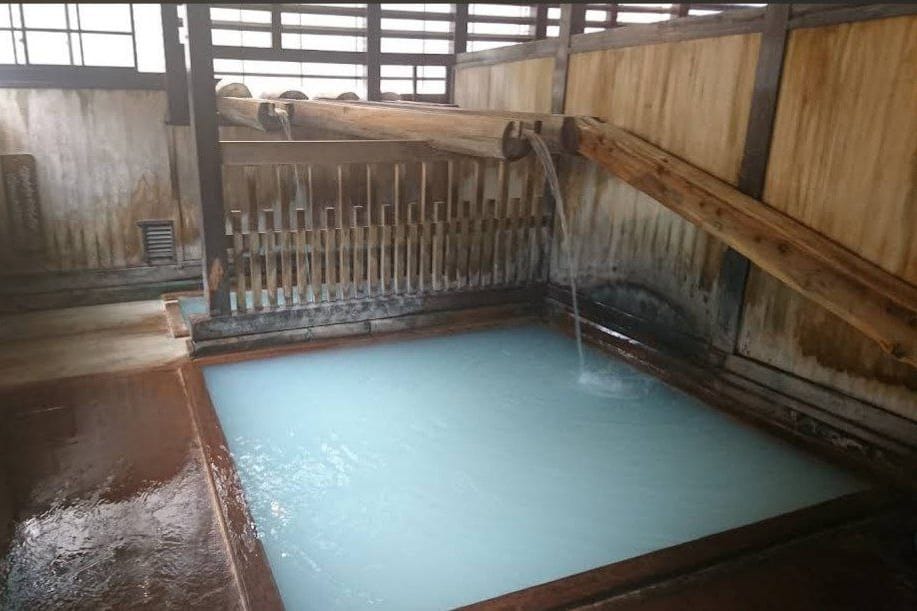
 Public Bathhouse
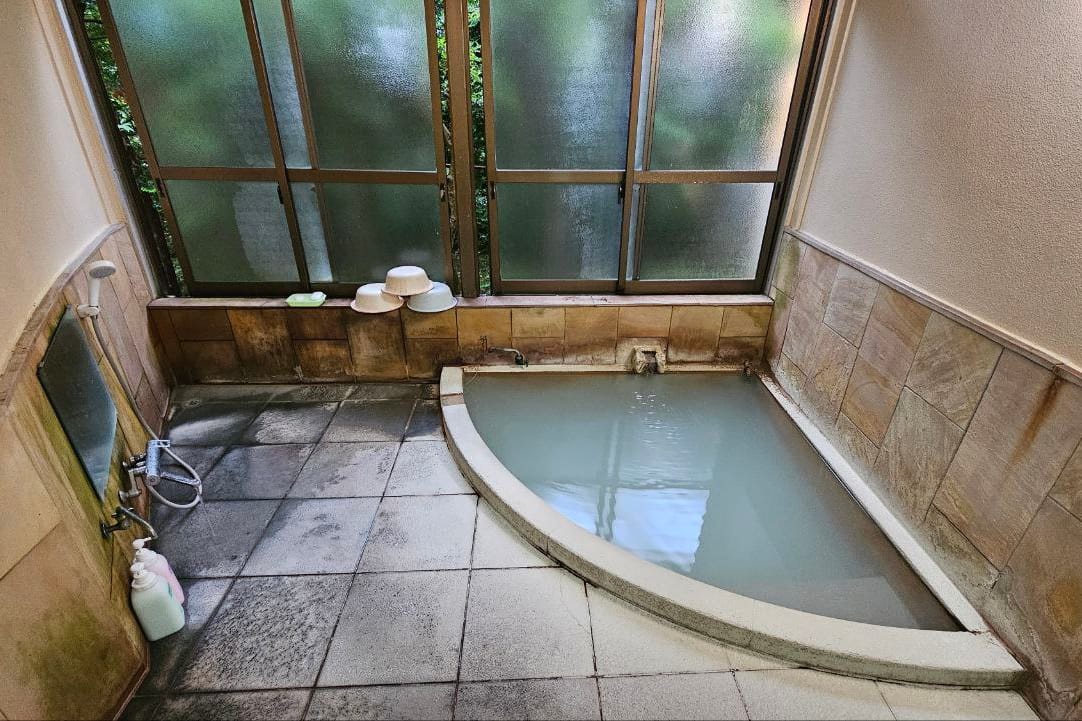
 Lodging