Lying on warm stone, dressed, until you sweat: what it is, where it began and how to do it.
岩盤浴がんばんよくganbanyoku
What ganbanyoku is
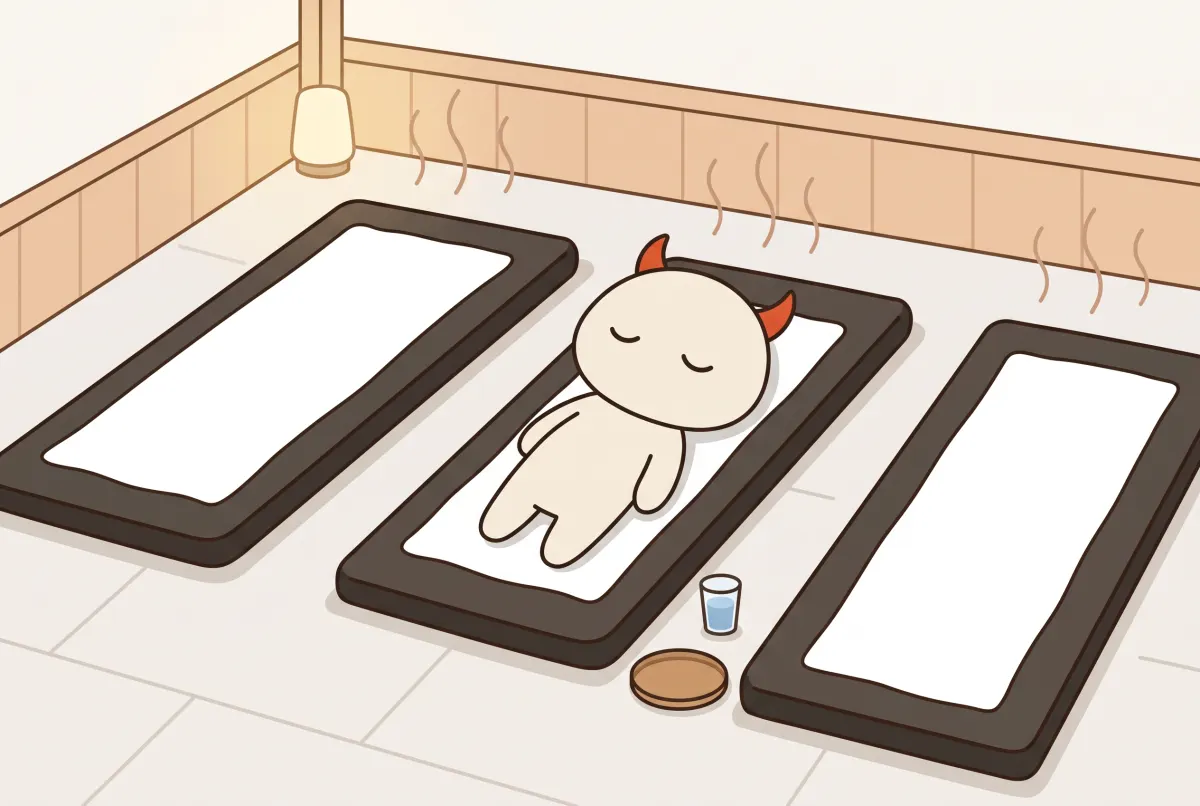
Ganbanyoku (岩盤浴) is bathing without water. You lie on slabs of warmed stone and let the heat work on you until you sweat. The dictionary puts it plainly: you spread a towel on a slab of stone warmed to about 40°C, lie down on it and warm the body. You keep your clothes on, in a set of loose wear the bathhouse gives you, and you lie on a towel, never on the bare stone.
The heat is gentler than a sauna's and the air is damper. When the Japan Sauna Association wrote its first standard for ganbanyoku in 2004, it described the room as kept at about 40°C and around 80% humidity, with heated granite or similar stone laid on the floor. Rooms today run a little either side of that: at Teine Onsen Honoka in Sapporo they range from about 38°C to 56°C.
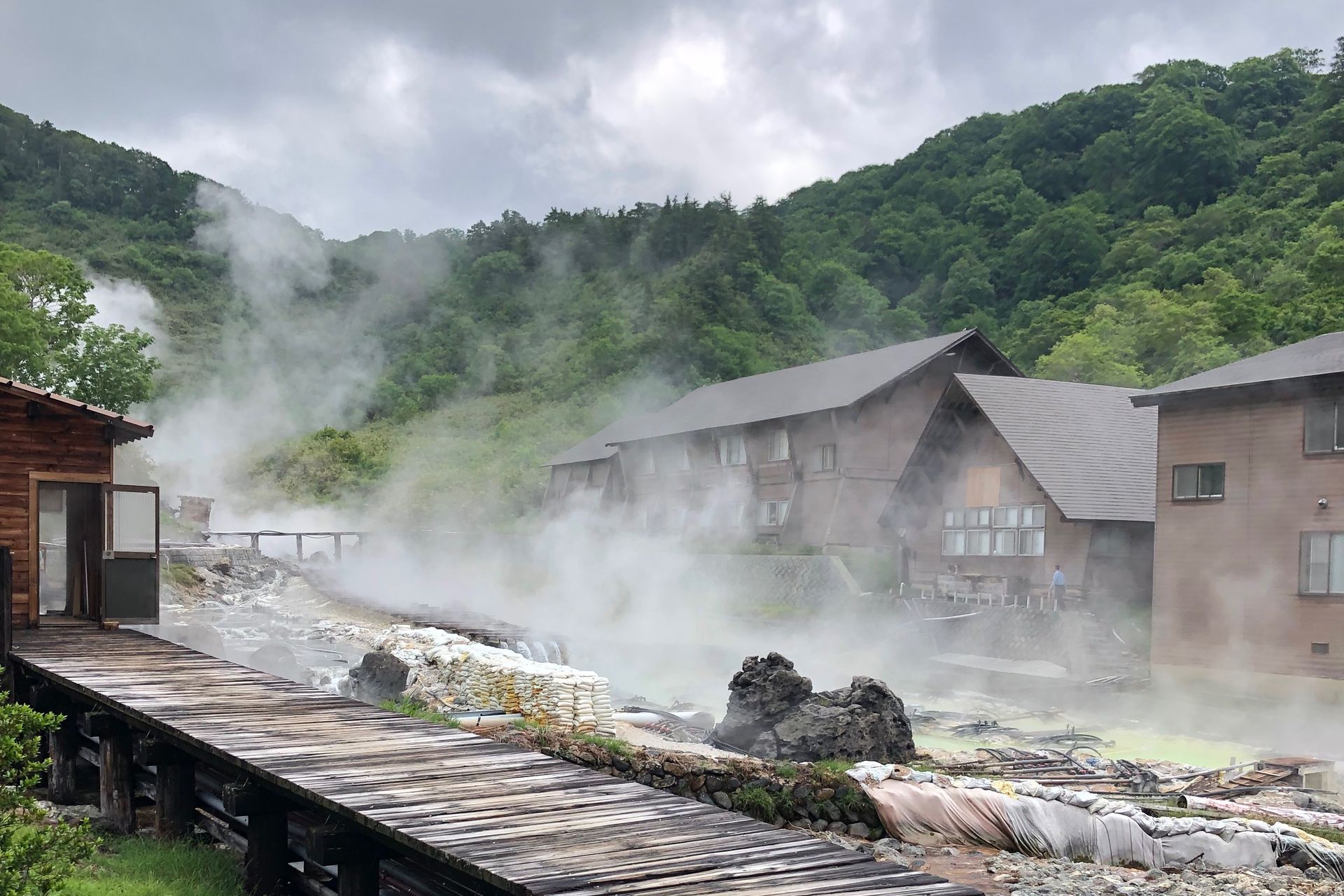
You will find it mostly at super sento and other large day spas, usually as an extra on top of the bath fee, and at some inns and onsen resorts. Because everyone is dressed, the room is often shared by men and women. And it has a natural forerunner: the hot ground of Tamagawa Onsen in Akita, where people still lie on the rock among the steam vents.
Both are hot rooms you go into to sweat, and many bathhouses have both. The differences are in the numbers, in what you wear and in what you do with your body.
Lower heat
Most sauna rooms are set somewhere between 50°C and 100°C, the Consumer Affairs Agency says. A ganbanyoku room is typically around 40°C, and much of the warmth comes up from the stone you lie on.
Damper air
The 2004 standard puts ganbanyoku at about 80% humidity. A dry sauna, as the agency defines it, is one with low humidity. One of Honoka's rooms is kept at 38°C and at least 65% humidity.
Lying down
In a sauna you sit on a wooden bench. In ganbanyoku you lie flat, first on your front and then on your back, and stay longer: Honoka suggests five minutes face down and ten face up.
Clothes on
A sauna in the bathing area is used naked, like the baths around it. Ganbanyoku is used in the wear the bathhouse provides: the 2004 standard says the operator must hand out clean wear, for hygiene.
Men and women together
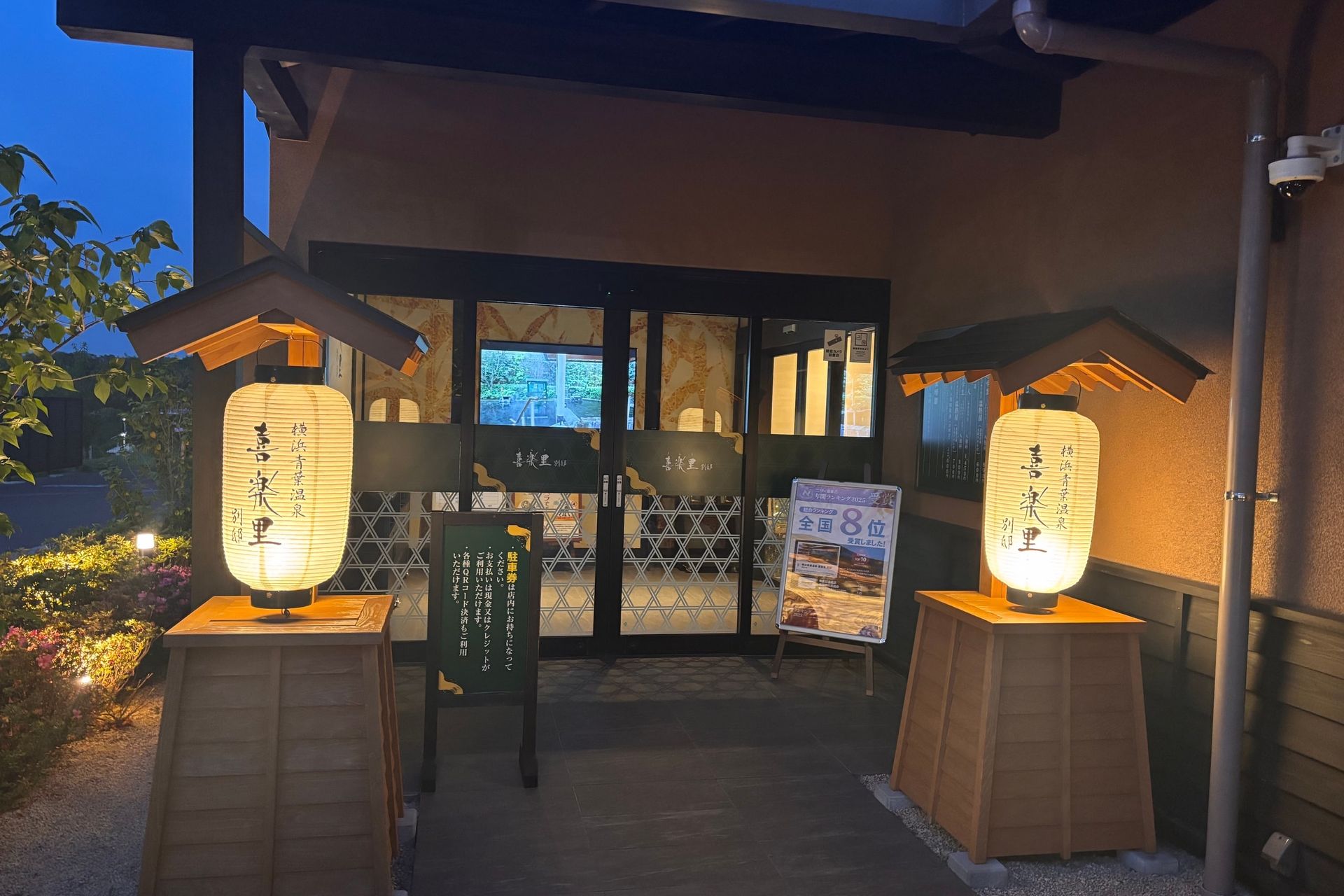
The baths, and the saunas inside them, are split into a men's side and a women's side. Ganbanyoku often is not: Honoka's is a space for both sexes, and Kirari Bettei in Yokohama invites couples to relax there together.
Where it came from
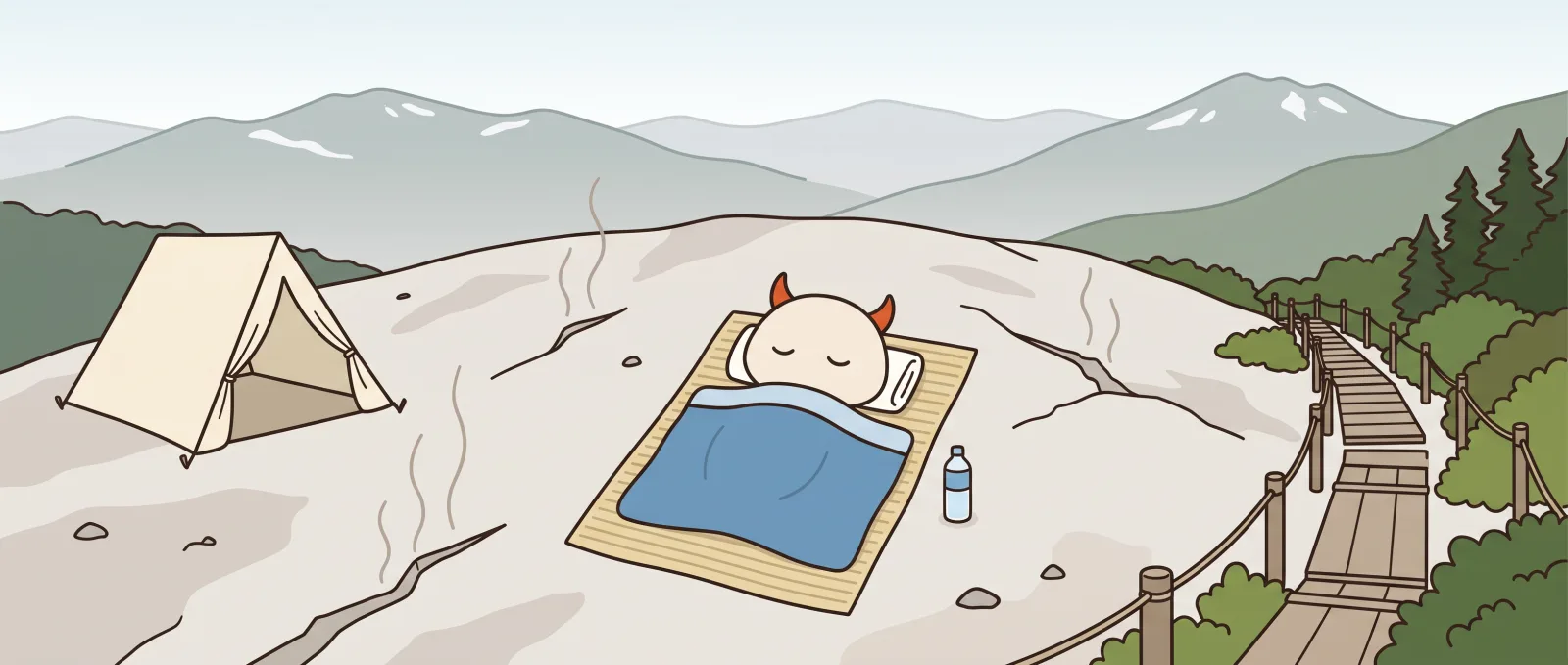
Tamagawa Onsen, high in the mountains of Akita, calls itself the birthplace of ganbanyoku. The spring was first found in 1681 and opened as a place for toji, long stays for a cure, in 1884. A nature trail of about a kilometre runs through its steaming ground, and the rock beside it, warmed by the earth's heat, makes a natural ganbanyoku: people spread a mat on it, cover themselves with a blanket and lie in the warmth.
The indoor kind is far younger. In October 2004 the Japan Sauna Association's newsletter wrote that heated stone beds had started to appear about three years before, apparently taking Tamagawa as their hint, and had become a boom starting from Fukuoka and Miyagi, spreading across Japan both as shops of their own and inside larger bathing facilities.
That September, with guidance from the Ministry of Health, Labour and Welfare, the association added ganbanyoku to its hygiene standards: the stone rooms cleaned every day and disinfected at least once a month, a place to wash, and clean wear from the operator. Because strangers lie in the same place and sweat, ganbanyoku counts as a public bath, one of the "other public baths" alongside health centres; Kanagawa's rules list it there today.
Lying on the ground at Tamagawa
Tamagawa's outdoor ganbanyoku is nothing like a spa room. You choose a warm spot on the rock along the trail, outside the areas closed to entry, and nothing is lent out: you bring everything yourself. The inn's own advice runs like this.
A straw goza mat is essential, and rush is better than vinyl. Bring a bath towel or clothes to use as a pillow. The inn's yukata and slippers may not be used on the rock.
A blanket on top
Lie under a towel blanket or a blanket to keep the heat in, dressed in something light such as a sweatshirt, with a jacket for the cold mornings and evenings.
Turn now and then
The hottest spots reach 40 to 50°C. To avoid low-temperature burns, change the way you are lying from time to time.
About 40 minutes
Tamagawa suggests about 40 minutes a session, once or twice a day.
Water and a change
You will sweat, so drink before you set out and when you get back (the inn asks for no food or drink on the trail, below), and bring dry clothes. Sneakers and a backpack are easier on the trail than sandals and a handbag.
Bears
This is mountain country. In 2026 the inn posted bear warnings: avoid the trail at night and early in the morning, take no food or drink there, carry a bear bell and go in a group if you can. It lends bells and poles free, and the tents on the rock have air horns.
How a visit goes
At a super sento or a day spa the routine is much the same everywhere. Ganbanyoku is usually an extra on top of the bath, often one you cannot buy on its own, and you wash in the bath before you change.
Pay the extra
At Kirari Bettei it is 600 yen on weekdays and 750 yen at weekends, the wear and a large towel included. At the Chimujirubang Spa in Kobe it is 1,000 yen on top of the bath, 900 for members. Neither sells ganbanyoku alone.
Change into the wear
You are given a set of loose clothes for the stone rooms and change into them after the bath. Take off metal jewellery and accessories first; both Honoka and Kirari Bettei ask for it.
Lie on a towel
Spread a large towel on the stone before you lie down. Honoka asks for one longer than you are tall, about 180 cm, because the floor gets hot, and Kirari Bettei says the towel is there to prevent low-temperature burns.
Front, then back
Honoka's routine: five minutes face down, ten face up, then water and a rest outside the room. Repeat two or three times, and fewer if your body says so.
Cool down between rounds
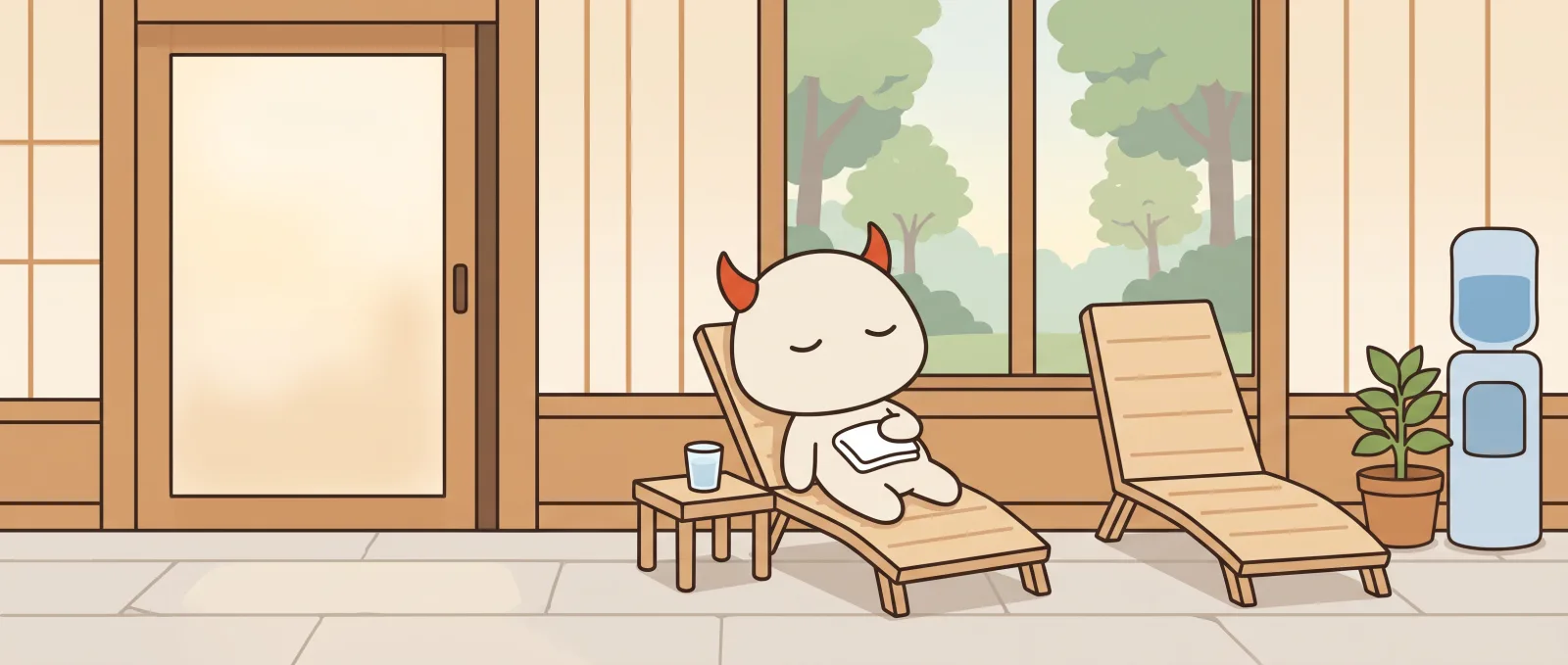
Many places have a cooler room for the breaks: Honoka's is kept at about 12°C, and Kirari Bettei suggests going back and forth between its cool room and the stone beds. Afterwards there is usually a kyukeijo rest area with reclining chairs, or shelves of comics.
Keep it quiet
It is a room for lying still. Kirari Bettei allows no food, drink, books or phones inside and may ask a loud talker or a snorer to leave. Honoka asks you not to save a spot for anyone, and not to wring a wet towel out onto the stone.
Tattoos
The clothes cover a tattoo, but the rule is the bathhouse's. Ofuro no Osama, for one, refuses tattooed visitors at the entrance, so its ganbanyoku is closed to them too. Check the policy before you go; the tattoo guide has the details.
Rooms and stones
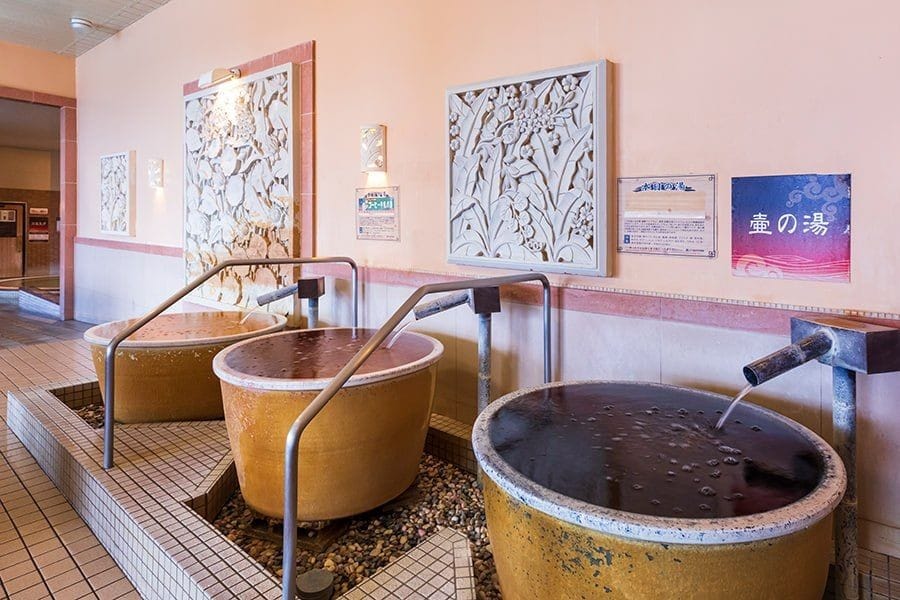
A large bathhouse often has several ganbanyoku rooms, each with a theme of its own. These are the kinds you will meet.
Beds of different stones
Kirari Bettei has stone of six kinds, among them black germanium, black silica and bakuhanseki. Yuya Ebisu in Beppu's Myoban Onsen has a low-temperature floor of bakuhanseki slabs.
Rock salt
Part of one of Honoka's rooms uses Himalayan rock salt and large natural stones, and one of Kisuke no Yu's rooms in Matsuyama has walls of pink rock salt.
Mist
Honoka's Unkaido and Kisuke no Yu's Unkai room fill the air above the stone with a fine mist, a sea of clouds you lie under.
Loyly
Some ganbanyoku rooms hold loyly sessions, as saunas do. Honoka's Enjudo, the hottest of its rooms at about 56°C, takes 16 people per session, with numbered tickets handed out ten minutes before.
Korean-style rooms
Some take after Korea's bathhouses. The Chimujirubang Spa in Kobe is named for the jjimjilbang and has nine spaces, seven of them bang rooms. Kisuke no Yu has a hanjeungmak, the traditional Korean sauna, and a domed room hung with ten kinds of medicinal herbs, where you sit on straw mats.
Staying safe
Ganbanyoku is gentler than a sauna, but it is still heat, and you are lying still in it, sometimes half asleep. The rules bathhouses post and the Consumer Affairs Agency's advice on saunas come down to the same few things.
Drink water
You sweat steadily, so drink before you start and between rounds. Honoka asks for plenty of water to prevent dehydration; for saunas, the agency's expert advises a glass or two before going in.
Not after drinking
Kirari Bettei asks anyone who has been drinking not to use its ganbanyoku, and Honoka turns away the very drunk. The agency's expert lists after drinking, a hangover included, among the times to stay out of a sauna.
Low-temperature burns
Warm stone can burn skin that lies on it long enough. Always lie on a towel, change position now and then, and try not to fall asleep: Honoka warns of low-temperature burns from sleeping deeply on the stone.
If you have a condition
Kirari Bettei asks people with high blood pressure or heart disease not to use its stone rooms. For saunas, the agency's expert says that anyone being treated for heart disease or high blood pressure, anyone who has had a stroke, and anyone pregnant should ask their doctor first.
Children
Most bathhouses set an age limit. Honoka and Kisuke no Yu admit middle school students and older; Kirari Bettei lets elementary school children use only its rest room and terrace.
Get up if you feel unwell
Leave the room as soon as you feel unwell, and tell the staff. The agency asks sauna users not to push themselves and to tell the staff or someone nearby straight away; the same holds on the stone.
What the stones are said to do
Bathhouses describe their stones generously. Black silica and bakuhanseki are said to give off far infrared rays or negative ions; the sweat is said to carry out waste and toxins, a "detox", and to help with skin, poor circulation, stiff shoulders and back pain. These are the operators' own words. The dictionary is more careful: ganbanyoku is "said to" help with fatigue.
The research is thin. The one study we found, a 2007 conference abstract by researchers at Miyazaki Prefectural Nursing University and Kanazawa Institute of Technology, had 11 healthy women lie on stone at about 41°C for three 15-minute rounds. Their core and skin temperatures rose and stayed up, their heart rates rose and their blood pressure did not change; the share of lymphocytes in the blood went up, while the change in natural killer cell activity was not significant. That is a small group, measured on the day, and it says nothing about cures. We found no study comparing one stone with another.
On detox, the US National Center for Complementary and Integrative Health lists using a sauna among detox approaches and says the studies of such programmes have been few and of low quality. In Japan, the law on misleading representations lets the Consumer Affairs Agency ask a business for reasonable grounds for a claim about what its product does, and a claim it cannot back up is treated as misleading. Go for the warmth and the quiet, and read the health promises as advertising.
Ganbanyoku on Onsen Oni
Each place page lists the special baths we know a place has, and the map can show only the places with ganbanyoku.
On a place page
Ganbanyoku appears among a place's baths, with a line saying what it is: lie on warm stone slabs, dressed, and sweat.
On the map
Turn on Ganbanyoku in the map's filters to see only the places that have it.
Which places
Mostly super sento and day spas, with some inns and onsen resorts. We record it only for a kind of place with staff and full baths, so a foot bath or an unstaffed bathhouse will never carry it.
No line means we don't know
If a place does not show it, the catalog has no answer yet. That is not the same as No.
Check before you go
Rooms, prices and age limits change. Look at the place's own site before you go.
Where to try ganbanyoku
One place in each region, from a super sento in Sapporo to the hot ground of Tamagawa and a bathhouse above Beppu Bay.
What is the difference between ganbanyoku and a sauna?
Ganbanyoku is cooler, typically around 40°C against the 50 to 100°C of most saunas, and the air is damper. You lie on heated stone instead of sitting on a bench, you keep your clothes on, and the room is often shared by men and women.
What do I wear for ganbanyoku?
The loose clothes the bathhouse provides, usually included in the ganbanyoku fee or rented, with a large towel to lie on. Change into them after washing in the bath, and take off metal jewellery.
What should I bring?
At a bathhouse, very little: the wear and the towel are provided or rented, and you only need to plan for water between rounds. For Tamagawa's outdoor ganbanyoku bring everything yourself: a straw mat, a pillow, a blanket, light clothes and a change of clothes, and drink before and after, since the inn asks for no food or drink on the trail.
Can men and women use ganbanyoku together?
Often, yes. Because everyone is dressed, many bathhouses run their ganbanyoku as a shared space, and couples go in together. The baths themselves stay separate.
Can I use ganbanyoku with tattoos?
Only where the bathhouse admits tattoos. The clothes cover them, but the rule is the bathhouse's, and some refuse tattooed visitors at the entrance. Check the policy before you go.
How long should I stay?
A common routine is about 15 minutes on the stone, five face down and ten face up, then a rest and some water, repeated two or three times. On Tamagawa's outdoor ground the inn suggests about 40 minutes, once or twice a day.
Does ganbanyoku detox the body?
That is a marketing claim. You do sweat, but the studies of detox programmes are few and weak, and the one small study of ganbanyoku we found measured body temperature and blood cells, not cures.
Can children use ganbanyoku?
Often not. Many bathhouses admit only middle school students and older. Check the place's own rules before you go.

 Other
 Lodging
 Bathing Complex