Glossary
Rotenburo: The Open-Air Bath
The bath outside, in the open air: what the word means, the kinds you will meet, and how to enjoy one.
露天風呂ろてんぶろrotenburo
What a rotenburo is
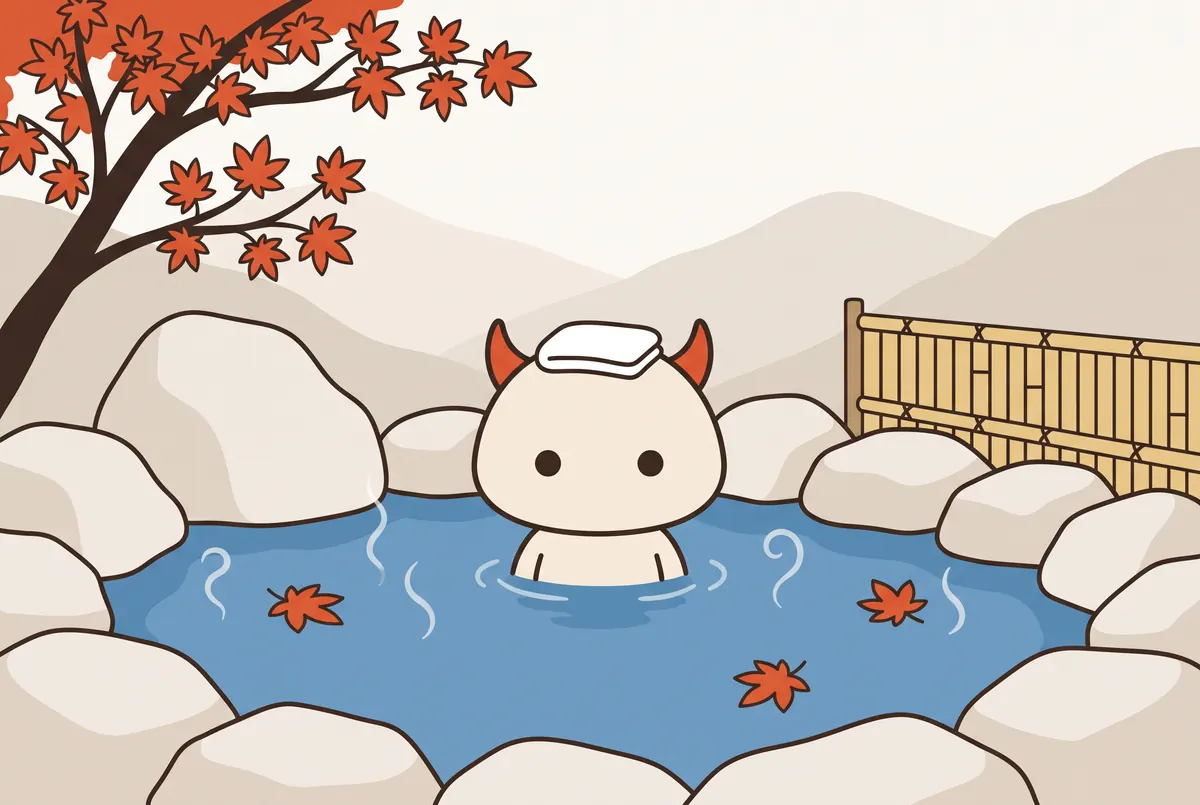
A rotenburo (露天風呂) is a bath outdoors, in the open air. Roten (露天) means out in the open, exposed to the sky and the weather, and furo (風呂) is a bath, which turns into buro after another word. Dictionaries describe it as a bath with no roof or enclosure, but many have a small roof over part of the pool and a fence or a screen around it. What makes one a rotenburo is that you bathe outside.
At an inn or a bathhouse it usually comes with an indoor bath, the uchiyu (内湯), where you wash and warm up before you step outside. The pool is often rock or wood, with whatever the place has to look at beyond it: a river, the sea, a mountain, a garden, or just the sky and the trees.
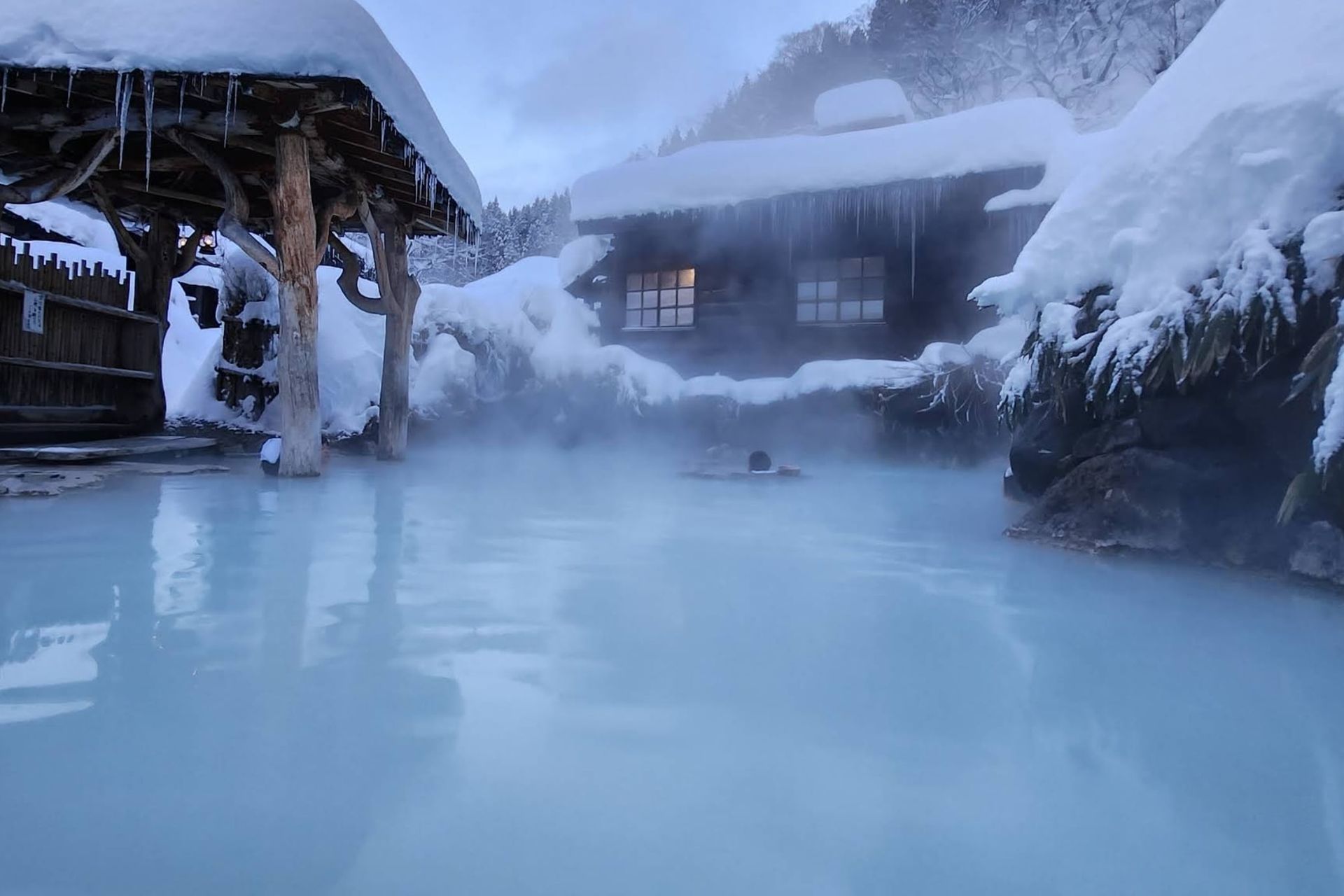
Tsurunoyu Onsen, Nyuto Onsen-kyo Sagae Onsen Hotel Symphony Annex Hokkawa Onsen
The word, piece by piece
- 露ろdew; also bare, open to the weather
- 天てんthe sky
- 風呂ふろa bath (read buro after another word)
A little history
People in Japan have bathed at hot springs for a very long time. The Izumo Fudoki, a record of Izumo province completed in 733, describes a spring that rises by a river at what is now Tamatsukuri Onsen in Shimane. Men and women, young and old, came along the roads and the shore every day, so many that it looked like a market, and the record says that one wash makes you fair to look at and a second cures every illness, which is why people called it the water of the gods.
Kurokawa Onsen in Kumamoto shows how the outdoor bath became a reason to travel. It was known as a place to take the waters by the middle of the Edo period, but after the war it was a handful of small inns that few visitors found. Goto Tetsuya, the third owner of the inn Shinmeikan, wanted it to feel like the countryside and planted native trees around his outdoor bath. In 1983 another inn built a new outdoor bath with his guidance, it drew guests, and the rest of the town followed.
In 1986 the inns' association reorganized itself. One team took down some 200 mismatched signs and put up shared ones, another began planting trees, and a third came up with the nyuto tegata (入湯手形), a wooden pass to the outdoor baths of any three inns, so that the two inns with no room for an outdoor bath could share in the others'. The pass is still sold: it covers three of about 25 outdoor baths and is valid for six months.
Kinds of rotenburo
The word covers a range of baths, from a pool in the woods to a tub on a hotel balcony, and some kinds have names of their own.
Notenburo (野天風呂)
Noten (野天) also means out in the open (野 is a field, or the wild), and dictionaries give notenburo as another word for rotenburo. Some places use it for a plainer bath with little built around it: Renge Onsen in Niigata calls its four baths out among the mountains notenburo, and they have no changing room.Tsubame Onsen Kawara no Yu, Myokokogen Onsen-go Tsurunoyu, Beppu Onsen Hebi No Yu, Beppu Onsen
Hanroten (半露天風呂)
A bath under a roof, with one or more sides open to the outside air. Booking sites often list it with the outdoor baths: you get the air and the view with less of the weather.Yamazato-no-iori Soene, Okuhida Onsen-go Shima Yamaguchikan, Shima Onsen Hotel Mount Fuji, Yamanakako Onsen
Kashikiri roten (貸切露天風呂)
An outdoor bath you book for yourself, your partner or your family for a set time, often for a fee. It is also one of the options Japan's Tourism Agency suggests for guests with tattoos.Superb view of the inn Sakuratei, Beppu Onsen Sanga Ryokan, Kurokawa Onsen Wat Hotel & Spa Hida Takayama, Hidatakayama Onsen
Kyakushitsu roten (客室露天風呂)
Some rooms come with their own outdoor tub on a balcony or a terrace. It is included in the room rate, and you can use it whenever you like.BOUROU LAKE TOYA, Toyako Onsen LiVEMAX Resort Innami Sea Front, Wakayama INFINITO HOTEL & SPA, Nanki-Shirahama Onsen
Konyoku roten (混浴露天風呂)
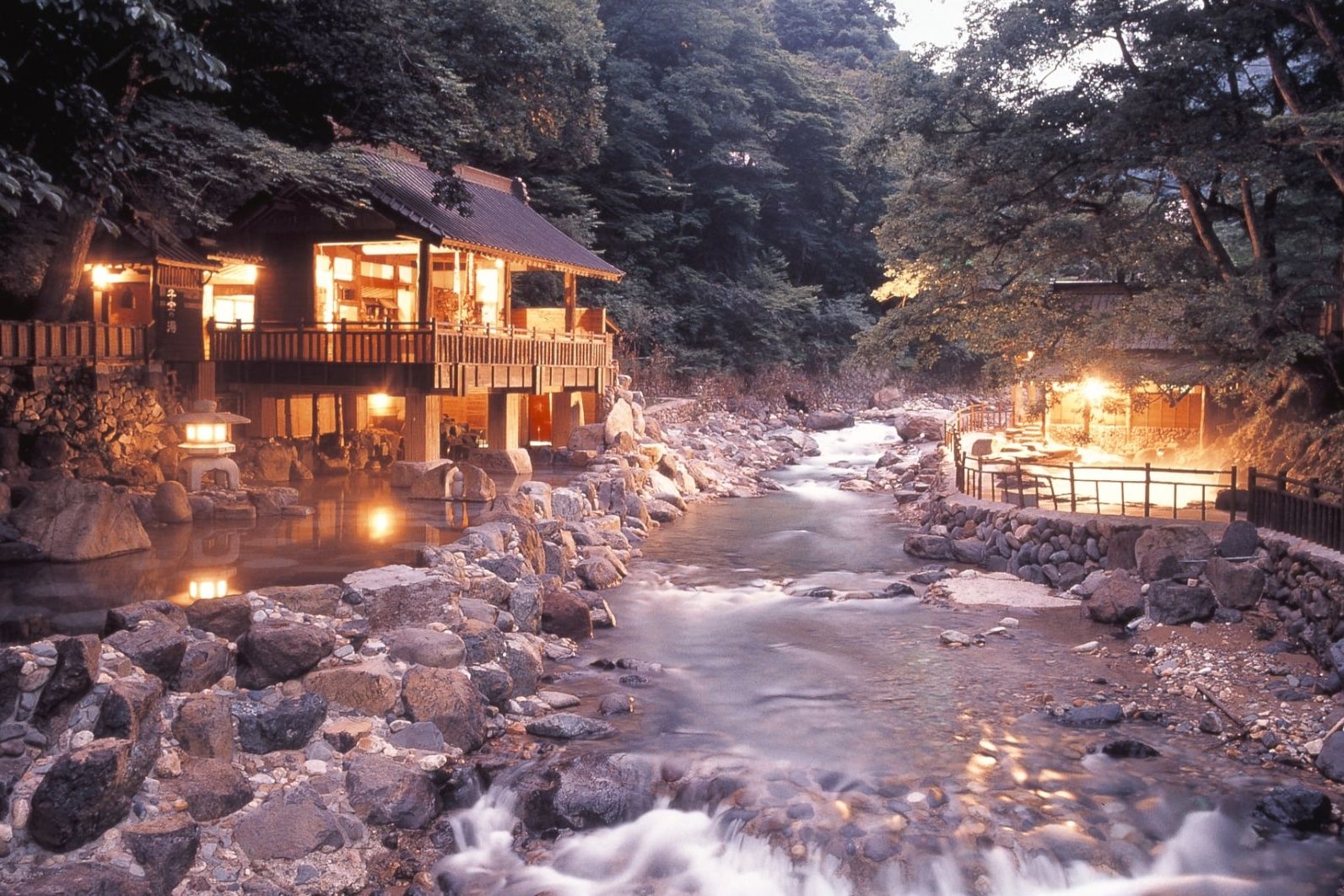
A mixed outdoor bath, shared by men and women. The rules differ from place to place: at Takaragawa Onsen in Gunma, for example, everyone in the mixed baths wears a bathing wrap, and there is a separate outdoor bath for women. The mixed bathing guide has the details.Lamp no Yado Aoni Onsen, Aomori Awanoyu, Shirahone Onsen
Baths in the river
Where hot water rises in a riverbed, you can sometimes bathe in the river itself. At Kawayu Onsen in Wakayama, water at over 70°C rises through the gravel of the Oto river, and outside the Senninburo season you can dig a pool of your own in the riverbank, in swimwear. From December to the end of February part of the river is dammed into one big pool, the Senninburo: free to use, with a changing room, swimwear required, and a different size every year.Kamiyu Onsen, Nara Yakushi no Yu, Kawaji Onsen Shinzanso, Okuhida Onsen-go
How to enjoy one
The rules are the same as indoors, plus a few that only matter outside.
Wash first, then pour
At an inn or a bathhouse the washing area is usually indoors, so wash there before you go out. Some outdoor baths, especially wild ones and some riverside and mountain baths, have no washing place at all. Either way, before you get in, do kakeyu: scoop hot water from the bath with a basin and pour it over yourself, starting with your feet and hands, to rinse off and get used to the heat. Soap and shampoo never go in the bath.The towel stays out of the water
As indoors, the small towel never goes in the bath. Fold it on your head or leave it on the edge.Mind the stones
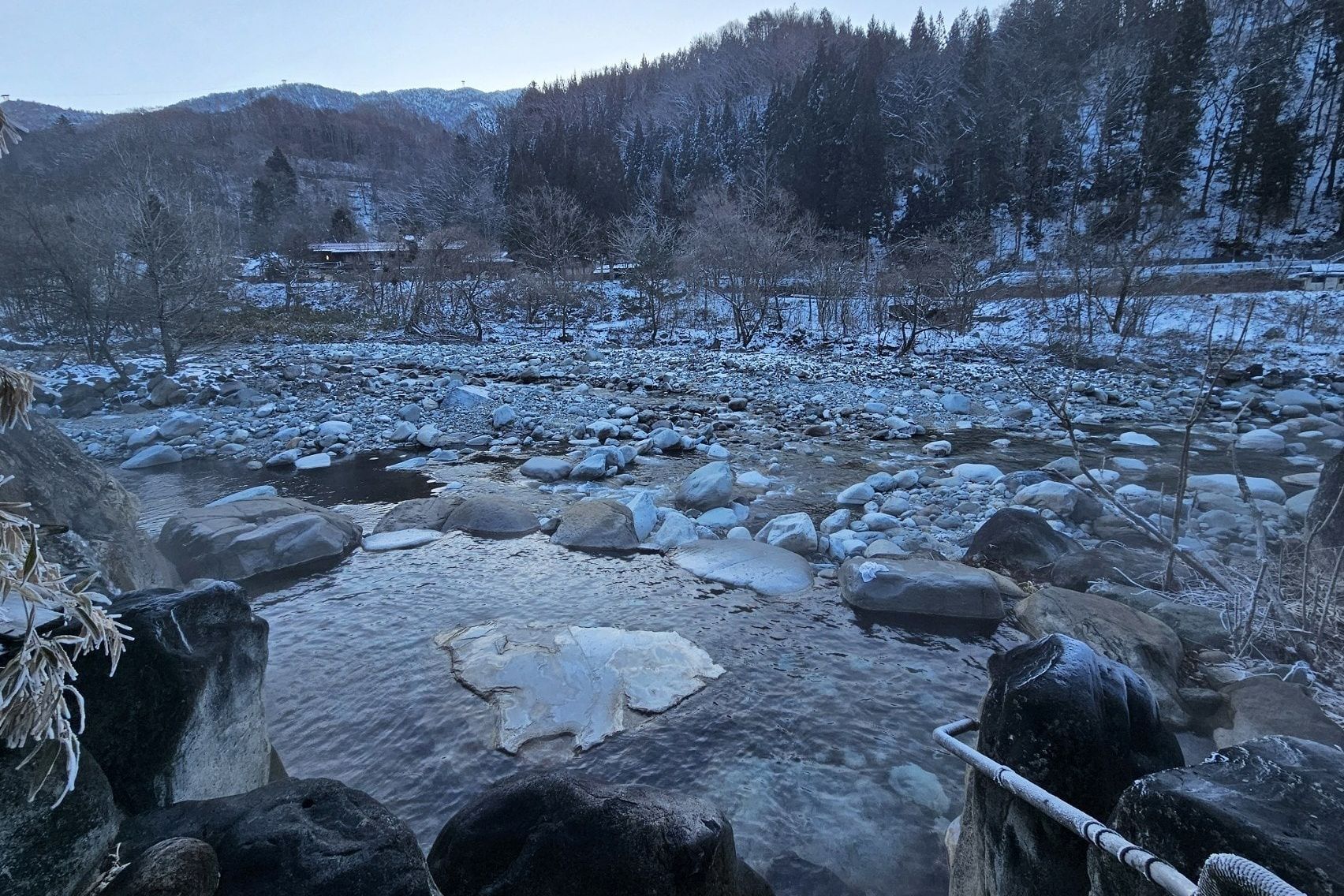
Rock edges and stepping stones can be slippery, and in winter they can freeze. Walk slowly, and use the handrail where there is one.Keep your voice down
A bath is for quiet soaking, not for swimming or splashing, and outdoors your voice carries over the fence and up to the rooms.No photos
Never take a picture with anyone in the bath, in the changing area or even nearby. Many places forbid cameras and phones in the bathing area altogether. If you want a photo of the bath itself, ask at the front desk first, and take it only when nobody is there.
Through the seasons

An outdoor bath changes with the weather and the year, and that is most of the pleasure: cherry blossom in spring, fresh green and cool mornings in summer, red maples in autumn, snow in winter.
Autumn
The leaves turn first in the mountains of Hokkaido, from about mid-September, and last in the south, until early December in Kyushu. The dates move with the weather, so check the forecast for the area before you go.Kinu No Yado Shikiotoro, Kinugawa Onsen Hotel Jogakura, Sukayu Onsen Awanoyu, Shirahone Onsen
Snow
Snow on the rocks and steam on the water is the outdoor bath many people picture. Keep the walk from the warm room short, pour hot water over your feet and hands before you get in, and get out slowly so you don't feel faint.Takimikan, Ginzan Onsen Seiryu-no-yu, Shima Onsen Genshichi Roten no yu Zao Onsen
Rain
Light rain on an outdoor bath can be lovely. In heavy rain or storms some places close their outdoor baths, and a river bath can stay closed after high water: Kawayu's Senninburo asks you to phone before coming after bad weather.Summer
Midday sun on an open bath gets hot quickly, so mornings and evenings are usually more comfortable, and a bath with a roof over part of it helps.Not every one is open all year
Some outdoor baths are seasonal. Renge Onsen in the Niigata mountains is open only from about July to October, and Kawayu's Senninburo only from December to February. Check the dates and the hours before a long trip.
After dark

At night many outdoor baths are lit by lamps along the path, and far from a town you may see more stars than you are used to. At Kawayu's Senninburo, lanterns line the riverbank on Saturday nights through the season.
It is darker out there than it looks from the door, so take the steps slowly. And keep the drink for afterwards: the bathing notes every onsen has to post say not to bathe after drinking alcohol.
Sanbeso Onsen Hotel, Shimane Hachimenzan Kanairo Onsenkan, Oita Kobe Minato Onsen Ren, Hyogo
Where to try one
One outdoor bath in each region, from a lake shore in Hokkaido to the Kirishima mountains in Kagoshima.
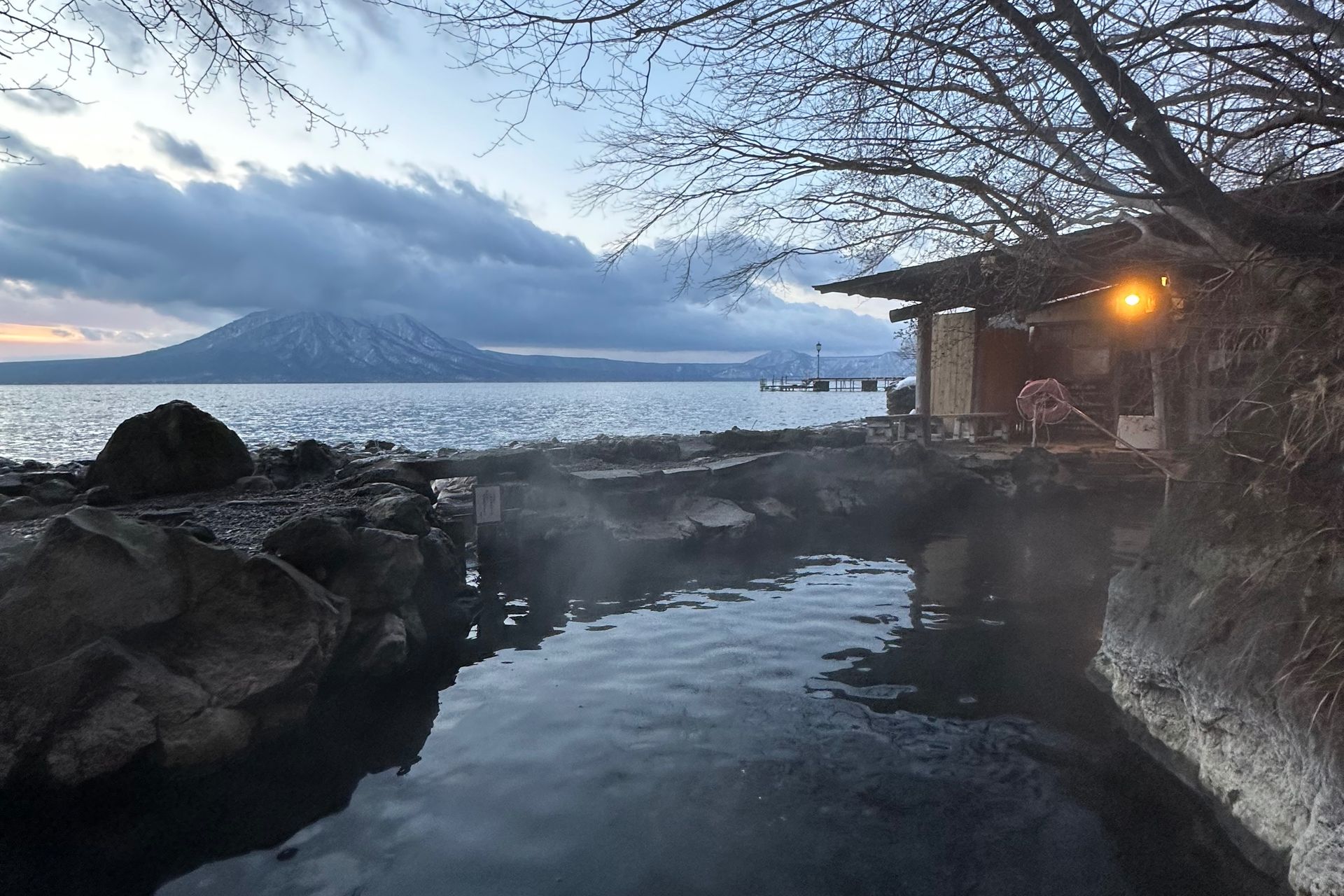
Marukoma Hot Spring Hotel湖畔の宿支笏湖 丸駒温泉旅館
- Day use 10:00–14:00
- ¥1,200 for a day bath
- Tattoos allowed
- Private bath
- Chloride spring, pH 6.9, 51°C at the source
Tsurunoyu Onsen乳頭温泉郷 鶴の湯温泉
- Day use 10:00–15:00
- ¥700 for a day bath
- No tattoos
- Konyoku (mixed bathing)
Takaragawa Onsen Osenkaku宝川温泉汪泉閣
- Day use 10:00–16:00
- ¥1,500 for a day bath
- Konyoku (mixed bathing)
- Simple spring, pH 7.8, 59°C at the source
Shinhotaka Onsen Yarimikan槍見の湯 槍見館
- Day use 10:00–14:00
- ¥800 for a day bath
- Private bath
- Konyoku (mixed bathing)
- Simple spring, pH 6.6, 45°C at the source
Watarase Onsen large open-air bathわたらせ温泉 大露天風呂
- Day use 06:00–21:30
- ¥1,000 for a day bath
- Bicarbonate spring, pH 6.7
Sanbeso Onsen Hotel国民宿舎 さんべ荘
LodgingNatural onsen waterShimane
- Day use 10:30–20:00
- ¥700 for a day bath
- Private bath
Sunriver Obokeサンリバー大歩危
LodgingNatural onsen waterTokushima1 review
- Day use 12:00–21:00
- ¥700 for a day bath
- Simple spring, pH 9.5, 20°C at the source
Arayu Onsen Shin Moeso新湯温泉新燃荘
- Day use, hours not recorded
- Konyoku (mixed bathing)
- Sulfur spring, pH 5.1, 61°C at the source
Questions people ask
- Is every rotenburo an onsen?
- No. Rotenburo says where the bath is, outside, not what is in it. Under Japan's Hot Spring Act, onsen water comes from underground and is at least 25°C at the source or carries certain minerals, and an outdoor bath at a sento or a hotel can just as well be filled with heated tap water. If the water matters to you, look at what a place says about its water.
- Are rotenburo mixed?
- Usually not. Japan's public bath guidelines say men and women from about age seven should not bathe together, so most outdoor baths have a men's side and a women's side, and some swap them by day or by hour. Mixed baths do remain, and some ask everyone to wear a bathing wrap or keep a separate bath for women.
- Can you go in a rotenburo in winter?
- Yes. Keep the walk from the warm room short, pour hot water over yourself before you get in, and get out slowly. Some mountain baths close for the winter, so check before you go.
- Do I have to wash before the outdoor bath?
- Yes, before any bath. Where there is an indoor washing area, wash there first; where there is none, pour hot water from the bath over yourself (kakeyu) before you get in. Moving between the indoor and the outdoor bath is normal, and nobody expects you to wash again each time.
- Can I have an outdoor bath to myself?
- Yes. Some inns have a private outdoor bath (kashikiri) you can book for a set time, and some rooms come with an outdoor tub of their own. On a day visit, look for places where day visitors can book the private bath: the private onsen pages list them by prefecture.
Related words
- Notenburo野天風呂Another word for an open-air bath (rotenburo), sometimes used for a plainer one out in nature with little built around it.
- Uchiyu内湯Indoor bath located within the facility building, providing year-round comfort regardless of weather.
- Iwaburo岩風呂Stone bath, typically constructed from large natural boulders.
- Kashikiri貸切Private or family bath you have to yourselves for a set time, often for an extra fee. Some are booked ahead and some are first come, first served, and not every place opens them to day visitors.
- Konyoku混浴Mixed bathing: a bath shared by men and women. Changing rooms are usually separate but not always, and some places allow or require a bathing wrap.
- Kakenagashi掛け流しFree-flowing: water from the source runs into the bath and overflows instead of being filtered and recirculated. A place that adds water, heats it or recirculates it has to say so, with its reasons, on a notice for bathers.
- Yumeguri湯めぐりHot spring hopping: visiting multiple baths in a row, often using a special pass available in onsen resort towns.
- Higaeri日帰りDay-use visit without overnight stay. Not always available at ryokan and hotels, so check in advance.
Where to go next
Sources
- コトバンク「露天風呂」(デジタル大辞泉・精選版 日本国語大辞典)
- 国立国会図書館「第1章 湯治場としての温泉」(『出雲国風土記』の出湯)official
- 黒川温泉観光旅館協同組合「黒川温泉とは」(黒川温泉郷の歴史)official
- 黒川温泉観光旅館協同組合「黒川温泉の入湯手形」official
- 寺島健・山口敬太・川崎雅史「黒川温泉における雑木植栽による修景の展開過程とその技法」ランドスケープ研究 81(5), 2018
- 熊野本宮観光協会「仙人風呂」official
- 熊野本宮観光協会「川湯温泉」official
- にいがた観光ナビ「白馬岳蓮華温泉ロッジ」official
- 観光庁 地域観光資源の多言語解説文データベース「白馬八方温泉/八方の湯」(温泉の入浴マナーの解説)official
- 北海道「温泉入浴施設において安全に入浴するための注意事項」(環境省の掲示基準より)official
- 温泉法(e-Gov 法令検索)official
- 仙台市「公衆浴場や旅館業の施設の共同浴室における男女の取扱いについて」official